You know that even the best recycled paper bales contain contaminants that have turned disposing of a paper mill pulper’s rejects into a cost problem. With moisture contents high enough to render the calorific value well below acceptable levels for incineration, paper mill pulper rejects normally end up in landfills.
That is why pulper rejects plastic removal is no longer just a housekeeping job. It is a yield, uptime, and disposal cost-saving lever.
This post explains practical, mechanical ways to keep plastic materials and metals out of your stock, while pushing more cellulose recovery back into paper production.
We will look at what typically causes clogs and fibre loss, then walk through ragger and junk trap systems, shredding and washing lines, Drycake Twister-style plastics recovery, and where artificial intelligence can cut downtime.
Key Takeaways
- Supplier descriptions of pulper reject treatment systems (European E-WPR-compliant) state that you can separate water, paper fibre, metals and plastics, and recover up to 90% of the material value from pulper residues.
- Published performance notes for Tecnofer’s pulper rejects treatment approach describe up to 98% fibre retention suitable for return to the mill, paired with screw press dewatering that can reach about 80% to 90% dry solids on the plastic fraction.
- In the US, your outbound classification is handled via your solid waste profile and state rules, not an EWC code, so your goal is to produce consistent, non-hazardous streams that your haulier and end user will accept.
- Ecube’s public E-WPR overview says the cost-benefit ratio becomes interesting starting at about 5,000 tons of waste per year, and your own tipping fees and reject mix will set the true break-even point.
Common Paper Mill Challenges in Pulper Rejects Plastic Removal
Pulper waste (rejects) is rarely just plastics. It is a mixed stream: films, strapping, tape, wet-strength pieces, wires, staples, grit, and occasionally wood and metals from bale handling. If you let those contaminants fragment early, you make every downstream separation step harder and more expensive.
The good news is that most mills can improve results without a chemistry change. You win with better sequence control, better detrashing at the pulper, and a reject line that washes and separates rather than just size-reduces everything.
Given the ever-rising demand for water, “washing” should be achieved with only tiny amounts of water or without water addition at all.
Contaminants in wastepaper recycling
The pulper’s job is simple: liberate fibres while keeping contaminants large enough to remove. A US Department of Energy profile of recycled-fibre pulping explains this clearly: the ragger collects long contaminants like baling wire, plastic sheeting and rags, while heavy debris drops into a dead zone and is purged via a junk chute (junk trap) on a set interval.
In practice, you will see these contaminant groups in a pulper’s rejects:
- Long, tough stringers: strapping, film, shrink wrap, tape backings, rag rope and wire.
- Heavy sinkers: stones, glass, tramp metal, grit, and dense composites.
- Sticky contaminants: pressure-sensitive adhesives, hot melts, label stock and waxy coatings that can ride along with fibre.
- Wet-strength and laminates: items that do not break down cleanly and can carry fibre out with them.
To turn this into action, start by sampling. Take a timed grab sample of pulper rejects (for example, a 15-minute window), hand-sort it into the groups above, then weigh each fraction. That one exercise tells you whether you should prioritise ragger settings, junk trap purge control, magnets, or washing capacity.
If you need a named benchmark for pulper detrashing hardware, Kadant’s Hydrapurge detrashing systems focus on removing both heavy and light contaminants directly from the pulper, with an explicit aim of minimal plastic breakdown, so you do not create hard-to-capture fragments.

“Pulp (paper) – Wikipedia” from en.wikipedia.org and used with no modifications.
Impact of plastics on recycling efficiency
Plastics in the pulper do more than create a disposal problem. They drive variability. They wrap rotors, foul screens, block pumps, and can distort consistency measurement because they move differently from the fibre in the slurry.
Where experts see mills lose the most value is at the handoff points: the moment when you move from pulping to screening, and from screening to reject handling. If you do not keep rejects conditioned and clean of inerts and organics, you either throw away fibre or you grind contaminants into smaller pieces that are harder to separate later.
Two practical ways to protect fibre yield without making the system delicate:
- Keep contaminants big early: use ragger and junk trap systems to pull long and heavy debris before any aggressive size reduction.
- Wash before you press: build a reject line that uses washing and mechanical separation to detach fibre from plastics, then use a screw press to reduce transport weight and stabilise the plastic fraction.
Clean pulp is not just nicer. It keeps your system stable, which is where the money is…
Clean, predictable output also matters beyond the mill fence. A March 2026 American Bar Association update on US packaging extended producer responsibility notes that multiple states now require producer reporting and programme participation. Even if you are not a big brand owner, your customers will push for better recycled feedstock quality and traceability.
Innovative Plastic Removal Methods
The most effective lines treat pulper waste as a recoverable feedstock, not a disposal headache. Your core levers are still mechanical: capture early, wash to liberate fibre, separate by density and shape, then dewater to a stable shipping form.
Below are the methods that tend to move the needle in mills processing OCC, mixed paper, and other secondary fibre streams, including MSW-adjacent material, where contamination loads can swing day to day.
Ragger and junk trap systems
Ragger and junk trap systems work because they remove contaminants before they fragment them. The ragger tail (rag rope) gives long plastics and wires something to grab, so you can pull them out continuously. The junk trap handles what sinks: heavy metals, stones, and grit that would otherwise circulate and wear the system.
Kadant’s ragger description is useful for operations planning because it is explicit about controls: you can run manually, set timer presets, or integrate to a remote DCS or a dedicated PLC controller. That matters if you want consistent removal without relying on operator feel.
For safer handling and better disposal logistics, pair the ragger with a rope cutter. One example is a rag rope cutter design that uses a double-cylinder guillotine and lists a 15 HP hydraulic power unit capable of developing 3,000 PSI, which helps you avoid manual cutting and reduces the risk of rag rope bridging in bins.
If you want quick wins, focus on these operating points:
- Set a junk trap purge schedule based on what you measure in your hand-sorts, not just on shift habits.
- Track rag rope mass per ton of inbound cardboard, then investigate spikes. Spikes often correlate with a supplier change or a seasonal packaging mix.
- Keep the pulper sweet by removing light trash before it rides the vortex and wraps rotors and extraction plates.
Advanced shredding and separation technologies
Shredders are deprecated now that research has shown the degree of accumulation of plastics both on land and in the oceans. All of us now circulate microplastics in our blood, and all that has occurred, unintentionally, almost unnoticed until recently, by the scientific (especially medical) community.
A published technical overview of Tecnofer’s pulper rejects treatment system describes a mechanical sequence. It also notes the need for low-pressure make-up water use and tight process control loops that watch back-pressure and temperature. These are what keep a press stable when the rejects composition changes.
Mechanical separation wins when plastics mix with fibre, because you can tune it without changing the chemistry of your mill water.
If you are building a business case, do not skip the protection steps. Magnets and metal removal upstream of washers are often the difference between a line that runs and a line that eats wear parts.
Benefits of the Drycake Twister Multi-Stream Plastics Recovery Solution
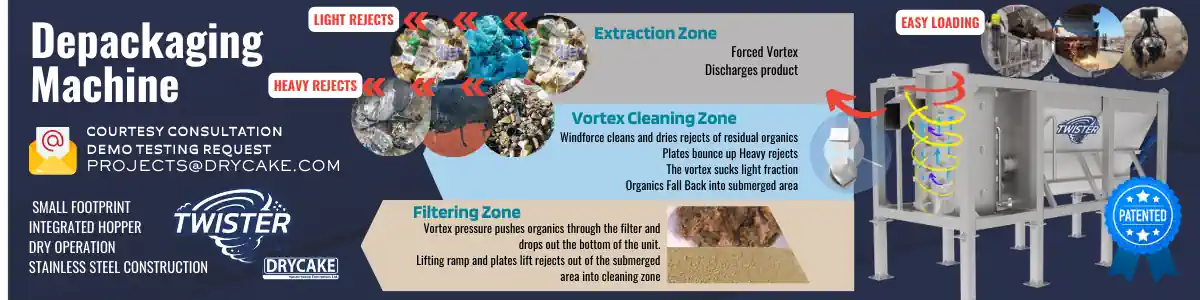
The core idea of a Drycake Twister-style, multi-stream plastics recovery line is that you do not have to accept a single, low-value mixed plastic output. You can split by density and behaviour in water, then condition each stream for its best end market.
Ecube’s E-WPR description lays out a practical Twister Separator separation path that many mills can relate to:
- Return water and paper fibre back to the paper mill process.
- Pull clean metals for sale.
- Send plastics to a secondary step that separates a heavy fraction (such as PVC) from a light fraction (such as PE and PP).
- Convert the light fraction to a granule aimed at the injection moulding market, where specifications tend to reward cleaner, more consistent material.
In US terms, the operational advantage is simple: better separation gives you cleaner outbound loads, fewer rejected shipments, and less time spent arguing about contamination at the gate.
Do keep the compliance piece grounded. If you operate across states, confirm how each outlet wants the material described and tested. Under US EPA rules, you still need to confirm whether a material is a solid waste, whether any portion could be regulated as hazardous, and whether your recycling route is legitimate rather than sham recycling.
Benefits of Cleaner Recycling Output
Cleaner output is not just an environmental story. It is a throughput story. When you keep plastics and metals out of your fibre loop, you protect screens, pumps, cleaners, and the paper machine itself.
You also gain optionality. A stable plastic fraction can go to recycling technology partners, pelletising lines, or permitted energy recovery. A clean metal fraction is far easier to market as scrap. A recovered fibre fraction reduces your need for virgin inputs and improves your circular economy narrative with customers.
Improved fibre recovery rates
Fibre recovery is where most mills see the fastest payback, provided you do not reintroduce contaminants. The logic is straightforward: if your reject line washes fibre off plastics and removes non-fibrous material, you can send that recovered fibre back upstream without poisoning your water circuit.
If you want a concrete reference point, published performance notes for Tecnofer’s approach claim up to 98% fibre retention with screening and hydrocyclonic separation, producing recovered fibre suitable for re-entry into the paper machine. Use that as a target to stress-test your own mass balance, not as a guarantee.
To keep recovery numbers honest, standardise your calculation method:
- Measure incoming pulper rejects on a wet basis and a dry basis, then decide which you will report.
- Track recovered fibre as a percentage of reject solids, not just as tonnes back to stock, so you can compare months with different moisture.
- Audit contaminant carryover with a simple hand-sheet or lab screen check before you commit recovered fibre to sensitive grades.
Reduced environmental impact
Mechanical plastic removal helps you reduce landfill, reduce wasted transport, and reduce the risk of microplastic generation inside the mill. It also supports environmental sustainability goals because you recover more usable fibre and keep more material in productive use.
From a compliance perspective, the US Environmental Protection Agency explains that the Resource Conservation and Recovery Act is the framework for hazardous and non-hazardous waste management, and it sets the baseline definition of solid waste. In plain terms, you need a defensible determination for each outbound stream, plus documentation that supports legitimate recycling where you claim recycling.
Cleaner separation also helps you respond to customer pressure tied to packaging policy. Several US states now run packaging extended producer responsibility programmes, and those programmes drive sharper scrutiny of recycling performance and end markets. Better sorting at the pulper reject stage makes downstream claims easier to support.
Income Potential from Recycled Plastics for Incineration, etc.
Income from recovered plastics and metals can offset waste management costs, but you only get paid for consistency. The highest-value shift you can make is moving from mixed, wet rejects to separated, dewatered commodities.
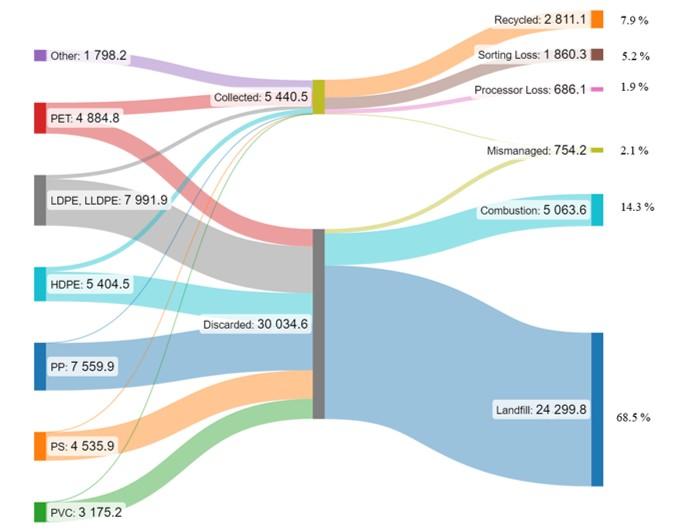
“U.S. Plastic Recycling Economy | NIST” from www.nist.gov and used with no modifications.
| Item | Benefits of Adding a Paper Mill Reject Separation Stage, such as the Twister Separator – Summary Points |
|---|---|
| Material outcome |
|
| Sale routes |
|
| Income streams |
|
| Financial incentives |
|
| Operational tools |
|
| Industry 4.0 integration |
|
| Commercial example |
|
Conclusion
In a paper mill, pulper plastic removal is one of the clearest ways to protect fibre yield, stabilise paper production, and turn pulper’s rejects into manageable streams.
A European E-WPR approach combines capture at the pulper (ragger and junk trap systems) with downstream washing, separation, and dewatering. That is how you lift cellulose recovery while cutting paper mill waste volumes.
Trials have shown that without shredding or a washing machine stage, the Drycake Twister Separator produces a dry-enough plastic fraction to return recovered paper fibre to the process and recycle, or incinerate the plastic for energy extraction.
FAQs – Paper Mill Pulper Rejects Plastic Removal Methods for Cleaner Recycling Output
1. What methods help with plastic removal in a paper mill pulper?
Paper mills use mechanical screening, flotation and density separation to help plastic removal in the pulper. These steps aim to give a cleaner recycling output.
2. Can the pulper remove all plastic?
No. The pulper cannot catch every piece of plastic. You still need extra process steps and good sorting to protect the cleaner recycling output.
3. How can a mill improve plastic removal and recycling output?
Start with better feed sorting before pulping. Add stronger screening, a separation step and a wash stage to free plastic from fibres. Monitor the water and the reject stream, then tweak settings to cut waste.
4. Does better plastic removal save money?
Yes, cleaner recycling output cuts rejects and lowers rework costs. It also steadies paper quality and can reduce energy use.
Discover more from IPPTS Depackaging Equipment Insights
Subscribe to get the latest posts sent to your email.