 Wackerbauer should therefore not be described simply as offering a “squeezing, not shredding” process. It offers several forms of mechanical treatment selected according to the incomingDisclosure: This is an independent technical review based on publicly available manufacturer information. Equipment performance should be verified using representative feedstock trials and incorporated into contractual acceptance criteria.
Key Takeaways
- Wackerbauer manufactures a three-stage squeezing press specifically for liquid and viscous products in packages smaller than approximately 200 mm.
- The press applies up to 50 tonnes of chamber pressure and uses 5 mm perforations to separate the contents from the packaging.
- It is intended for products such as cans, beverage containers, aluminium tubes, plastic cups, composite drink cartons and flexible packs containing soft foods.
- The squeezing press is distinct from Wackerbauer’s hammermill-based food-waste treatment systems.
- Wackerbauer’s hammermills operate at approximately 1,000–1,200 rpm and can process food residues at up to around 16 tonnes per hour, depending on consistency.
- The manufacturer quotes an output particle size of approximately 10 mm for relevant food-waste applications.
- Complete Wackerbauer plants can include reception, screw conveying, manual or mechanical sorting, magnetic separation, metal detection, hammermilling, hygienisation and storage.
- The squeezing press may preserve some packages better than a hammermill, but 50 tonnes of pressure will crush and deform most containers.
- The hammermill is clearly an intensive size-reduction process and should not be classified as low-impact depackaging.
- Public information does not provide universal guarantees for organic recovery, organic-output purity, reject cleanliness or plastic fragmentation.
Who Is Wackerbauer Maschinenbau?
Wackerbauer Maschinenbau GmbH is a German engineering and manufacturing company active in process engineering, plant construction, food-waste recycling, custom machinery, steel structures and container manufacture.The company offers services including:- process and plant design;
- manufacture of individual machines and components;
- project management;
- installation of complete plants;
- food-waste reception systems;
- conveying and sorting equipment;
- hammermills;
- packaged-food squeezing presses;
- hygienisation systems;
- storage tanks; and
- access platforms and structural steelwork.
Wackerbauer’s Packaged-Food Squeezing Press
The Wackerbauer pressing machine for packaged food is a three-stage cyclic press developed to separate liquid and viscous products from their packaging.The manufacturer states that it is suitable for packages with a diameter of less than approximately 200 mm.Typical products include:- canned foods;
- beverage cans;
- aluminium tubes containing mustard, ketchup or similar products;
- plastic cups containing dairy products or fats;
- composite beverage cartons;
- foil-wrapped sausages;
- fresh pasta;
- soft cheese; and
- other low-consistency packaged foods.
How Does the Squeezing Press Work?
Wackerbauer describes the machine as a three-chamber cylindrical press installed inside a rotating housing. The machine operates through three indexed cycles.Published construction details include:- three individual press chambers;
- each chamber approximately 250 mm in diameter;
- each chamber approximately 800 mm long;
- up to 50 tonnes of pressure within the chamber;
- 5 mm perforations in the press cylinders; and
- an additional perforated zone extending approximately 300 mm before the end wall.
- An individual packaged food item enters an empty chamber.
- The housing indexes the loaded chamber into the pressing position.
- A hydraulic or mechanical ram applies pressure to the package.
- The container collapses or ruptures under compression.
- Liquid and soft viscous contents pass through the 5 mm perforations.
- The crushed packaging remains within the chamber.
- The housing indexes again so that the emptied package can be discharged and the next package loaded.
Is the Wackerbauer Press a Depackaging Machine?
Yes. It performs the essential depackaging function of separating food contents from their container.However, it is a specialised press rather than a general-purpose mixed-waste depackager.Its apparent strengths are most relevant where the feed consists of:- recognisable individual packages;
- relatively uniform container dimensions;
- liquid or soft viscous contents;
- limited quantities of loose waste;
- controlled industrial product recalls; or
- expired stock from food and drink manufacturers.
- large outer cartons;
- bags within bags;
- loose food mixed with packaging;
- rigid containers larger than the chamber limit;
- brittle glass;
- cutlery and miscellaneous contaminants;
- dense solids; or
- highly variable household food waste.
Is Squeezing a Low-Impact Process?
The squeezing press does not appear to use rotating knives, paddles or hammermill hammers. In that sense, it may apply less repeated cutting and abrasion than many rotary depackagers.However, a chamber pressure of 50 tonnes is substantial. The package is intentionally crushed or ruptured so that its contents can escape through 5 mm perforations.The process may therefore:- flatten metal cans;
- split or fracture plastic cups;
- burst flexible film;
- delaminate composite cartons;
- tear aluminium tubes; and
- force small packaging fragments towards or through the perforations.
Limitations of the 5 mm Perforated Press Cylinders
The 5 mm perforations determine which material can pass from the press chamber into the recovered organic stream.This raises several questions:- Can pieces of brittle plastic smaller than 5 mm enter the recovered liquid?
- Can aluminium foil fragments be forced through the holes?
- How are fibres and fragments prevented from blocking the perforations?
- What proportion of thick or sticky food remains within crushed packages?
- How is the machine cleaned between product types?
- Can high-fat or high-viscosity products pass through without dilution or heating?
Wackerbauer Complete Food-Waste Recycling Plants
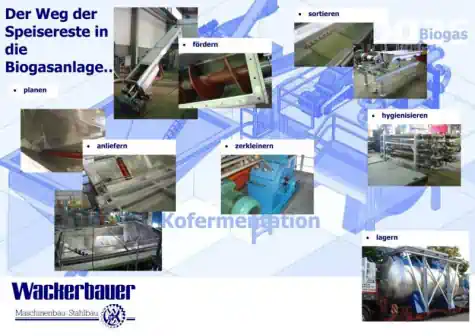
Wackerbauer also designs complete plants for processing food waste and biodegradable residues.The manufacturer lists plant components including:- a receiving or insertion hopper;
- a trough screw conveying material towards sorting;
- magnetic separation of ferrous metals;
- additional metal detection on a vibrating chute;
- conveying to a crusher or mill;
- a hammermill for particle-size reduction;
- hygienisation in double-tube heat exchangers or heated tanks;
- silo tanks for storage and cooling; and
- steel structures with accessible working platforms.
- sorting;
- metal removal;
- size reduction;
- heat treatment;
- buffer storage; and
- controlled feeding into anaerobic digestion.
Wackerbauer Hammermills
Wackerbauer manufactures industrial hammermills for fine, coarse and preliminary crushing.Published technical data include:- drive power from approximately 44 kW to 100 kW;
- grinding widths of approximately 500 mm or 600 mm;
- rotor speeds from approximately 1,000 to 1,200 revolutions per minute;
- machine weight of approximately 2,500 kg excluding the drive;
- food-residue throughput of approximately 16 tonnes per hour, depending on consistency; and
- an output particle size of approximately 10 mm for the stated food-waste application.
- reversible wear-resistant hammers;
- round-hole or application-specific screens;
- replaceable wear plates;
- a foreign-material discharge box;
- inspection and cleaning openings;
- optional cleaning-in-place connections; and
- optional liquid inlets.
How Does the Hammermill Fit into the Process?
Wackerbauer’s public information does not state that every package processed by the three-stage squeezing press must subsequently pass through the hammermill.The more cautious interpretation is that Wackerbauer supplies different processing routes and complete plant configurations according to feedstock.Possible arrangements include:- using the squeezing press for uniform packs containing liquids and soft foods;
- using sorting and hammermilling for mixed food residues;
- combining outputs from different reception lines before hygienisation;
- using a hammermill to reduce unpackaged food residues to a required size; or
- using both systems at the same facility for different waste streams.
The Original “Squeezing Not Shredding” Claim
The original version of this article listed “squeezing not shredding” as an advantage.That statement is accurate only when referring specifically to Wackerbauer’s packaged-food press.It is not accurate as a description of Wackerbauer’s full food-waste technology range because the company expressly supplies hammermills for food-residue size reduction.A better distinction is:- Packaged-food squeezing press: high-pressure, cyclic compression through perforated chambers.
- Hammermill plant: high-speed impact size reduction through hammers and screens.
Plastic Fragmentation and Microplastic Considerations
Squeezing press
The squeezing press may create fewer fragments than a hammermill because it does not repeatedly circulate packages through a high-speed grinding chamber.Nevertheless, crushing brittle, thin or multilayer packaging under high pressure may still create:- cracked plastic pieces;
- foil fragments;
- split laminates;
- small pieces generated at sharp folds; and
- particles capable of passing through the 5 mm perforations.
Hammermill
The hammermill operates at approximately 1,000–1,200 rpm and deliberately reduces material to around 10 mm in the stated food-residue application.If packaging is present in the hammermill feed, the process can be expected to:- fragment plastic packaging;
- tear films and composite materials;
- abrade particles against screens and wear plates;
- increase the number of small packaging pieces; and
- make subsequent packaging recovery more difficult.
Organic Recovery and Purity
Wackerbauer does not publish universal organic-recovery or recovered-output purity figures for the packaged-food press.Performance will vary according to:- product viscosity;
- package strength;
- package shape and size;
- perforation area;
- press pressure and cycle time;
- temperature;
- the tendency of food to adhere to packaging; and
- whether rinsing or dilution is used.
- Organic recovery: the proportion of available food recovered from each package.
- Recovered-organic purity: the concentration of plastic, metal, foil, paper and other physical contaminants in the output.
- Reject organic loss: the amount of food remaining inside or attached to the crushed packaging.
Reject Packaging Quality
The squeezing press is likely to discharge crushed packages rather than a clean, dry and sorted recyclable product.Reject quality may depend on:- the amount of food remaining in the package;
- whether the package is metal, plastic, foil or composite;
- the extent of crushing and tearing;
- whether different packaging materials are processed separately;
- moisture content;
- the presence of labels, closures and sleeves; and
- the acceptance requirements of the intended outlet.
Hygienisation and Complete-Plant Integration
Wackerbauer offers hygienisation using either double-tube heat exchangers or heated vessels.This may be useful for food-waste treatment facilities where biological safety and regulatory requirements apply.The complete system can also include:- metal removal before size reduction;
- buffer storage;
- heating;
- cooling;
- pumping;
- access platforms; and
- plant-wide integration.
Potential Advantages
Dedicated press for liquid and viscous packaged foods
The three-stage press is specifically designed for products that can be expressed from crushed packages.No rotating high-speed mechanism in the press
The press itself appears to separate through cyclic compression rather than rapid rotary impact.Potentially larger packaging pieces
Crushed packages may remain more recognisable than packaging processed through a hammermill.Handling of metal, plastic, foil and composite packs
Wackerbauer lists a useful range of container types, including cans, cups, tubes and cartons.Complete plant engineering
The company can provide reception, conveying, sorting, metal separation, size reduction, hygienisation, tanks and structural steelwork.Metal removal before milling
Magnetic separation and metal detection may protect downstream equipment and reduce contamination.Established German engineering company
Wackerbauer has long-standing experience in custom machinery and food-waste treatment plants.Potential Limitations
- The squeezing press appears best suited to liquid and soft viscous products rather than all food wastes.
- Packages larger than approximately 200 mm may require alternative treatment.
- High pressure will crush and may fragment packaging.
- Small fragments may pass through the 5 mm perforations.
- Thick or sticky foods may remain trapped in crushed packages.
- The press appears cyclic rather than fully continuous, which may limit throughput.
- Current public information does not state press throughput or energy use.
- Cleaning requirements could be significant when changing products.
- The complete plant may include a high-speed hammermill.
- Hammermilling can fragment packaging if plastics remain in the feed.
- Publicly available recovery, purity and reject-quality data are limited.
- A full turnkey system may be disproportionately complex for a medium-sized processor.
Questions to Ask Wackerbauer Before Buying
- Is the three-stage squeezing press suitable for the proposed product range?
- What is the maximum package diameter, length and weight?
- What package types cannot be processed?
- What is the press throughput in packages and tonnes per hour?
- Is the press batch, cyclic or continuously fed?
- What causes the package to rupture?
- Can brittle plastics fragment sufficiently to pass through the 5 mm perforations?
- What organic recovery is guaranteed?
- What physical-contaminant concentration is guaranteed in the recovered output?
- How much food remains in the crushed packages?
- Is water, heat or steam required for viscous products?
- How are perforations kept clear?
- How is the press cleaned between different food products?
- What happens if a package contains a hard foreign object?
- What reject moisture content is achieved?
- Can metal cans be separated from plastics and composites?
- What outlet is recommended for the crushed packaging?
- Does the proposed plant include a hammermill?
- If so, does packaging enter the hammermill or only unpackaged organic material?
- What hammermill screen and output particle size are proposed?
- What plastic particle-size distribution results from the complete system?
- What energy consumption is expected per tonne?
- Which parts are wear components?
- Can representative packaged products be tested before purchase?
- Will throughput, recovery, purity and reject quality be guaranteed contractually?
Independent Assessment
Wackerbauer offers two technically distinct approaches relevant to packaged food and food-waste recycling.The first is a specialised three-stage squeezing press. This appears well suited to controlled streams of liquid and soft viscous products in individual cans, cups, tubes, cartons and flexible packs.The machine uses substantial pressure rather than high-speed rotary impact. It may therefore preserve packages in fewer and larger pieces than a hammermill. However, it should not be described as completely gentle: 50 tonnes of chamber pressure will deliberately crush, rupture and deform packaging.The second approach is Wackerbauer’s complete mixed-food-waste treatment plant, which may incorporate a hammermill running at approximately 1,000–1,200 rpm. That is a conventional intensive size-reduction stage and is not consistent with a general claim of “squeezing rather than shredding.”The available information does not establish that every package treated by the squeezing press is subsequently hammermilled. The two machines may process different feedstocks or operate as separate lines within a larger facility.For a prospective buyer, the most important task is therefore to obtain a clear process-flow diagram showing:- which wastes enter the squeezing press;
- which wastes enter the hammermill;
- whether packaging is present during hammermilling;
- where metal and other contaminants are removed;
- what downstream screening is provided; and
- how each reject stream is managed.
- throughput;
- organic recovery;
- recovered-output purity;
- packaging particle size;
- reject organic content;
- reject moisture;
- water and energy consumption;
- wear and cleaning costs; and
- the availability of viable reject outlets.
Frequently Asked Questions
Does Wackerbauer manufacture a food waste depackager?
Yes. Wackerbauer manufactures a three-stage squeezing press that separates liquid and viscous foods from packages smaller than approximately 200 mm.How does the Wackerbauer squeezing press work?
Packaged food is compressed in one of three cylindrical chambers. Pressure ruptures or collapses the package, and the contents pass through 5 mm perforations while the packaging remains in the chamber.Does the press shred packaging?
It does not appear to use conventional rotating shredder knives or hammermill hammers. However, high pressure crushes and may tear or fragment the packages.What pressure does the machine use?
Wackerbauer publishes a chamber pressure of 50 tonnes.What products can it process?
The manufacturer lists cans, beverage containers, aluminium tubes, plastic dairy cups, composite drink cartons and flexible packages containing soft products such as sausage, pasta and cheese.Does Wackerbauer also use hammermills?
Yes. Wackerbauer supplies hammermills for food-residue size reduction as part of complete food-waste processing plants.What is the hammermill speed?
The published range is approximately 1,000–1,200 revolutions per minute.Does all material from the squeezing press enter a hammermill?
Wackerbauer’s public information does not say that this is always the case. The press and hammermill may serve different feedstocks or processing lines.Is the Wackerbauer system low impact?
The squeezing press may be lower impact than a hammermill because it uses cyclic pressure rather than rapid repeated impacts. The hammermill itself is an intensive size-reduction process and should not be classified as low impact.Can the crushed packaging be recycled?
Possibly, particularly where metal cans or other materials are processed separately. Mixed crushed packaging may require further cleaning and sorting or may be sent for energy recovery.Sources
- Wackerbauer Maschinenbau: Food Waste Recycling Plants.
- Wackerbauer Maschinenbau: Pressing Machine for Packaged Food.
- Wackerbauer Maschinenbau: Hammermills.
- Wackerbauer Maschinenbau: Company and Engineering Services.
- Wackerbauer Maschinenbau: Corporate History.
Discover more from IPPTS Depackaging Equipment Insights
Subscribe to get the latest posts sent to your email.