Selecting depackaging separation and materials-handling equipment requires more than comparing headline throughput and organic-recovery claims.
A complete food-waste depackaging installation may need to receive irregular loads, open packaging, separate organic material, remove metals and grit, produce pumpable feedstock, clean or dewater the packaging reject and deliver both outputs to viable downstream users.
This article compares two established European depackaging equipment manufacturers:
- Smicon, manufacturer of the SMIMO range of active cutting, grinding and screening depackagers; and
- Rowan Food and Biomass Engineering, manufacturer of the UK-built Dominator paddle-based depackaging machine.
The purpose is not to identify one universal winner. The correct machine depends on feedstock, output specification, throughput, water availability, downstream treatment and the intended destination of the packaging reject.
Disclosure: This is an independent technical comparison based on publicly available manufacturer information. Performance claims should be confirmed through representative trials and included in contractually enforceable acceptance criteria.
Key Takeaways
- Smicon and Dominator both manufacture industrial depackaging equipment, but they use different mechanical approaches.
- The Smicon SMIMO actively cuts or grinds organic material before passing it through an interchangeable screen.
- The Dominator uses configurable rotating paddles and centrifugal action to open packages and force the recovered material through a screen.
- Neither system is intended for residential household use.
- Smicon currently offers the SMIMO80, SMIMO120 and SMIMO160 rather than a SMIMO30.
- Dominator currently offers five base models with published capacities from approximately 4 m³/hour to 30 m³/hour.
- Dominator reports food-waste output purity of up to 99.94%, verified by independent customer testing in August 2024, but the result remains application-dependent.
- Smicon states that some installations achieve at least 99.5% clean organic output, depending on the incoming material and process configuration.
- Purity, organic recovery and reject cleanliness are different performance measurements and should not be confused.
- A successful installation may require considerably more than the primary depackaging machine.
What Is Depackaging Separation Equipment?
Depackaging equipment separates food, beverages or other recoverable materials from their containers.
Typical incoming materials include:
- expired supermarket food;
- food-manufacturing rejects;
- commercial food waste;
- source-separated household organics;
- packaged beverages;
- bakery products;
- dairy products;
- fruit and vegetables;
- canned products;
- plastic tubs and bottles;
- flexible film and pouches; and
- composite cartons.
The organic output may be used for:
- anaerobic digestion;
- composting, where permitted and suitable;
- animal feed or feed ingredients, where legally permissible;
- rendering or by-product recovery; or
- other industrial recovery processes.
The separated packaging may be:
- recycled after further cleaning and sorting;
- processed into refuse-derived fuel or solid recovered fuel;
- sent to energy-from-waste treatment; or
- disposed of where no recovery outlet is available.
A depackaging machine does not automatically make packaging recyclable. That depends on the quality of the reject and the requirements of an identified receiving facility.
Why the Depackager Is Only Part of the System
The primary depackaging machine is often the most visible item of equipment, but a complete installation may also require:
- vehicle reception and unloading;
- storage bunkers;
- metering screws or conveyors;
- manual inspection;
- bag or case opening;
- magnetic metal separation;
- stone, grit and glass removal;
- pumps and pipework;
- buffer tanks;
- further organic-output screening;
- reject washing or pressing;
- air classification;
- odour control;
- hygienisation;
- controls and automation; and
- safe access for cleaning and maintenance.
Equipment should therefore be compared as part of a complete process rather than by considering the depackager in isolation.
Smicon SMIMO Depackaging Machines
Smicon is a Netherlands-based manufacturer of food-waste recycling and processing equipment.
Its current SMIMO depackaging range comprises:
- SMIMO80;
- SMIMO120; and
- SMIMO160.
Smicon states that SMIMO machines have been used to unpack packaged foods since 2006. Its company history records the introduction of the SMIMO120 in 2014 as an important development in the product range.
How the SMIMO works
The SMIMO is an active cutting or grinding and screening machine.
A typical operating sequence is:
- Packaged and unpackaged material enters the machine.
- Internal rotating components open and agitate the packaging.
- Soft organic material is cut or ground sufficiently to pass through the selected screen.
- The recovered organic fraction leaves through one outlet.
- Packaging and retained contaminants leave through a separate outlet.
The screen can be selected according to feedstock and output requirements.
Smaller apertures may improve the removal of visible contaminants but can:
- reduce throughput;
- increase organic loss;
- increase blockage risk; and
- increase wear.
Larger apertures may improve throughput and recovery but allow larger packaging fragments into the organic output.
SMIMO output-quality claims
Smicon states on recent project pages that a SMIMO120 can achieve an organic output of at least 99.5% cleanliness, depending on the incoming material.
That figure should be interpreted as a manufacturer claim applying to particular conditions. A buyer should establish:
- whether it is measured by wet mass or dry mass;
- the contaminant categories included;
- the minimum particle size measured;
- the screen used;
- the composition of the incoming waste;
- whether water was added;
- whether downstream treatment contributed to the result; and
- the organic recovery achieved simultaneously.
Smicon post-treatment equipment
Smicon offers additional machines for improving the two SMIMO outputs.
BS260 Belt Separator
The BS260 Belt Separator can operate as a standalone depackager for suitable soft packs or as a polishing stage for the organic output from a SMIMO.
CS300 Cyclone
The CS300 Cyclone is used after depackaging to remove grit and improve the quality of the recovered organic material.
SP600 Screw Press
The SP600 Screw Press post-treats the packaging stream to reduce its weight and recover additional organic material.
Smicon publishes a capacity of approximately 30 m³/hour for the SP600.
Wind separation and metal removal
Smicon can also include magnetic separation and wind classification to recover metal and separate lightweight packaging from heavier remaining organics.
These options demonstrate that optimum output quality may require a complete processing line rather than the SMIMO alone.
The Dominator Depackaging Machine
The Dominator Depackaging Machine is manufactured in the United Kingdom by Rowan Food and Biomass Engineering.
Dominator describes its equipment as predominantly paddle-based, with centrifugal force contributing later in the separation process.
The machine is promoted for:
- food waste;
- source-separated organics;
- beverages;
- metal cans;
- plastic bottles and containers;
- composite cartons;
- coffee pods;
- pharmaceuticals and cosmetics;
- animal-feed recovery; and
- plasterboard.
How the Dominator works
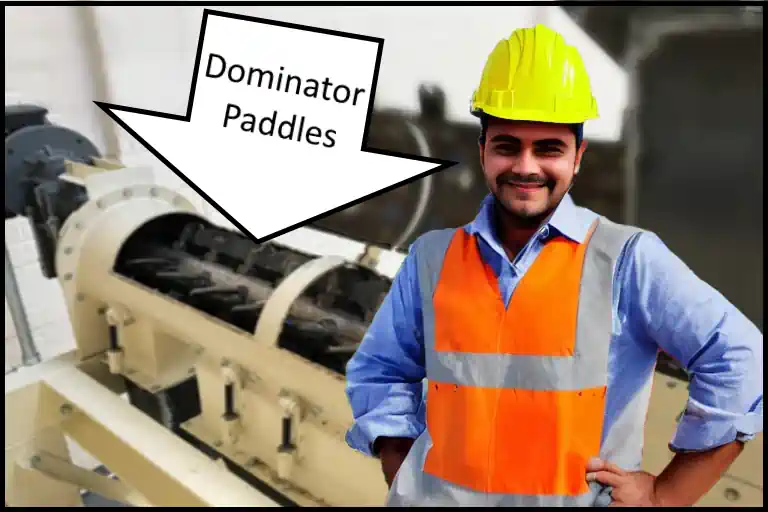
The machine contains a solid horizontal shaft fitted with configurable paddles inside a screened barrel.
A typical sequence is:
- Material is fed into the barrel.
- Rotating paddles agitate, strike and open the packaging.
- Mechanical and centrifugal forces release the contents.
- Food, liquids or other sufficiently small recovered materials pass through the screen.
- The packaging and larger retained objects travel to the reject discharge.
Dominator contrasts this paddle process with conventional hammermilling. The company states that the paddles provide gentler agitation, retain packaging in larger pieces and reduce the risk of small plastic contamination.
Those advantages are plausible relative to an aggressive high-speed hammermill, but packaging is still exposed to repeated impact, abrasion and screen contact. Fragmentation should therefore be measured rather than assumed to be negligible.
Dominator Models and Published Capacities
Dominator currently lists five base models.
| Model | Published capacity | Published motor power | Maximum published paddle count |
|---|---|---|---|
| 1800 | Up to 4 m³/hour | 15 kW | 46 |
| 2000 | Up to 8 m³/hour | 22 kW | 50 |
| 2500 | Up to 12 m³/hour | 30 kW | 72 |
| 3000 | Up to 15 m³/hour | 37 kW | 78 |
| 3500 | Up to 30 m³/hour | 45 kW | 96 |
These are volumetric maximum figures and depend on the processed material. Buyers should obtain guaranteed mass throughput for their actual feedstock.
Dominator can supply:
- the depackaging machine alone;
- a complete line with reception, conveying, pumps, controls and platforms; or
- an LR compact model incorporating a hopper, feed screw and control panel.
Dominator’s 99.94% Purity Claim
Dominator states that independent testing conducted by Alfred H Knight Energy Services in August 2024 recorded food-waste output purity of 99.94%.
The company says the full report is available on request.
This is more useful than an unsupported general efficiency claim, but prospective buyers should still request the report and establish:
- the feedstock tested;
- the packaging composition;
- the model and machine settings;
- the screen aperture;
- the analytical method;
- whether purity was measured on a wet or dry basis;
- the smallest contaminants included;
- the organic recovery;
- the reject organic content; and
- whether the result applies to the machine alone or the complete processing line.
A purity of 99.94% would leave 0.06% contamination on the stated measurement basis. At high annual throughput, even a small percentage can represent a material quantity, so the test definition remains important.
Smicon and Dominator: Main Technical Differences
| Consideration | Smicon SMIMO | Dominator |
|---|---|---|
| Principal mechanism | Active cutting or grinding and screening | Rotating paddles, agitation, centrifugal action and screening |
| Current principal models | SMIMO80, SMIMO120 and SMIMO160 | 1800, 2000, 2500, 3000 and 3500 |
| Packaging treatment | More deliberate size reduction | Packages opened and emptied by configurable paddles |
| Fragmentation risk | Potentially higher because of cutting or grinding | Potentially lower than a grinder, but not eliminated |
| Organic-output post-treatment | Belt separator and cyclone options | Screen and paddle configuration; additional equipment can be integrated |
| Reject post-treatment | Windshifter, magnetic separation and SP600 screw press | Project-specific downstream handling or recycling equipment |
| Published purity claim | At least 99.5% in selected applications | Up to 99.94% in independently tested food-waste application |
| Added water | Can operate without added liquid, although liquid may be introduced | Can run wet or dry; injection points can be added |
| Pre-purchase trials | Available | Available at the Cheltenham facility or through trial-machine hire |
This comparison should not be used as a substitute for testing. Machine performance depends on the complete configuration and the actual waste.
Organic Recovery Is Not the Same as Purity
Manufacturer literature often uses terms such as “efficiency,” “recovery” and “purity” interchangeably. They describe different outcomes.
Organic recovery
The proportion of the available food or organic content transferred to the recovered organic output.
Organic-output purity
The proportion of that output consisting of the desired organic material rather than plastic, metal, glass, paper or other contaminants.
Reject organic loss
The amount of recoverable food remaining with the discharged packaging.
Reject purity
The extent to which the packaging output is free from food, water and other unwanted material.
A machine can produce highly pure organics by rejecting a large quantity of food. It can also recover almost all the food while allowing excessive packaging contamination into the organic output.
A valid performance test must measure both streams.
Materials-Handling Equipment Required
The characteristics of the reception and conveying equipment can materially affect depackager performance.
Reception bunkers
These should be sized for delivery peaks and designed to prevent bridging, leakage and uncontrolled odour release.
Metering conveyors or screws
A consistent feed rate helps prevent overloading and allows stable separation.
Magnetic separation
Ferrous metals should be removed where they could damage pumps, screens or other downstream equipment.
Stone and grit removal
Glass, stones, ceramics and dense plastics may require sedimentation, cyclone treatment or other dedicated separation.
Organic-output pumping
Pumps must be selected for the solids content, fibre length, viscosity and remaining physical contaminants.
Reject conveying
Wet films and mixed packaging can bridge, wrap around shafts and adhere to conventional conveyors. The handling system should be demonstrated with representative material.
Buffer storage
Tanks or bunkers may be required to equalise output before pumping to anaerobic digestion or other treatment.
Can the Packaging Reject Be Recycled?
Both manufacturers describe the possibility of recycling separated packaging, but this should not be assumed for every installation.
Recyclability depends on:
- material composition;
- organic contamination;
- moisture content;
- particle size;
- the mixture of flexible and rigid plastics;
- the presence of paper and multilayer composites;
- metal separation;
- local recycling capacity; and
- the receiving facility’s acceptance specification.
Where material recycling is not practical, a relatively dry packaging stream may still be suitable for RDF, SRF or energy-from-waste treatment.
The intended outlet should inspect representative samples and provide written acceptance before the business case assumes recycling income or avoided disposal charges.
Plastic Fragmentation and Microplastic Risk
All mechanically active depackagers can damage plastic packaging.
The risk and extent of fragmentation depend on:
- rotor or shaft speed;
- cutting, grinding or paddle geometry;
- screen aperture;
- residence time;
- feed rate;
- packaging type;
- plastic thickness and brittleness;
- the presence of abrasive contaminants; and
- downstream screening.
The SMIMO’s cutting or grinding mechanism gives a credible reason to examine smaller plastic-particle production closely.
The Dominator’s paddle system is intended to retain packaging in larger pieces, but repeated agitation can still create fragments.
Neither machine should be selected based solely on a general statement about microplastics. Representative testing should quantify:
- visible packaging particle sizes;
- plastic contamination within the recovered organics;
- particles smaller than the primary screen aperture;
- flexible and rigid plastics separately; and
- the effect of alternative machine settings.
Animal Feed Claims Require Caution
Both depackaging manufacturers and older industry literature may refer to animal-feed recovery.
Whether recovered food can legally and safely enter animal feed depends on:
- the origin of the material;
- whether it contains catering waste;
- animal by-product controls;
- packaging contamination;
- traceability;
- processing and hygiene standards; and
- the jurisdiction in which the equipment operates.
Equipment capability does not establish regulatory permission. A project should obtain specialist legal and regulatory advice before relying on an animal-feed outlet.
Neither System Is Intended for Residential Use
The former version of this article suggested that the Dominator might be suitable for individuals wishing to keep their homes clean.
That was incorrect.
Both Smicon and Dominator manufacture industrial machines requiring:
- three-phase electrical supplies;
- mechanical feeding equipment;
- machine guarding;
- industrial controls;
- trained operators;
- cleaning and maintenance systems;
- safe output handling; and
- commercial quantities of suitable feedstock.
They are intended for businesses, public authorities, waste contractors and industrial processing facilities.
How to Compare Depackaging Equipment Manufacturers
Buyers should provide each shortlisted manufacturer with the same feedstock and test specification.
The comparison should include:
- Guaranteed throughput in tonnes per hour.
- Organic recovery as a percentage of available organic material.
- Physical contamination in the organic output.
- Food remaining in the packaging reject.
- Water added per tonne.
- Recovered-organic dry-solids concentration.
- Reject moisture content.
- Packaging particle-size distribution.
- Electrical consumption per tonne.
- Wear-part consumption and cost.
- Cleaning time and water use.
- Labour requirements.
- Noise and odour-control requirements.
- Availability and downtime assumptions.
- Compatibility with downstream pumps and digesters.
- Acceptance by the intended reject outlet.
Questions to Ask Smicon and Dominator
- Which exact model and complete plant configuration are proposed?
- What throughput is guaranteed for our representative feedstock?
- What screen aperture will be used?
- What cutting tools, paddles or other internal components are proposed?
- What normal rotational speed will be used?
- What organic recovery is guaranteed?
- What organic-output purity is guaranteed?
- What analytical method defines purity?
- What minimum particle size is included in contamination testing?
- How much organic material remains in the reject?
- What packaging particle-size distribution is produced?
- How much water is added per tonne?
- What dry-solids concentration is achieved?
- What moisture content remains in the reject?
- What additional organic polishing is required?
- What additional reject treatment is required?
- Can the reject be accepted by our intended recycler or fuel outlet?
- What energy consumption is guaranteed per tonne?
- Which parts are expected to wear?
- What is the expected annual cost of wear parts?
- How long does routine cleaning take?
- What happens when the feed contains metal, glass or dense contaminants?
- Can the complete proposed system be tested rather than the depackager alone?
- Can we visit a reference installation processing comparable material?
- Will the agreed performance figures be incorporated into the supply contract?
Independent Comparison
Smicon and Dominator both offer credible industrial depackaging equipment, but their mechanical philosophies differ.
The SMIMO uses more deliberate cutting or grinding. This can provide robust processing and effective organic release, particularly within a complete Smicon line incorporating belt separation, cyclone cleaning, wind classification and screw pressing.
The Dominator uses configurable paddles and centrifugal action. Its design aims to open packaging while retaining larger pieces than a conventional hammermill. The independently tested 99.94% purity claim is noteworthy, although the full test basis should be examined before using it in procurement decisions.
For projects prioritising:
- processing resilience;
- high organic release;
- multiple post-treatment options; and
- a complete integrated line,
the Smicon approach may merit serious consideration.
For projects prioritising:
- reduced packaging fragmentation;
- lower water use;
- configurable paddle treatment;
- UK manufacture and support; and
- potentially cleaner, larger reject pieces,
the Dominator may offer relevant advantages.
These observations are not substitutes for trials. Feedstock variability can reverse an apparent advantage, and the best-performing machine on one waste stream may not be the best on another.
Buyers should also compare both systems with other food waste depackaging machine technologies, including vortex, screw-press, paddle, extrusion and other separation systems.
Frequently Asked Questions
Who manufactures the Smicon SMIMO?
Smicon, based in the Netherlands, manufactures the SMIMO80, SMIMO120 and SMIMO160 depackaging machines and associated separation equipment.
Who manufactures the Dominator?
The Dominator is manufactured in the United Kingdom by Rowan Food and Biomass Engineering Ltd.
Is there a Smicon SMIMO30?
No current SMIMO30 is listed by Smicon. Its present main depackaging range comprises the SMIMO80, SMIMO120 and SMIMO160.
Does the SMIMO use a patented debagger?
Smicon’s current product information does not describe the SMIMO as using a separate patented debagger. That description in the previous article appears to have been taken from an unrelated system.
Is the Dominator a centrifugal depackager?
It is predominantly a paddle machine. Dominator states that centrifugal force also contributes later in the process.
Does the Dominator use paddles?
Yes. A powered horizontal shaft carries configurable paddles inside a screened barrel.
Can these machines recycle plastic bottles?
They can separate contents from plastic bottles. Whether the bottles can then be recycled depends on their cleanliness, condition, polymer type and the requirements of the receiving recycler.
Can the Dominator process plasterboard?
Yes. Dominator promotes the machine for separating gypsum from its paper backing, and offers trials using representative waste.
Which machine produces the cleanest organic output?
That cannot be answered reliably without testing the same waste in both proposed systems. Published purity claims use different applications and may use different test methods.
Which creates fewer plastic fragments?
The paddle-based Dominator is designed to retain packaging in larger pieces than cutting or grinding systems. However, comparative particle-size testing using identical feedstock would be required to substantiate the difference.
Can either machine operate without added water?
Both manufacturers state that their machines can process suitable materials without added water, although water or liquid injection may be used for certain feedstocks and output requirements.
Are these machines suitable for households?
No. They are industrial processing machines intended for commercial and municipal facilities.
Sources
- Smicon: SMIMO Depackaging Machine.
- Smicon: Company and SMIMO Product History.
- Smicon: BS260 Belt Separator.
- Smicon: CS300 Cyclone Organic-Stream Treatment.
- Smicon: SP600 Reject Screw Press.
- Smicon: German Organic-Waste Depackaging Installation.
- Smicon: French Turnkey Depackaging and Separation Installation.
- Dominator Depackaging: Manufacturer and Product Overview.
- Dominator Depackaging: Models and Published Specifications.
- Dominator Depackaging: Technology and Application FAQs.
- Dominator Depackaging: Food-Waste Application and Purity Testing.
- Dominator Depackaging: Pharmaceutical Recovery Application.
- Dominator Depackaging: Plasterboard Separation Application.
Manufacturer links:
[Published April 2023. Rewritten June 2026.]
Discover more from IPPTS Depackaging Equipment Insights
Subscribe to get the latest posts sent to your email.