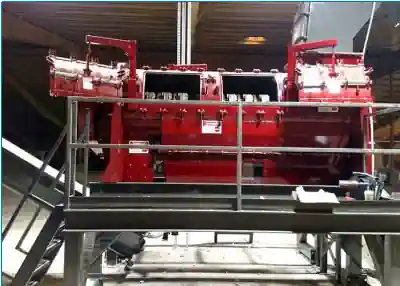
The Scott Turbo Separator is a horizontal paddle-based depackaging machine designed to recover food, liquids and other organic materials from plastic, paper, metal and composite packaging.
Unlike a conventional hammermill, the Turbo Separator uses a variable-speed horizontal shaft fitted with application-specific paddles. These paddles strike, open, empty and convey packaged material above interchangeable screens. Organic material passes through the screens while the lighter packaging travels towards a separate discharge.
Scott Equipment markets several Turbo Separator models for packaged food, commercial source-separated organics, beverages and food-manufacturing waste. Atritor markets closely related Turbo Separator technology in the United Kingdom and other international markets.
Disclosure: This is an independent technical review based on publicly available manufacturer information and industry reporting. Supplier performance claims should be confirmed through representative feedstock trials and contractually defined acceptance criteria.
Key Takeaways
- The Scott Turbo Separator is a paddle-based depackager rather than a conventional knife shredder or hammermill.
- A horizontal rotating shaft carries multiple paddles that open packaging through impact, flexing and mechanical agitation.
- Centrifugal force and self-generated airflow assist with movement and separation of the lighter packaging fraction.
- Interchangeable screens allow food, liquids and other recovered material to pass beneath the paddle chamber.
- Scott currently markets T20, T30, T42 and THOR systems for different packaging sizes, feedstocks and throughputs.
- Some Scott systems use twin screws to pre-crush cartons and cases before they enter the Turbo Separator.
- Scott claims organic recovery or purity of approximately 99% or more for suitable applications, but the terminology and test basis require clarification.
- The machine can process many feedstocks without adding water, although water may be added for rinsing or to obtain a pumpable output.
- The process is less destructive than a high-speed hammermill, but repeated paddle impact can still tear, abrade and fragment packaging.
- Packaging recyclability depends on its material composition, cleanliness, moisture content and degree of damage.

What Is the Scott Turbo Separator?
The Scott Turbo Separator is an industrial depackaging and product-recovery machine manufactured by Scott Equipment Company in the United States.
Scott promotes the system for recovering organic materials that may subsequently be used in:
- anaerobic digestion;
- composting;
- animal nutrition, where permitted;
- rendering or by-product recovery;
- secure product destruction; and
- other food and material recycling applications.
Potential users include:
- food and beverage manufacturers;
- anaerobic digestion operators;
- composting facilities;
- supermarket and distribution-centre waste processors;
- materials recovery facilities;
- waste transfer stations;
- commercial food-waste collectors; and
- product-destruction contractors.
How Does the Scott Turbo Separator Work?
The Turbo Separator contains a horizontal variable-speed shaft fitted with multiple paddles. Interchangeable screens are positioned beneath the rotating shaft.
A typical process can be summarised as follows:
- Packaged food or mixed organic waste is delivered to the system.
- Outer cartons and cases may first be opened or compressed by twin-screw feed equipment.
- The material enters the horizontal Turbo Separator chamber.
- Rotating paddles strike, flex, open and empty the packages.
- Food, liquids and sufficiently small organic material pass through the selected screens.
- The lower-mass packaging is carried towards the reject discharge by the paddles, centrifugal action and self-generated airflow.
- The recovered organic fraction and packaging reject leave through separate outlets.
The system combines:
- paddle impact;
- mechanical agitation;
- centrifugal force;
- self-generated airflow;
- screening; and
- controlled material residence time.
Is the Scott Turbo Separator a Shredder?
The Turbo Separator should not be described as a conventional shredder.
A knife shredder intentionally cuts material between blades. A hammermill normally uses comparatively narrow, high-speed hammers to repeatedly smash material until it becomes small enough to pass through a screen.
The Turbo Separator instead uses comparatively broad paddles or flails mounted on a horizontal shaft. Industry descriptions state that the paddles slap packaged products, encouraging packages to split at seams and release their contents.
This arrangement may retain packaging in larger pieces than a high-speed hammermill. Once emptied, the lighter packaging can be carried along the chamber and discharged without necessarily being reduced to the screen aperture.
However, the statement that the process “avoids shredding or damage to packaging” should be interpreted as a relative manufacturer claim. Packaging is still subjected to:
- repeated paddle impacts;
- flexing and tearing;
- abrasion against other packages;
- contact with screens;
- centrifugal forces; and
- possible twin-screw pre-crushing.
Some packaging damage and fragmentation should therefore be expected.
Paddle Design and Operating Speed
The paddles are central to the Turbo Separator’s operation.
Different paddle profiles can be selected to:
- open particular package types;
- generate airflow;
- convey material;
- retain material within the separation chamber for longer; and
- balance recovery against packaging damage.
Atritor states that Turbo Separator shaft speeds may be adjusted between approximately 100 and 1,000 rpm, depending on the machine and application.
Independent reporting on Scott systems has described operation at approximately 400 rpm for food-waste depackaging. The exact speed should be confirmed for each proposed model and feedstock.
Increasing rotational speed may:
- increase package opening;
- increase throughput;
- increase centrifugal separation;
- increase generated airflow; and
- increase packaging abrasion or fragmentation.
Lower speed may reduce damage, but could also reduce opening efficiency or throughput. The correct speed should therefore be established through trials.
How Does Airflow Contribute to Separation?
The rotating paddles generate airflow inside the separator chamber. Together with centrifugal force, this airflow helps move lightweight emptied packaging away from the denser recovered organic material.
This self-generated airflow should be distinguished from a completely separate windshifter or air-classification plant.
Atritor’s published material explains that the paddle shaft itself generates the airflow required for separation. Earlier descriptions of some Turbo Separator installations have also referred to air conveying, cyclones or bag filters, particularly when processing dry and dusty products.
However, a cyclone or reverse-jet filter should not be assumed to be part of every Scott food-waste installation. The required air-handling arrangement will depend on:
- whether the input is wet or dry;
- the amount of dust generated;
- odour-control requirements;
- the packaging type;
- the preferred reject-conveying method; and
- site environmental controls.
Scott Turbo Separator Models
Scott currently promotes several models for different waste streams and packaging sizes.
T20 Turbo Separator
The T20 is promoted for smaller individual containers, including beverage packs of up to approximately one US gallon. Scott states that it can process up to approximately 10 tons per hour in suitable beverage applications.
T30 Turbo Separator
The T30 can accept individual or cased products. Scott publishes typical capacities of approximately 5 to 10 tons per hour for palletised foods and up to approximately 20 tons per hour for some beverage applications.
T42 Turbo Separator
The T42 is intended for larger throughputs, mixed packaged foods and cased products. Scott publishes average rates of approximately 12 to 30 tons per hour for suitable pre-consumer waste streams.
THOR Turbo Separator
The THOR is promoted for mixed commercial food waste, source-separated organics and cased products. Scott publishes average rates of approximately 12 to 30 tons per hour for suitable feedstocks.
Older industry reporting also refers to TS-series and MEGA-THOR machines. Model designations and configurations appear to have developed over time, so buyers should obtain a current model-specific specification.
Twin-Screw Pre-Crushing
Scott’s current product pages state that the T30, T42 and THOR may use twin screws to pre-crush boxes or cased goods.
This feed stage may:
- break down outer corrugated cases;
- reduce bulky palletised loads;
- provide more consistent feeding;
- release inner packs from cartons; and
- reduce surges entering the separator.
Pre-crushing boxes is not necessarily equivalent to shredding every individual item of food packaging. Nevertheless, buyers should establish precisely what the screws do to:
- plastic tubs;
- pouches and films;
- metal cans;
- plastic bottles;
- multilayer cartons; and
- other primary packaging.
Where minimising fragmentation is important, particle-size testing should include the output of the complete feed and separation system, not just the Turbo Separator chamber.
Scott and Atritor Turbo Separators
Atritor Limited markets Turbo Separator systems from Coventry in the United Kingdom. The Scott and Atritor machines share the same broad operating principle:
- a horizontal variable-speed shaft;
- application-specific paddles;
- screens beneath the shaft;
- centrifugal force;
- self-generated airflow; and
- separate organic and packaging outlets.
Scott and Atritor have also appeared together in current corporate and industry communications.
However, it would be unsafe to assume that every Scott and Atritor model is identical in:
- shaft design;
- number and profile of paddles;
- screen area;
- drive power;
- throughput;
- air-handling configuration;
- feeding equipment; or
- controls.
The Scott THOR should therefore not automatically be described as merely another name for a particular Atritor model unless the manufacturers confirm the exact equivalence.
Published Recovery and Purity Claims
Scott states that its system can produce a 99% pure organic stream and claims organic recovery of 99% or more for some applications.
Atritor publishes claims of up to 99% product recovery.
These statements are encouraging but use different technical terms:
- Organic recovery is the percentage of available food or product recovered from the incoming packages.
- Organic purity is the percentage of the recovered output that consists of the desired organic material rather than packaging and other contaminants.
- Reject cleanliness describes the amount of organic material remaining with the discarded packaging.
A machine may achieve high recovery but produce a contaminated organic stream. Alternatively, it may produce a clean organic stream while losing a significant quantity of food with the packaging.
Purchasers should therefore ask Scott to define:
- whether 99% refers to recovery or purity;
- whether it is measured on a wet-mass or dry-mass basis;
- the sampling and analytical method;
- the minimum contaminant size included;
- the packaging composition tested;
- the screen used;
- the amount of water added; and
- whether the result applies to the complete installation or the separator alone.
Can the Turbo Separator Operate Without Added Water?
Yes. Scott states that many food wastes can be depackaged without adding water.
This is potentially valuable because avoiding unnecessary dilution can:
- preserve organic dry-solids concentration;
- reduce digester hydraulic loading;
- reduce pumping requirements;
- reduce heating demand;
- reduce digestate volume; and
- improve the economics of transporting recovered organics.
However, Scott also states that water may be added to rinse beverage containers or suit particular processing requirements.
The relevant performance figure is therefore not simply “water-free” or “wet process.” Buyers should request the actual litres or gallons added per tonne for their feedstock and required output specification.
Potential Feedstocks
Scott promotes Turbo Separator systems for materials including:
- expired packaged foods;
- supermarket and distribution-centre returns;
- commercial source-separated organics;
- restaurant and fast-food waste;
- meat, dairy, bakery and produce waste;
- cased and palletised products;
- aluminium and steel cans;
- plastic bottles;
- paper fibre cartons;
- Tetra Pak-type containers;
- flexible pouches;
- large tubs and pails;
- tea bags and coffee pods;
- dry foods and powders;
- liquid beverages; and
- some non-food products, such as plasterboard and paint containers.
This is an unusually broad range. No single paddle, speed and screen configuration should be assumed to process every feedstock equally well.
Potential Advantages
Established commercial history
Scott has manufactured Turbo Separator systems for many years and has supplied machines internationally.
Reduced dependence on added water
The ability to process many wet and dry packaged foods without dilution may be advantageous for anaerobic digestion and transport.
Paddle-based rather than conventional hammermill separation
Broad paddles operating at relatively moderate speed may preserve packaging more effectively than a high-speed narrow-hammer mill.
Adjustable operating configuration
Shaft speed, paddle arrangement, screen design and feed equipment can be adapted to the material.
Wide feedstock range
The equipment can process liquids, solids, dry foods, packaged beverages and mixed commercial food waste.
Large nominal throughput
Scott advertises systems capable of processing from relatively small specialised streams to approximately 30 tons per hour, depending on model and material.
Testing facilities
Scott offers material testing in its test laboratory. Representative testing is especially important where packaging type and waste consistency vary.
Potential Limitations
- Paddle impact can still tear and abrade packaging.
- Higher shaft speeds may increase plastic fragmentation.
- Twin-screw pre-crushing may damage primary packaging as well as outer cartons.
- Published 99% figures do not always distinguish recovery from purity.
- Performance is highly dependent on paddle and screen configuration.
- Some feedstocks may require added rinse water.
- Reject packaging may remain mixed, damp or contaminated.
- A separate air-handling, pumping or downstream contaminant-removal system may be required.
- Public information does not provide universal fine-plastic or microplastic test results.
- Large nominal throughputs may not apply to dense, difficult or highly variable commercial food waste.
Is the Turbo Separator a Low-Impact Depackager?
The Scott Turbo Separator can reasonably be described as lower impact than many conventional high-speed hammermills, but it should not automatically be placed in the gentlest category of depackaging technology.
Positive features include:
- broad paddles rather than narrow hammermill hammers;
- variable speed;
- an operating principle intended to split packs and empty their contents;
- airflow-assisted movement of lightweight packaging; and
- the ability to process many materials without added water.
However, it remains a mechanically active system. Depending on the selected speed and paddle configuration, packages are repeatedly struck and moved through the chamber.
The machine should therefore be assessed using measured results for:
- packaging particle-size distribution;
- fine-plastic contamination in the organics;
- organic recovery;
- organic-output purity;
- reject organic content;
- reject moisture; and
- energy consumption per tonne.
Microplastic and Packaging Fragmentation Considerations
Any mechanical depackager that repeatedly strikes plastic packaging can create smaller fragments.
The extent of fragmentation will depend on:
- shaft speed;
- paddle profile;
- paddle clearance;
- screen aperture;
- residence time;
- feed rate;
- pre-crushing intensity;
- packaging polymer and thickness; and
- the presence of brittle or multilayer packs.
The broad paddle concept may reduce fragmentation compared with a high-speed hammermill, but this should be demonstrated rather than assumed.
Buyers should request tests covering:
- visible reject particle sizes;
- plastic fragments retained in the organic fraction;
- fine particles smaller than the screen aperture;
- flexible and rigid plastics separately; and
- the effect of different shaft speeds.
Reject Packaging Quality
Scott states that certain packaging can be recycled after separation. This appears credible for suitable material streams such as relatively clean aluminium cans or single-polymer bottles.
However, recyclability will vary significantly.
A mixed commercial food-waste reject may contain:
- plastic film;
- rigid plastics;
- metal cans;
- paperboard;
- multilayer cartons;
- pouches;
- labels and closures;
- residual food; and
- moisture.
The reject may require:
- magnetic metal separation;
- further washing;
- dewatering or drying;
- optical or manual sorting;
- RDF or SRF preparation; or
- energy-from-waste treatment.
Buyers should obtain representative samples and written confirmation from the intended outlet before assigning recycling revenue to the reject stream.

Questions to Ask Before Buying a Scott Turbo Separator
- Which current Scott model is proposed?
- What is the exact relationship between the proposed Scott model and any equivalent Atritor machine?
- What feed preparation is required?
- Will twin screws open only outer cartons, or also crush primary packaging?
- What paddle profiles will be installed?
- How many paddles are fitted?
- What shaft speed will be used?
- What screen aperture and design are proposed?
- What tonnes-per-hour throughput is guaranteed for representative waste?
- Does the quoted 99% figure refer to recovery, purity or both?
- What test method supports that figure?
- What organic material remains with the discharged packaging?
- What plastic contamination remains in the recovered organic fraction?
- What packaging particle-size distribution is produced?
- Has fine-plastic contamination been measured?
- How much water is added per tonne?
- What dry-solids concentration is achieved in the recovered organics?
- What moisture content remains in the packaging reject?
- Is external air extraction, a cyclone or filtration required?
- What odour and aerosol controls are required?
- Can the reject be recycled, or is it intended for RDF, SRF or incineration?
- What is the energy consumption per tonne?
- Which paddles, screens and liners are wear components?
- What is the expected replacement frequency and cost?
- Can the proposed complete system be tested with representative feedstock?
- Will recovery, purity, water use, energy consumption and reject quality be guaranteed contractually?
Independent Assessment
The Scott Turbo Separator is a credible and established paddle-based depackaging technology.
The original version of this article questioned whether the machine used shredders or paddles. Available technical information now confirms that the principal separator contains a horizontal variable-speed shaft fitted with paddles above interchangeable screens.
The self-generated airflow is also a genuine part of the process. It assists centrifugal and mechanical separation of the lighter packaging fraction. However, this does not mean that every food-waste installation requires a separate cyclone or bag filter.
The system’s principal strengths appear to be:
- a long commercial track record;
- high nominal throughput;
- the ability to process diverse package types;
- operation without added water for many materials;
- adjustable paddles, screens and shaft speed; and
- less destructive action than a conventional high-speed hammermill.
Its limitations arise from the fact that repeated paddle impact, centrifugal action and optional pre-crushing still apply significant mechanical energy to the packaging.
The supplier’s 99% claims are potentially impressive, but buyers should insist on a clear distinction between:
- organic recovery;
- organic-output purity;
- reject cleanliness;
- packaging fragmentation; and
- water consumption.
The Scott Turbo Separator should not be dismissed as a shredding machine. Equally, it should not be assumed to preserve every package intact or eliminate all fine-plastic contamination.
Where low fragmentation, high slurry purity and a clean recoverable reject are primary objectives, buyers should compare the Turbo Separator with other food waste depackaging machine technologies using the same representative waste and a common test protocol.
Frequently Asked Questions
Does the Scott Turbo Separator use paddles?
Yes. The machine uses a horizontal variable-speed shaft fitted with multiple application-specific paddles above interchangeable screens.
Is it a hammermill?
No. It is a paddle-based separator. The broad paddles are intended to open and empty packaging rather than repeatedly mill all material down to the screen aperture.
Does it shred packaging?
Not in the same manner as a conventional knife shredder or hammermill. Nevertheless, paddle impact and optional twin-screw pre-crushing can tear, crush and fragment packaging.
How is packaging separated?
The paddles open packages and release their contents. Organics pass through screens while centrifugal force and self-generated airflow help move lightweight packaging towards a separate discharge.
Does the system use an air classifier?
The paddles generate airflow within the chamber, but a separate windshifter is not necessarily required. External air handling may be added for particular dry, dusty or odorous applications.
Is the Scott THOR the same as the Atritor TS42?
The systems use closely related Turbo Separator principles, but public information does not establish that every THOR and TS42 configuration is mechanically identical. This should be confirmed with the manufacturers.
Can the Turbo Separator operate without water?
Yes. Scott states that many wet and dry foods can be processed without added water. Water may nevertheless be added for rinsing or to meet a required output consistency.
Does it achieve 99% recovery?
Scott publishes claims of approximately 99% or more for suitable applications. Buyers should establish whether the figure refers to product recovery, organic purity or both and require representative testing.
Can the packaging be recycled?
Some relatively clean and identifiable packaging, such as metal cans, may be recyclable. Mixed commercial packaging may require further cleaning, drying and sorting or may instead be sent for energy recovery.
Is it a low-impact depackager?
It is likely to cause less fragmentation than many high-speed hammermills, but it remains mechanically active. The actual fragmentation level should be established through feedstock trials.
Sources
- Scott Equipment Company: Recycling and the Scott Turbo Separator.
- Scott Equipment: Pre-Consumer Palletised Food Depackaging.
- Scott Equipment: Mixed Pre-Consumer Food Waste Depackaging.
- Scott Equipment: Beverage Depackaging.
- Turbo Recycling: Scott Depackaging Equipment.
- Atritor Turbo Separator.
- Atritor Turbo Separator Technical Brochure.
- BioCycle: Food Depackaging — The Systems.
- Atritor: Company History and Turbo Separator Product Development.
Manufacturer website: Visit the Scott Equipment Turbo Separator page.
This machine also appears to be marketed by Atritor as the TS42 THOR.
[Published December 2022. Updated and rewritten June 2026.]
Discover more from IPPTS Depackaging Equipment Insights
Subscribe to get the latest posts sent to your email.