Article At A Glance
- Too Good To Go lets you buy discounted “magic bags” of surplus food from restaurants, cafes, and supermarkets — typically saving 50–80% off retail price.
- OLIO is a free community sharing app where neighbours and local businesses give away surplus food at no cost, making it ideal for anyone facing food budget pressures.
- Both apps are certified climate tools — but they work very differently, and knowing which one suits your lifestyle could be the difference between actually using it and letting it gather digital dust.
- Too Good To Go has partnered with over 500 schools and universities to educate people on food waste, showing its commitment goes well beyond the app itself.
- Used together, these two apps can dramatically cut your household food waste — keep reading to find out exactly how to make both work for you.
Two Apps, One Goal: Which One Actually Cuts Food Waste?
Every year, millions of tonnes of perfectly edible food get thrown away before it ever reaches a plate — and two apps are fighting back hard against that reality. Too Good To Go and OLIO have both built loyal followings by tackling surplus food from completely different angles. One charges a small fee for discounted restaurant and supermarket bags. The other connects you with neighbours giving food away for free. Both are genuinely effective, but they are built for different people and different problems.
Sustainable living doesn’t have to mean expensive choices or dramatic lifestyle changes. Sometimes it’s as simple as downloading the right app. Organizations like Oddbox, which rescues wonky and surplus fruit and vegetables from going to waste, are part of the same growing movement that believes reducing food waste is one of the single most impactful things individuals can do for the planet.
So which app actually wins? Here’s the full breakdown.

“Too Good To Go – Wikipedia” from en.wikipedia.org and used with no modifications.
What Is Too Good To Go?
Too Good To Go is a marketplace app that connects consumers with restaurants, cafes, bakeries, and supermarkets that have surplus food at the end of the day. Instead of throwing that food away, businesses list it on the app as a “magic bag” — a surprise collection of items sold at a fraction of the original retail price. The app is free to download, and users can set dietary preferences to filter listings that work for them.
The app operates across multiple countries and has built partnerships with major chains including Greggs, Pret a Manger, and Starbucks, alongside thousands of independent local vendors. This means whether you live in a city centre or a smaller town, there’s a solid chance you’ll find active listings near you. The variety of businesses on the platform is genuinely one of its strongest selling points.
How a Magic Bag Works — Quick Snapshot:
1. Browse available magic bags on the map near your location.
2. Reserve and pay through the app (typically between £2.50 and £5.99 depending on the business).
3. Collect your bag within the listed time window — usually at closing time or end of service.
4. Discover what’s inside once you collect. Contents are always a surprise but are genuinely usable, edible food items.
How the Magic Bag System Works
The magic bag model is brilliantly simple. Businesses upload their surplus at the end of service, customers grab a spot, pay in-app, and collect within a specific window — often 30 to 60 minutes long. You never know exactly what you’ll get, which is part of the appeal. Meals, baked goods, groceries, or a mix of all three could be waiting for you. The unpredictability keeps it interesting and the savings keep people coming back.
What Types of Businesses Use Too Good To Go
The range of businesses on Too Good To Go is one of its biggest strengths. You’ll find everything from high-street bakeries offloading end-of-day loaves, to sushi restaurants clearing fresh stock, to supermarkets bundling near-expiry groceries. Big chains like Greggs, Pret, and Starbucks sit alongside independent cafes and local food vendors, giving users an impressive variety depending on their location. For more information on the importance of managing food waste, explore the benefits of food waste circularity.
Wholesalers and meal kit providers have also begun listing on the platform, which significantly expands the type of food available. This means a single magic bag might contain restaurant-quality leftovers one day and a bag of fresh produce the next. Additionally, this approach supports food waste circularity, promoting sustainability in food distribution.
Too Good To Go’s Broader Mission Beyond the App
Too Good To Go is a certified B Corp, which means it meets rigorous standards of social and environmental performance. But their mission extends well beyond the app itself. They are actively pushing for legislation to reform confusing food labelling — specifically the “best before” date system — which they argue leads to massive unnecessary food waste at the consumer level.
The app has also worked with over 500 schools and universities through events, lectures, and research initiatives. Their “Look, Smell, Taste” campaign teaches people to trust their senses rather than automatically binning food the moment a date passes. This kind of systemic thinking is what separates Too Good To Go from a simple discount food app — it’s genuinely trying to shift behaviour at scale.

“Olio (app) – Wikipedia” from en.wikipedia.org and used with no modifications.
What Is OLIO?
OLIO is a community-based food sharing app that works on a completely different model from Too Good To Go. Instead of buying surplus food from businesses, users list items they have too much of — whether that’s a bunch of bananas going soft, a loaf of bread they won’t finish, or groceries they’re clearing out before a holiday. Neighbours then claim those items and arrange a local pickup. Everything is free.
The app has expanded well beyond food and now includes non-food household items, but its roots are firmly in tackling the everyday food surplus that accumulates in homes and local businesses. The community-driven nature of OLIO gives it a warmth that purely transactional apps can’t replicate. People genuinely form neighbourhood connections through it.
OLIO also trains and deploys a volunteer network called “Food Waste Heroes” — people who collect surplus food directly from local businesses and supermarkets at closing time and redistribute it through the app to community members the same day.
How Neighbour-to-Neighbour Food Sharing Works
Using OLIO as a recipient is incredibly low-friction. You open the app, browse listings in your area, request an item you want, and arrange a pickup time directly with the person listing it. There’s no payment involved — the entire transaction runs on community goodwill. For people dealing with food budget pressures, this isn’t just environmentally useful, it’s practically life-changing.
Listing your own surplus food is equally straightforward. Snap a photo, add a short description, set a pickup window, and wait for requests to roll in. Most active listings get claimed within hours, sometimes minutes, in densely populated areas. The speed of uptake is a strong signal of how much genuine demand exists in local communities for this kind of sharing.
The app also allows users to rate each other after exchanges, which builds accountability and trust within the community. This peer-review system is a small but important detail — it keeps the experience reliable and encourages people to follow through on collections. For more insights on sustainable practices, you can explore food waste circularity and its impact.
OLIO In Practice — A Typical User Flow:
• A user has leftover homemade soup and two ripe avocados they won’t use.
• They photograph the items, list them on OLIO with a same-day pickup window.
• A neighbour within walking distance claims both items within 20 minutes.
• Food that would have gone in the bin gets eaten. No money changes hands. No waste created.
OLIO’s Business and Retail Partnerships
Beyond individual sharing, OLIO has built formal partnerships with retailers and food businesses to intercept surplus stock before it reaches landfill. Their Food Waste Heroes programme is central to this — trained volunteers collect unsold food from partnered supermarkets and businesses at end of day, then list it immediately on the app for local community members to claim. It’s a remarkably efficient system that scales the neighbourhood sharing model into something with serious commercial reach.
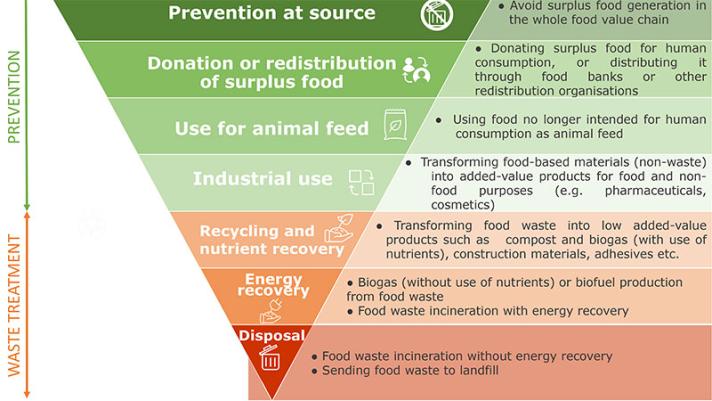
“Food use and waste hierarchy – Food Safety – European Commission” from food.ec.europa.eu and used with no modifications.
Too Good To Go vs. OLIO: Head-to-Head Comparison
Both apps are doing important work, but they solve the food waste problem from completely different directions. Understanding the practical differences between them is the fastest way to figure out which one — or which combination — actually fits your life. For more information on how these apps are helping reduce food waste, check out this blog post.
Cost: Discounted Bags vs. Completely Free Food
Too Good To Go magic bags typically cost between £2.50 and £5.99, with the value of the food inside usually ranging from three to five times what you pay. That’s a genuinely significant saving, especially if you’re picking up bags from higher-end restaurants or specialty grocers. OLIO, on the other hand, costs you absolutely nothing. Every listing is free, which makes it the clear winner on pure cost grounds — though what’s available depends entirely on what your neighbours and local businesses happen to be giving away that day.
Convenience: Collection Windows vs. Flexible Pickup
Too Good To Go operates on strict collection windows, often just 30 to 60 minutes long, typically at the end of a business’s service day. If you miss that window, you forfeit the food and the money you paid. OLIO is considerably more flexible — pickup times are negotiated directly between users, which means you can often arrange something that fits your actual schedule. For people with unpredictable routines, OLIO’s flexibility is a meaningful practical advantage.
Food Variety: Surprise Bags vs. Community Listings
With Too Good To Go, variety is built into the model — you never know exactly what you’re getting, which is exciting but can be challenging if you have specific dietary needs or restrictions. Despite being able to set dietary preferences, the “surprise” element means occasional mismatches. OLIO listings are fully visible before you claim them, so you know exactly what you’re getting. The trade-off is that selection depends entirely on what your community happens to be sharing at any given moment, which can be hit or miss depending on where you live.
Environmental Impact: Which App Saves More Waste
Both apps make a measurable dent in food waste, but they operate at different scales. Too Good To Go works with commercial businesses that produce consistent, predictable surplus daily — which means the volume of food saved through the platform is enormous and reliable. OLIO tackles the household and local business level, which is equally important given that a significant portion of total food waste originates at the consumer level rather than the retail or hospitality level.
The honest answer is that neither app is definitively “better” for the environment — they’re complementary tools targeting different points in the food waste chain. Using both together creates a much more comprehensive approach to cutting waste than either can achieve alone.
Who Should Use Too Good To Go?
Too Good To Go is the better fit for people who live near or regularly pass through areas with high concentrations of cafes, restaurants, and supermarkets. It works brilliantly for commuters who can time a collection around their regular route, or for people who enjoy the spontaneity of not knowing exactly what food they’ll get. If you eat fairly adventurously and don’t have highly restrictive dietary requirements, magic bags can become a genuinely enjoyable and cost-effective part of your weekly food routine.
Best For | Too Good To Go | OLIO |
|---|---|---|
Budget-conscious shoppers | ✓ Discounted food at 50–80% off | ✓ Completely free listings |
Flexible schedule | ✗ Strict 30–60 min collection windows | ✓ Negotiate pickup times directly |
Dietary control | ✗ Surprise bag — limited control | ✓ Full visibility before claiming |
Urban users | ✓ Large chain and independent partners | ✓ Active in dense communities |
Giving food away | ✗ Consumer-facing only | ✓ Built specifically for sharing surplus |
Environmental mission | ✓ B Corp certified, systemic advocacy | ✓ Community redistribution model |
Students and young professionals living in city centres tend to get the most out of Too Good To Go. The combination of low cost, exciting variety, and the sheer density of participating businesses in urban areas makes it an easy habit to build. Picking up a magic bag from a local sushi restaurant or artisan bakery for under £4 on your way home is a genuinely satisfying experience — and one that directly saves food from landfill every single time.
Too Good To Go is also an excellent option for anyone who enjoys cooking and wants to challenge themselves with whatever ingredients land in their bag. Think of it as a real-world version of a cooking competition — you get what you get, and figuring out how to make a great meal from it is half the fun. This mindset shift, from viewing food as a controlled purchase to seeing it as an opportunity, is one of the most useful sustainable living habits you can build.
Families with flexible meal planning can also benefit significantly. If you’re comfortable building dinners around what’s available rather than rigidly sticking to a pre-planned menu, Too Good To Go can supplement your weekly shop in a meaningful and affordable way.

“Food rescue – Wikipedia” from en.wikipedia.org and used with no modifications.
Who Should Use OLIO?
OLIO is built for people who want to actively participate in a local food-sharing community — both as givers and receivers. It suits people who often find themselves with surplus food they won’t get through, people who want to help neighbours in food-insecure situations, and anyone who prefers full transparency over what they’re receiving. The community aspect makes it especially powerful in areas where neighbours are already engaged and active on the platform.
People Facing Financial Hardship
For households managing tight food budgets, OLIO is a genuinely valuable resource. The fact that every single item listed is completely free removes the barrier that even Too Good To Go’s low prices can create for people in serious financial difficulty. OLIO’s Food Waste Heroes programme further amplifies this by channelling end-of-day supermarket surplus directly into local communities through the app, meaning the quality and volume of free food available can be surprisingly high — far beyond what most people expect from a community sharing platform.
Those With Surplus Food to Give Away
If your household regularly ends up with food you won’t use — whether that’s produce bought in bulk, leftovers from a big event, or items you’ve impulse-bought and reconsidered — OLIO gives those items a second life with almost zero effort. The listing process takes under two minutes, and in active areas, items are typically claimed within the hour.
This is particularly useful before holidays or extended trips away. Rather than watching food spoil while you’re gone or cramming everything into an already-full freezer, listing surplus items on OLIO the day before you leave is a genuinely easy, feel-good solution. It keeps food out of the bin, puts it in the hands of someone who will actually use it, and takes less time than composting would.
The Real Catch With Both Apps
Neither app is without its friction points, and being honest about the limitations is important if you’re going to actually stick with using them. Too Good To Go’s biggest practical challenge is its collection window system. Those 30 to 60 minute slots are non-negotiable — the business is closing or moving on, and your bag won’t be held indefinitely. If your journey gets delayed, you have a last-minute commitment, or you simply forget you reserved a bag, you lose both the food and the money. Building a habit of only reserving bags when you’re confident you can collect is a discipline that takes a few weeks to develop.
OLIO’s challenges are more social than logistical. The app depends entirely on the reliability and responsiveness of its users — if someone claims your food listing and then doesn’t show up, that food may still end up wasted. Equally, as a recipient, you need to be responsive when the lister contacts you and reliable enough to show up when you say you will. In less active areas, listings can also be sparse or inconsistent, which limits how much you can depend on it as a regular food source. The app works best as a community resource — the more people participate, the better it gets for everyone involved.
Too Good To Go’s Strict Collection Windows
The collection window is the single biggest practical barrier for new Too Good To Go users. Windows are typically 30 to 60 minutes long, set by the business based on when they close or when surplus becomes available. Miss it, and you forfeit both the food and the money you paid. There’s no rescheduling, no refund for no-shows, and no flexibility built into the system. The workaround is simple but requires discipline: only reserve a bag when you are already certain you can make the collection, not just fairly confident.
OLIO Requires Time, Responsiveness and Reliability
OLIO runs entirely on social trust, which means it only works as well as the people using it. If you claim a listing and don’t show up, that food may still end up in the bin — defeating the entire purpose of the app. Listers face the same challenge from the other direction: if your pickup window closes and nobody has collected, you’re back to square one. In highly active urban areas this is rarely an issue, but in quieter locations the platform can feel inconsistent. Treating OLIO like a genuine community commitment, rather than a casual browsing experience, is what makes it actually work.
Use Both Apps Together for Maximum Impact
The smartest sustainable living strategy is to stop thinking of these apps as competitors and start using them as a tag team. Use Too Good To Go for structured, reliable access to discounted food from businesses near your commute or daily routine. Use OLIO as your household overflow valve — anything you won’t get through before it turns goes straight onto a listing instead of into the bin. Together, they cover both ends of the food waste problem: what comes into your home and what leaves it. That combination is genuinely powerful, and it costs almost nothing to maintain once the habit is built.
Frequently Asked Questions
Here are the most common questions people have before committing to either app — answered directly so you can make the right call for your lifestyle.
Is Too Good To Go free to use?
Yes, downloading and registering on Too Good To Go is completely free. There are no subscription fees or membership costs involved. To learn more about food waste management, you can explore resources on food waste circularity.
The only money you spend is on the magic bags themselves, which are priced by the individual business — typically ranging from £2.50 to £5.99 per bag in the UK. Payment is handled entirely within the app before collection, so there’s no cash required at pickup. Given that the food inside is usually worth three to five times what you pay, the cost is rarely a barrier for most users.
Can you choose what food you get with Too Good To Go?
Not exactly — the “surprise” element is fundamental to how the magic bag model works. Businesses pack bags with whatever surplus they have at the end of service, which means the contents vary every single time. This unpredictability is intentional; it’s what makes the model scalable and allows businesses to participate without the logistical overhead of customising individual orders.
That said, Too Good To Go does allow users to set dietary requirements within their profile. You can filter listings to avoid businesses that don’t cater to your needs — for example, filtering out non-vegetarian options or listings that may contain allergens relevant to you. This doesn’t guarantee a perfectly tailored bag, but it does meaningfully reduce the risk of receiving food you can’t eat.
The best mindset for Too Good To Go is flexible curiosity. Users who approach magic bags as an adventure — willing to cook with whatever arrives — consistently get the most value from the app. Those with highly specific or restrictive dietary needs may find the surprise element more frustrating than exciting, in which case OLIO’s fully visible listings may be a better fit.
- Vegetarian/vegan filters — available within app preferences to narrow down participating businesses
- Allergen awareness — businesses list major allergen information where possible, but contents vary daily
- Bag type variety — some businesses offer “meal” bags (prepared food) vs. “grocery” bags (raw ingredients), which you can distinguish from the listing
- Business reviews — user reviews on each listing give a good indication of what previous magic bags from that specific business have contained
Is OLIO only for food, or can you share other items?
What You Can Share on OLIO:
• Food items — Fresh produce, packaged goods, home-cooked meals, baked goods, beverages
• Household items — Furniture, kitchenware, books, clothing, children’s toys
• Garden surplus — Homegrown vegetables, plants, seeds
• Beauty and personal care — Unopened or lightly used products
• Business surplus — End-of-day stock from partnered retailers and cafes via Food Waste Heroes
OLIO started as a food sharing app but has expanded significantly into a general community sharing platform. Today, non-food items make up a substantial portion of listings on the app, from furniture and books to clothing and children’s toys. The core ethos remains the same — giving things a second life rather than sending them to landfill — but the scope is now much broader than food alone.
For sustainable living purposes, this expansion is genuinely useful. If you’re clearing out a kitchen and replacing appliances, OLIO lets you rehome the old ones within your local community rather than sending them to a tip. The environmental logic is identical to the food sharing model: keep usable things in circulation for as long as possible.
The food sharing function remains the most active part of the platform for most users, particularly through the Food Waste Heroes programme which pipelines commercial surplus directly into community listings daily. But if you haven’t explored the non-food side of OLIO yet, it’s worth a browse — the variety of what people give away freely is often genuinely surprising.
Which app saves more money: Too Good To Go or OLIO?
OLIO saves more money in absolute terms because everything on it is free. There is no transaction involved whatsoever. Too Good To Go does involve a small upfront cost per bag — typically £2.50 to £5.99 — but delivers consistent, reliable value that’s hard to match. If your priority is maximising financial savings, OLIO wins on paper. If your priority is reliable access to quality food at dramatically reduced prices regardless of what your neighbours happen to be giving away, Too Good To Go is the more dependable option. Used together, the two apps can meaningfully reduce your weekly food spend while simultaneously cutting household waste.
Are Too Good To Go and OLIO available across the entire UK?
Too Good To Go has strong coverage across major UK cities and towns, with the densest concentration of listings in urban centres like London, Manchester, Birmingham, Edinburgh, and Bristol. Coverage in rural areas is more limited, as the app depends on businesses generating consistent daily surplus — which naturally correlates with population density. That said, the platform continues to expand its UK reach, and even mid-sized towns now frequently have active listings.
OLIO is available across the UK and tends to perform well even in smaller communities, because its model relies on individual users rather than commercial partnerships. In areas where the user base is active and engaged, OLIO can be remarkably effective even in towns where Too Good To Go has limited presence. The Food Waste Heroes programme, however, is concentrated in areas where OLIO has secured formal retail partnerships, so the volume and consistency of business surplus listings varies by location.
The honest advice is to download both apps and check your local area before making any assumptions about which will be more useful where you live. Both platforms are free to join, so there’s genuinely no downside to testing each one for a week or two and seeing which delivers more value for your specific location and routine. Your local results will tell you far more than any generalised coverage map ever could. And if you want to take your food waste reduction even further, exploring services like Oddbox — which rescues surplus and wonky produce directly from farms — adds another powerful layer to a genuinely sustainable food habit.
Reducing food waste is a critical step in promoting sustainability and conserving resources. Apps like Too Good To Go and OLIO are making significant strides in this area by connecting users with surplus food that would otherwise go to waste. These platforms not only help reduce waste but also provide affordable food options for consumers. For more insights on how these apps are helping in the fight against food waste, check out this blog on food waste apps.
Discover more from IPPTS Depackaging Equipment Insights
Subscribe to get the latest posts sent to your email.