Microplastic contamination, machine jamming, and excessive organic loss are typical issues with depackaging equipment. These problems are often caused by strong mechanical forces that chop up packing into pieces instead of separating it cleanly.
Summary of the Article
- Contamination of microplastics in organic output is one of the most serious and least-monitored risks of mechanical depackaging — and the machine you choose determines how bad it gets.
- The difference between a 95% and a 99%+ organic capture rate translates directly into lost revenue and downstream compost quality issues that compound over time.
- Difficult packaging types — rigid HDPE containers, multilayer films, and vacuum-sealed trays — are responsible for the majority of unplanned downtime at depackaging facilities.
- Most compliance gaps operators face aren’t from breaking rules — they come from operating in a regulatory grey zone where no clear measurement protocols exist yet.
- The single most common mistake operators make is running mixed waste streams through a machine configuration built for a single stream type — keep reading to find out how leading facilities fix this.
Most depackaging equipment problems don’t announce themselves — they quietly drain throughput, contaminate outputs, and create compliance headaches until someone finally runs the numbers.
The organics recycling industry has been booming with the adoption of mechanical depackaging. Previously, facilities would only use source-separated organics, but now they’re processing hundreds of tons of packaged food waste daily through depackaging systems. Companies such as Drycake Twister and Mavitec have been leading this shift by developing equipment designed to separate organic material from packaging without milling or shredding it into microplastic fragments. However, even the best equipment can cause problems if it’s not applied, configured, or maintained correctly.
It’s not always the case that the best operators are using the most expensive equipment. What sets them apart is their understanding of where and how failures can occur, and their implementation of systems to prevent these failures. In this article, we’ll be looking at the seven most common issues with depackaging equipment and how the best in the business deal with them.
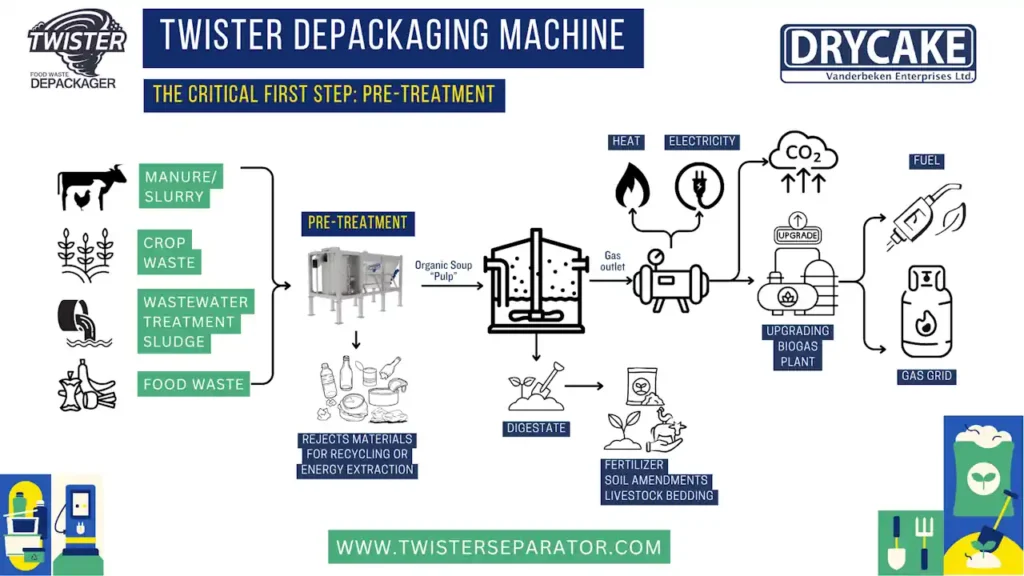
“What Is Depackaging” from wastersblog.com and used with no modifications.
The Real Cost of Depackaging Equipment Failure
When depackaging equipment doesn’t perform as it should, the losses are extensive and far-reaching. A decrease in organic capture results in less slurry for the digester or composter, and the quality of the slurry is also reduced. Packaging contamination means more rejections further down the line. Unplanned downtime adds up, resulting in a considerable loss of processing capacity. There’s also the risk of regulatory exposure, which can put operating permits in jeopardy, especially with state-level oversight becoming more stringent.
These problems can be especially expensive because many operators don’t measure them accurately enough to see the full extent of the issue. For example, a facility that processes 50 tons per day with a 95% organic capture rate is losing 2.5 tons of recoverable organics every day. When you consider typical tipping fees and avoided disposal costs, that’s a significant financial loss — every single day.
1. Contamination of Microplastics in the Organic Output
Currently, the industry is trying to solve this problem. Mechanical depackaging naturally combines food waste with plastic packaging under mechanical force. The question is not whether plastic ends up in the organic slurry. The question is how much and in what form.
The Issue with Overusing Force
Separating food contents from packaging is a quick process when machines use harsh shredding, milling, or other strong mechanical forces. However, this approach has its downsides. Brittle plastics, such as PVC, and hard plastics such as high-density polyethylene (HDPE) and polypropylene break when subjected to high mechanical stress. This creates fragments small enough to pass through screens downstream and into the organic slurry. Microplastics then make their way into the slurry, then into compost or digestate, and ultimately into the soil.
The main problem is that applying more force doesn’t necessarily result in better separation. Instead, it leads to more fragmentation. More fragments increase the surface area, to which organics obstinately adhere. The best equipment designs focus on controlled mechanical action. The goal is to apply enough force to open the packaging and release the organic contents without destroying the integrity of the packaging. This distinction is crucial for the quality of the output.
Minimising Plastic Fragmentation with Modern Equipment Design
The best depackaging systems employ a mix of mechanical action, controlled paddle geometry, and progressive separation instead of just brute-force shredding. The aim is to open packaging along its natural seams and weak points, which allows the organic material to be released while keeping the packaging pieces large enough to be effectively screened out. Machines that are designed with this approach, including those used in high-throughput European anaerobic digestion facilities, consistently yield cleaner slurries with a “rejects” stream of larger, more recoverable packaging remnants.
What Operators Look for to Check Contamination Levels
This is one area where the industry is seriously lacking. Currently, there is no standard measurement protocol for microplastics in depackaged organic slurries, compost, or digestate. BioCycle’s research found that only a few facilities that use depackagers are subject to contaminant limits in their slurried food waste output. Until standard lab-based protocols are adopted, top operators rely on:
- Visual screening of output slurry for visible plastic fragments above a defined size threshold
- Screen aperture audits to confirm downstream separation equipment is functioning correctly
- Periodic third-party testing of compost or digestate end products for plastic content
- Equipment manufacturer guidelines for maximum input packaging ratios and material types
2. Poor Organic Capture Rates Killing Throughput Value
Organic capture rate is the percentage of food content successfully separated from packaging and recovered in the output slurry. It sounds like a simple metric, but it’s one of the most impactful numbers in the entire operation. The difference between running at 95% versus 99%+ capture isn’t marginal — it compounds across every ton processed.
There are a few reasons why you might experience capture rate losses, including the wrong sieve size for the incoming stream, worn or misaligned paddles, the wrong amount of moisture, or processing packaging types that the machine wasn’t designed to handle. Each of these problems has a solution, but only if operators are keeping a close enough eye on the capture rate to notice the problem.
How Real Numbers Reflect the Gap Between 95% and 99%+ Capture Rates
Imagine a facility that handles 100 tons of packaged food waste every day. Assume that the ratio of food to packaging by weight averages out to 80:20. This means that there are about 80 tons of recoverable organics in each day’s input. Here’s what the differences in capture rates look like at that volume:
| Rate of Capture | Organics Retrieved (tons/day) | Organics Missed (tons/day) | Loss Over a Year (tons) |
|---|---|---|---|
| 95% | 76 | 4 | 1,460 |
| 97% | 77.6 | 2.4 | 876 |
| 99% | 79.2 | 0.8 | 292 |
The organics that go missing don’t just vanish — they usually go out with the packaging portion, raising the contamination level of the separated packaging and lowering its ability to be recycled. The downstream effects impact two revenue streams at the same time.
Less organic slurry means less biogas income, and at an assumed minimum of €150 per tonne EU total cost for landfill disposal or incineration, the disposal cost would vary between €219,000 and €43,800. Except that at 97% capture rates and higher, there is a good chance that incineration as a fuel for its calorific value becomes possible, reducing the gate fee below landfill disposal rates.
The Influence of Paddle Angle and Screen (Sieve) Size on Recovery
The design of the paddle is a key factor in how forcefully the contents are removed from their packaging during the process. A more acute paddle angle increases the mechanical action and can enhance capture rates for dense or viscous food products like peanut butter, sauces, or wet pet food, but it also increases the risk of breaking fragile packaging. The size of the sieve’s holes (screen size) determines what goes into the organic stream versus what goes with the packaging fraction. Using a sieve that’s too small for the incoming stream type causes organic material to be rejected with the packaging, directly reducing the capture rate.
3. Equipment Downtime Due to Challenging Packaging Types
Unscheduled downtime is the most common operational issue mentioned by depackaging facility managers — and the main culprit is usually the same: a type of packaging that the machine wasn’t set up or built to process efficiently has been put into the machine.
Most Problematic Packaging Materials
Not all packaging is created equal. From hands-on experience in high-volume facilities, it’s clear which materials cause the most issues:
- Stiff HDPE and polypropylene containers — these don’t yield under mechanical pressure; they break and produce sharp pieces that scrape internal machine surfaces and clog screens
- Multilayer flexible films — these get tangled around mechanical parts, build up, and cause drive motor overloads if not cleaned regularly
- Stiff Vacuum-sealed trays with lidding film — the combination of a stiff base and a tightly bonded flexible top creates separation resistance that standard paddle configurations have difficulty with
- Glass packaging — any leftover glass in the input stream is an immediate equipment hazard for many depackager designs, causing accelerated wear on screens and paddles
- Foil-laminated pouches — the foil layer resists ripping in ways that standard films don’t, increasing the chance of entire pouches bypassing separation
Operational Changes Top Facilities Implement Before Processing
The most effective action takes place before a single ton enters the machine. Top facilities put in place an incoming stream inspection protocol that flags problematic packaging types at the receiving dock. When a load arrives with large amounts of stiff HDPE containers or vacuum-sealed trays, operators may either pre-sort those items out by hand or change machine settings before processing starts. This pre-processing audit adds time at the beginning but consistently reduces mid-run clogs and the expensive full shutdowns that come after them.
Many facilities employ a basic visual grading system upon receipt, ranking incoming loads on a scale of 1 to 3 based on the complexity of the packaging, and directing loads with a higher complexity to processing windows when maintenance personnel are present. This is a low-tech solution that has a tangible effect on the frequency of unexpected downtime. For more information on how this process is streamlined, you can explore depackaging and separation techniques.
How Regular Maintenance Schedules Reduce Unplanned Downtime
Recommended Maintenance Intervals for High-Volume Depackaging Operations
Daily: Inspect and clear the screen, visually check paddle surface, log drive motor temperature, sample slurry output for visible packaging fragments
Weekly: Remove and clean the entire screen, measure paddle wear against baseline spec, check bearing lubrication, inspect seal integrity
Monthly: Lockout machine and conduct a full internal inspection, assess paddle replacement, verify sieve aperture against target spec, check drive belt tension and wear
Quarterly: Have a certified technician conduct a complete mechanical audit, reconcile wear part inventory, check for manufacturer firmware/software updates, review throughput performance against baseline KPIs
The facilities with the lowest rates of unplanned downtime all have one thing in common: they view maintenance as a production activity, not as a response to failure. They plan scheduled downtime for maintenance into the weekly processing schedule just like they plan tonnage targets. When maintenance windows are seen as optional, they get skipped. And the cost of skipping them shows up later in the form of emergency repairs during peak processing times.
For some rotating paddle designs, operators don’t pay enough attention to paddle wear. Even a few millimetres of wear on the surface profile of a paddle in some depackager models can result in noticeably lower organic capture rates and higher packaging fragmentation. Reportedly, this can happen before the wear is even visible. Always follow the manufacturer’s instructions when they recommend that users regularly measure the paddle geometry each month and compare it to the manufacturer’s baseline specifications. This can catch any degradation early. This allows them to replace components on schedule rather than waiting for them to fail. For more information on improving organic capture rates, explore organic waste depackaging machines.
Another factor that contributes to downtime is the management of parts inventory. Even if a facility has a strict maintenance schedule, if it doesn’t keep critical wear parts like screens, paddles, seals, and drive belts in stock, it will still have to deal with long shutdowns if a part unexpectedly fails. Top operators keep a minimum on-hand inventory of all parts that take more than a week to get, and they review and restock this inventory every quarter.
4. Excessive Dependence on Manual Sorting Before Depackaging
It’s not uncommon for facilities to manually sort items before depackaging, and in some situations, it can be beneficial. However, many facilities have created operational processes that rely too heavily on manual labour. This level of dependence is simply not sustainable, and the throughput figures clearly demonstrate the issue.
When Manual Pre-Sorting Is Still a Good Idea
Manual sorting still has a role to play in the early stages of depackaging operations for specific tasks that are of high value: removing glass containers that could cause damage to the equipment, taking out items that are clearly not food and should not be in the stream in the first place, and identifying loads that have been mislabeled by the generator. These are tasks that require judgment, and a trained worker can really add value here. The problem comes when manual sorting is used as the main way to achieve packaging separation or organic purity — tasks that mechanical systems can perform more consistently, with higher throughput, and at a lower cost per ton.
The Point at Which Manual Labour Becomes the Limiting Factor in Throughput Volume
The specific point at which this occurs can vary depending on the type of stream, but the operational pattern is always the same. When dealing with volumes of roughly 10 to 15 tons per day or less, a small, highly trained manual sorting team can significantly improve output quality without slowing down throughput. However, when volumes exceed this amount, the use of manual labour in the pre-sort stage becomes a limiting factor that slows down the rate at which the depackager can be fed. Furthermore, the cost per ton of manual sorting increases linearly, while the throughput of mechanical processes increases exponentially with equipment upgrades.
It’s clear from the experiences of facilities that have transitioned from manual-heavy to mechanically-led preprocessing that the benefits are significant: increased throughput, more consistent output quality, and reduced labour costs per ton processed. The transition does require an initial capital investment in equipment setup and staff retraining, but for any facility processing more than 20 tons per day, the numbers quickly add up.
5. Using Incompatible Machine Configurations for Mixed Streams
One of the most frequent and preventable reasons for substandard depackaging performance is using the wrong machine configuration for a particular stream. This often occurs when facilities agree to new waste generator contracts without first assessing the packaging composition of the incoming stream, or when equipment settings do not adjust to accommodate seasonal changes in food waste composition.
What happens is that a machine that has been optimised for one type of stream ends up processing another. Paddle angles and sieve sizes that have been calibrated for soft retail bakery waste will perform quite differently when the input is switched to rigid-packaged wet pet food or vacuum-sealed deli meats. The rate of organic capture decreases, the fragmentation of packaging increases, and operators often attribute the decline in performance to wear and tear on the equipment rather than to a mismatch in configuration.
The Problem with a One-Size-Fits-All Approach to Machine Setup
Food waste streams are not created equal. The physical characteristics of the waste can vary greatly — from moisture content to food-to-packaging ratio, packaging rigidity, and average package size. All these factors can affect the performance of a depackager. A setup that works well for high-moisture retail food waste with mostly flexible film packaging may not work as well for dry goods in rigid containers. The mechanical action needed to separate dense, low-moisture food content from rigid packaging is quite different from what’s needed to recover a high-moisture sauce or liquid product from a flexible pouch.
How Facilities Determine the Right Settings for New Waste Streams
Before a facility accepts a new waste stream from a generator, they perform a stream characterisation audit. This audit involves taking a sample from a representative load, manually sorting it into different packaging categories, recording the food-to-packaging ratio by weight, and noting the distribution of packaging types — flexible film, rigid plastic, foil laminate, paper-based, etc. This information is used to determine the appropriate sieve aperture size, paddle configuration, and water addition rate for processing the stream. The audit typically takes two to four hours for an experienced operator, but it can prevent weeks of suboptimal performance.
Adjusting for Changes in Stream Due to Seasons or Generators
The composition of a stream is not constant. In the summer, grocery retail generators move from streams heavy in fresh produce to streams of more packaged processed food waste in the winter. Food manufacturing generators alter their output based on their production schedules. Facilities that set their machine configuration once at the start of a generator contract and never look at it again are almost certainly operating sub-optimally for a significant part of the year. At high-performing facilities, the standard practice is to conduct a quarterly stream audit for each major generator and review and adjust the machine configuration as necessary.
6. Recyclable Packaging That Is Too Wet or Dirty to Process
Depackaging doesn’t just yield organic material — it also yields a fraction of packaging that, in theory, can be recycled. In reality, this value often goes untapped because the separated packaging comes out of the machine too wet, too dirty with organic residue, or too broken up to be accepted by recycling facilities.
How the Cleanliness of Packaging Impacts Its Resale Value
Material recovery facilities and plastic recyclers have stringent contamination limits. If packaging contains more than a specific percentage of organic residue — usually determined by visible food contamination and moisture content — it is either outright rejected or accepted at a substantial discount that removes the material’s economic value. The cleanliness of the packaging fraction that a depackager produces is not just a matter of aesthetics; it directly affects whether the separated packaging generates income from recycling and, if not, has a high enough calorific value to be classified as RDF or SRF. If it breaks even at disposal cost, or becomes a net liability.
Adding water during depackaging enhances the pumpability of organic slurry but also increases the moisture content of the packaging fraction. This is a common issue. The most successful facilities handle this balance consciously. They use the least amount of water necessary to achieve the desired slurry consistency. They also send the packaging fraction through a dedicated drainage step before it gets to the output conveyor. For more insights, explore organic waste depackaging machines and their efficiency in handling such challenges.
Organic residue contamination on packaging is a separate but related issue. Machines that achieve high organic capture rates — recovering 99%+ of food content into the slurry — inherently produce cleaner packaging fractions, because there’s less food residue left on the packaging surface. This is another reason capture rate optimisation benefits two output streams simultaneously: a cleaner organic slurry and a cleaner, more recyclable packaging fraction.
How Some Operators Use Downstream Drying and Sorting Steps
When the packaging fraction leaves the depackager, the best facilities guide it through a dedicated drainage conveyor. This is usually an inclined screw conveyor or vibrating drainage deck. It goes here before it gets to any storage or transport container. This one step can lower packaging fraction moisture content by 15 to 25 percentage points. Often, this is the difference between a material that meets MRF acceptance criteria and one that doesn’t.
Several facilities introduce a secondary trommel or air classification stage after drainage to get rid of small organic particles that are still stuck to the packaging surfaces. This is especially useful when dealing with high-sugar or high-fat food streams like jams, sauces, and oils, where the residue sticks the most. The extra capital cost of a drainage conveyor and secondary screening stage is usually recouped within six to twelve months due to the improved value of the packaging fraction and lower disposal costs.
7. Regulatory and Compliance Gaps That Operators Miss
The regulatory landscape for mechanical depackaging is changing more quickly than many operators can keep up with. What was once a largely unregulated preprocessing step is now coming under increasing scrutiny from state environmental agencies, compost quality certification bodies, and municipal procurement standards that set maximum allowable levels of contaminants in compost end products.
The main issue with compliance is that the rules are scattered, inconsistent, and in many jurisdictions, still not fully established. There isn’t a federal framework that specifically regulates depackaging operations. Instead, there is a hodgepodge of state-level solid waste regulations, compost quality standards, and anaerobic digestion permitting requirements that together form a compliance environment that’s hard to manoeuvre without active monitoring.
The biggest compliance issue that remains unsolved in the industry is the lack of measurement for microplastics. BioCycle’s research discovered that only a few facilities that operate depackagers are currently subject to specific contaminant limits in slurried food waste output. Even those limits depend on visual inspection instead of standardised lab-based measurement protocols. This results in a situation where operators may think they are compliant because there is no official measurement standard, but their organic output contains microplastic levels that will likely be restricted by future regulations.
What this means in practice is that operators who aren’t currently taking the initiative to measure and document their output quality are failing to build a foundation of baseline data for the inevitable regulatory environment. When these standards are finally put into place, which is a matter of when rather than if considering the path of state-level regulation, facilities that have been keeping track of their quality histories will have a much stronger footing in terms of compliance than those who are starting from scratch.
- California — SB 1383 implementation is driving rapid depackaging adoption while simultaneously tightening compost contamination standards; operators must meet specific physical contaminant limits in finished compost
- Massachusetts — The Commercial Food Material Disposal Ban has accelerated depackaging infrastructure deployment, but compost quality oversight varies significantly by composting facility permit
- New York — Emerging organic waste mandates are creating new depackaging demand, with compost quality standards still being refined at the state level
- Connecticut — Has moved toward integrated food waste processing with depackaging requirements built into facility permits, representing one of the more structured state frameworks currently in place
- Depackaging Equipment Problems in Most Other States — Operating under general solid waste and compost regulations not written with mechanical depackaging in mind, creating genuine ambiguity about compliance requirements
How State-Level Depackaging Regulations Differ Across the U.S.
The states with the most developed regulatory frameworks — California, Massachusetts, Connecticut — have generally arrived at depackaging-specific oversight through a combination of food waste diversion mandates and compost quality standards. The compliance requirements flow from two directions simultaneously: mandates pushing more food waste into depackaging systems, and quality standards limiting what contaminant levels are acceptable in the end products those systems produce. Operators in these states face the most defined compliance environment, but also the most clearly mapped path to meeting requirements. Operators in states without specific frameworks face a different challenge — operating in a grey zone where the absence of explicit rules doesn’t mean absence of future liability.
Long-Term Risks for Facilities Lacking Proactive Oversight
Facilities that operate without proactive quality oversight run the risk of regulatory retroactivity in the long term. As the regulatory trajectory strongly suggests, states will formalise compost contaminant standards specific to depackaging. Facilities that have been monitoring output quality and recording results will have baseline data. This data will show that their processes meet or are close to meeting the upcoming standards. Facilities that have not been doing this will immediately face a compliance gap that could be costly.
There is also a depackaging equipment problem business risk that operates independently of formal regulation. Compost buyers — municipalities, agricultural operations, landscaping companies — are increasingly specifying maximum plastic contaminant levels in procurement contracts. Facilities whose compost contains detectable microplastic levels are being excluded from higher-value markets regardless of whether they are technically in regulatory compliance. The commercial pressure is arriving ahead of the regulatory pressure in many markets.
The third most commonly underestimated risk by operators is insurance and liability exposure. As the research linking depackaging operations to microplastic soil contamination progresses, facilities that have knowingly operated without quality measurement protocols will be confronted with increasingly complex liability issues. Operators who can provide documentation of a consistent quality monitoring program, even if it’s flawed and based on current best practices, are in a significantly better legal position than those with no documentation at all.
Depackaging Operators: A Compliance Action Checklist
Immediate (0-30 days):
• Use available visual inspection methods to document the current quality baseline of your output
• Review your state’s solid waste and compost regulations for language specific to depackaging
• Check compost or digestate end product buyer contracts for contaminant specificationsShort-Term (30-90 days):
• Arrange for periodic third-party testing of the plastic content in compost or digestate output
• Implement a protocol for auditing incoming streams and link the results to machine configuration records
• Review the guidance from your equipment manufacturer on minimizing microplastics and document the compliance steps you’ve takenOngoing:
• Monitor state regulatory developments quarterly — changes in California and Massachusetts often signal the direction of the nation
• Keep a continuous log of output quality with dates, stream sources, and test results
• Participate in industry groups like BioCycle and NRDC that are working on the development of a standardized measurement protocol
Common Queries About Depackaging Equipment Problems
Those assessing the performance of depackaging equipment often have a number of similar queries — and the responses are more detailed than the usual advice implies. Here are the most critical ones tackled head-on, including insights into organic waste depackaging machines.
Facilities that fully comprehend the failure modes and have specific operational responses for each are the ones that get the most out of their depackaging investments. Those that don’t continue to suffer avoidable losses.
What is the major contamination risk with mechanical depackaging equipment?
A major depackaging equipment problems contamination risk is the creation of microplastics from too much mechanical force used on rigid or brittle packaging materials. When machines break HDPE, polypropylene, or foil-laminated packaging instead of opening it along natural seam lines, the resulting fragments are small enough to pass through downstream screens and enter the organic slurry. Those microplastics then move into compost or digestate and ultimately into soil. The risk is highest with machines designed around high-speed shredding rather than low-speed controlled mechanical separation.
What are the secrets to a 99%+ organic capture rate for top operators?
Three factors must be in sync to achieve high capture rates: the sieve aperture size must be appropriate for the type of incoming stream, the paddle geometry must be suitable for the density of the food product and the packaging format being processed, and the water addition rates must be set to maintain the desired slurry consistency. Operators who consistently achieve 99%+ capture rates regularly audit their incoming streams before processing, adjust the settings on their machines as needed, check the wear on their paddles monthly against the manufacturer’s baseline specs, and replace worn components on schedule rather than waiting for them to fail. Capture rate is treated as a key performance indicator (KPI) that is tracked in production and reviewed on a weekly basis, rather than being estimated quarterly.
Is it possible for one depackaging machine to handle all kinds of food packaging?
While it’s true that one machine can handle a wide range of packaging types, it can’t do so with just one fixed setup. The mechanical adjustments that work best for flexible film packaging on soft retail food waste are quite different from what’s needed for rigid HDPE containers or vacuum-sealed trays. One of the most frequent reasons for low capture rates and high packaging fragmentation is running configurations that don’t match.
Some facilities that handle high volumes and multiple stream types at the same time choose to invest in two or more machines. Each machine is set up for a different category of stream. This way, they don’t have to try to find a single setup that can handle everything okay, but nothing really well.
How frequently should depackaging equipment be serviced to avoid downtime?
High-performing facilities employ a maintenance schedule that includes daily screen inspection and clearing, weekly full screen removal and cleaning, monthly paddle wear measurement and mechanical checks, and quarterly full mechanical audits by a certified technician. For more details on the importance of maintenance, you can explore US regulations on food waste depackaging equipment.
Can depackaging equipment produce clean enough packaging to be recycled?
The cleanliness of the separated packaging is entirely dependent on how the depackaging machine is set up and operated. The cleanliness of packaging fractions is directly affected by the organic capture rate. If a machine recovers more than 99% of food content into the organic slurry, there will be very little residue left on the packaging surfaces. However, if a machine is only capturing 95%, it will leave four times more organic residue on the packaging. This residue will accumulate moisture, create odour, and push the packaging fraction above contamination thresholds.
Another barrier to recyclability is packaging fragmentation. Machines that break down rigid packaging into tiny pieces produce a mixed-size packaging output that is hard to sort, doesn’t meet standard bale specifications, and is largely unrecyclable regardless of cleanliness. Equipment designed to keep packaging pieces intact — opening along seams rather than breaking under impact — produces a packaging fraction that can be physically sorted and potentially baled for commodity sale.
When these three components are in place, the packaging fraction can change from a disposal cost to a small revenue stream. For Tiger Depack, their primary goal is to help operators achieve this through their carefully engineered separation technology. For more insights on how depackaging technology addresses contamination issues, you can read about depackaging technology tackling contamination.
Discover more from IPPTS Depackaging Equipment Insights
Subscribe to get the latest posts sent to your email.