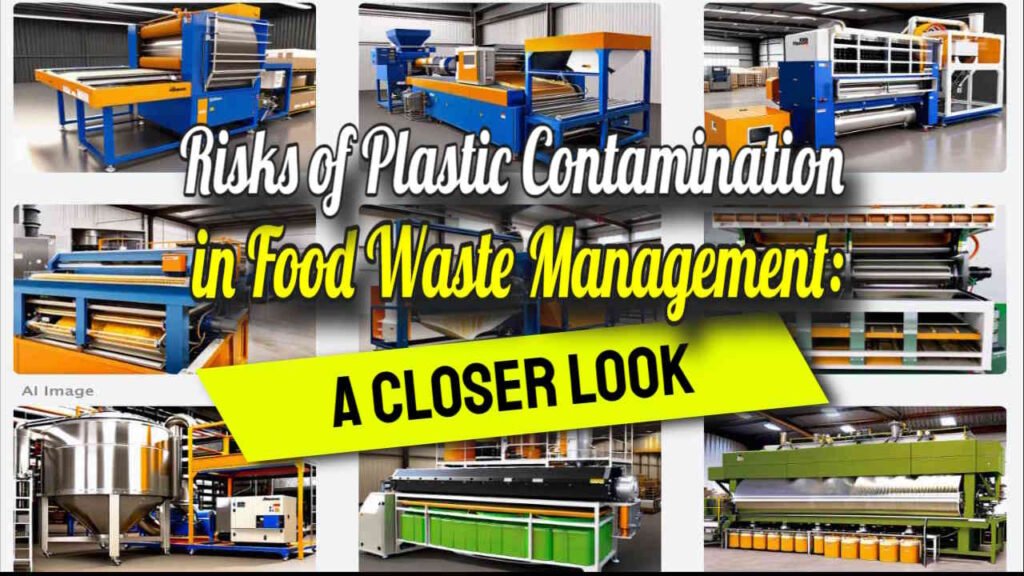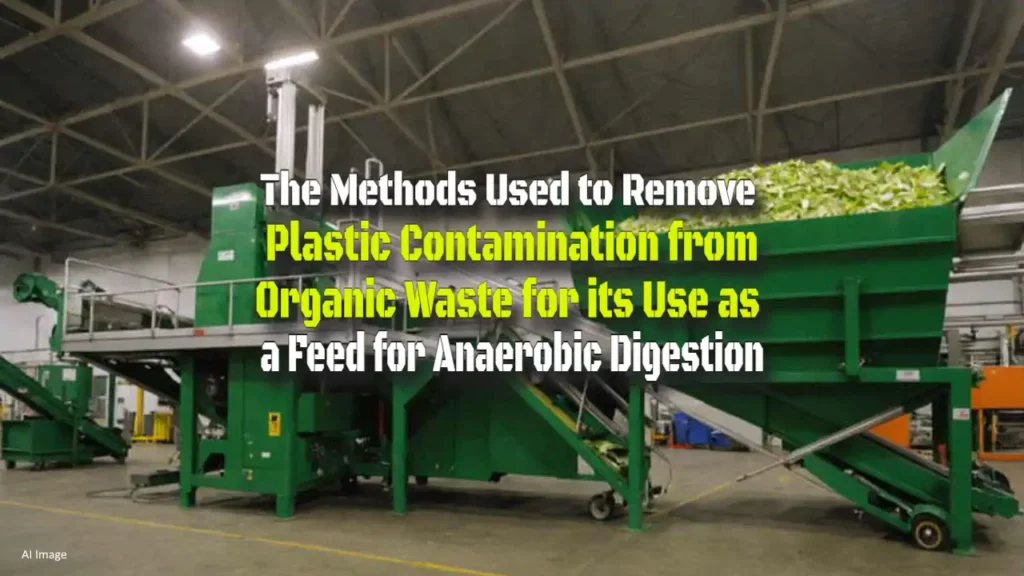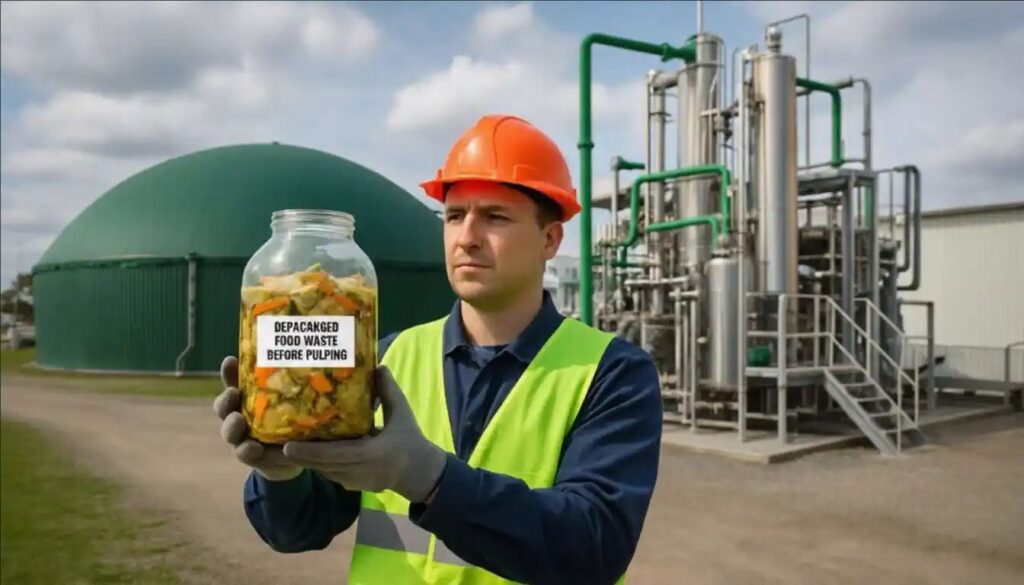
Food waste is converted into renewable energy primarily through Anaerobic Digestion (AD) and the use of depackaging equipment. In this process, microorganisms break down organic food matter in sealed, oxygen-free tanks. This produces methane-rich biogas for electricity and heating, and a nutrient-rich sludge used as agricultural fertiliser.
For the efficient transformation of kitchen scraps into power, there is a need for machines that follow a highly efficient, closed-loop process. Food waste is collected and then must be sorted to remove any contaminants (like plastics and packaging), and blended into a dry organics-only slurry. That’s where depackaging equipment is essential
Summary
- Food waste is the third-largest source of greenhouse gas emissions worldwide, producing 3.3 billion tonnes of greenhouse gases annually. However, it can be converted into usable energy.
- There are several established technologies for converting food waste into energy, including anaerobic digestion, pyrolysis, gasification, and fermentation.
- Processing just 100 tons of food waste per day through anaerobic digestion can generate enough renewable electricity to power up to 1,400 households each year.
- One conversion method is the most efficient and widely scalable, and it might surprise you to learn which communities are already using it.
- HomeBiogas provides accessible, home-scale biodigester systems that allow ordinary households to convert kitchen waste into cooking fuel and biofertilizer.
Every time you throw away a banana peel or leftover dinner, you’re throwing away something that could be used to power a home.
Food waste is often seen as just that — waste. Something that we discard without thinking twice about. But the truth is, food waste is a resource that is grossly underutilized and misunderstood. When we throw away our food, it typically ends up in a landfill where it decomposes without oxygen. This process produces methane, a greenhouse gas that is 28 times more powerful than carbon dioxide over a 100-year span. The environmental impact is astounding, especially considering that we are essentially throwing this resource away.
Fortunately, the organic material that is causing harm to the environment can be repurposed into a real energy source. HomeBiogas is a company that is making this possible on a household level by providing biodigester systems that turn kitchen waste into clean cooking gas and liquid fertilizer. This idea becomes truly fascinating when you consider scaling it from a backyard to an entire city.
Why the Global Energy Crisis is Caused by Food Waste
The sheer magnitude of the food waste issue is hard to comprehend. Around the world, about one-third of all food made for human consumption is lost or wasted annually. This waste isn’t just a waste of resources like water, land, and work – it becomes an active environmental hazard as soon as it reaches a landfill.

“Global food waste has become an …” from www.digitaljournal.com and used with no modifications.
3.3 Billion Tonnes of Greenhouse Gases Produced by Food Waste Every Year
As per the Food and Agriculture Organization (FAO), 3.3 billion tonnes of greenhouse gases are released into the atmosphere every year due to food waste. This makes food waste the third largest emitter of greenhouse gases globally if it were considered a country. The majority of these emissions come from organic matter decomposing in landfills and releasing methane. Even a small reduction in this waste could have a significant effect on global emission targets if it were redirected into energy systems.
How Landfills Exacerbate the Issue
Landfills are devoid of oxygen, creating an anaerobic environment. When food waste decomposes in this setting, it doesn’t decompose neatly. Instead, it produces landfill gas, a mix that is about 50% methane and 50% carbon dioxide. Without systems to capture it, that gas is released straight into the atmosphere.
From a sustainability perspective, this is particularly vexing because it is entirely avoidable. Food waste has chemical energy trapped within organic compounds. The whole problem — and opportunity — is to discover effective methods to extract that energy before the waste ever ends up in a landfill.
Turning Food Waste Into Energy: The Process
The process of turning food waste into energy isn’t a one-size-fits-all solution. There are various technologies available, each suited to different scales, types of waste, and energy objectives. Knowing how each one functions can help determine which systems are best for residential, municipal, or industrial use.
First and foremost, all of these methods have the same central aim — to harness the chemical energy contained in organic matter and transform it into something useful, such as electricity, heat, fuel, or gas. For a deeper understanding of these processes, explore various food waste valorisation strategies.
The Most Common Method: Anaerobic Digestion
Anaerobic digestion (AD) is a process that uses microbes to break down organic matter in an environment without oxygen. This process is similar to what happens in a landfill, but it’s done in a controlled environment where the biogas that’s produced can be captured. This biogas, which is mostly methane, can then be used to generate electricity and heat, or it can be upgraded to biomethane and used as a substitute for natural gas.
There are some staggering statistics when it comes to AD. The Environmental and Energy Study Institute (EESI) has found that if you were to process 100 tons of food waste every day through anaerobic digestion, you could produce enough renewable energy to provide electricity for 1,400 households for a year. Biodigesters that are designed for home use operate on the same principle. They are designed for daily kitchen scraps and can produce enough biogas for cooking. They also create nutrient-rich liquid biofertilizer as a byproduct. For more insights, you can explore how food waste is converted to energy effectively.
Thermal Conversion: Pyrolysis and Gasification
Thermal conversion methods use high temperatures to convert food waste into energy-rich products. Pyrolysis heats organic material without oxygen, resulting in bio-oil, syngas, and biochar. Gasification uses limited oxygen at very high temperatures, transforming waste into syngas — a combination of hydrogen and carbon monoxide that can be used for electricity generation or converted into liquid fuels. Both methods are highly adaptable and can process agricultural waste, food waste, and a wide range of organic materials.
Turning Food Waste into Bioethanol Through Fermentation
Microorganisms are used in fermentation to turn the sugars in food waste, especially fruit and vegetable waste, into bioethanol. This biofuel can be used as a replacement for traditional gasoline in transportation or used in industrial processes. There is a growing interest in the scientific community in optimizing fermentation pathways for different food waste streams, as seen in research found on platforms like Google Scholar under “Fruits and Vegetable Waste to Energy Generation”.
Landfill Gas Collection Systems
Instead of stopping landfill gas from forming, collection systems trap it after it’s formed. Holes are dug into existing landfills, and the gas, which is rich in methane, is piped out, cleaned, and used to produce electricity or heat. Although this method doesn’t solve the landfill problem, it’s a feasible solution for the billions of tons of food waste that are already in active and closed landfill sites around the world.
Landfill gas recovery is especially important in areas where waste diversion from landfills is still a distant goal. It gets something useful from an existing problem instead of waiting for infrastructure changes to catch up.
Incineration
Incineration involves burning food waste at high temperatures to produce steam, which powers turbines and generates electricity. The latest waste-to-energy incineration facilities come with emission control systems to minimize air pollution. Although incineration is less popular than anaerobic digestion from a circular economy standpoint — it doesn’t recover nutrients — it’s still a common method for managing large amounts of mixed municipal waste in countries such as Japan, Sweden, and Denmark.
“Energy Conversion Technologies …” from link.springer.com and used with no modifications.
Types of Energy Produced From Food Waste
| Method of Conversion | Main Energy Product | Additional Product | Most Suitable Scale |
|---|---|---|---|
| Anaerobic Digestion | Biogas / Biomethane | Biofertilizer in Liquid Form | From Home to Industrial |
| Pyrolysis | Bio-oil / Syngas | Biochar | Industrial |
| Gasification | Syngas | Heat | Industrial |
| Fermentation | Bioethanol | Biopolymers | Industrial |
| Incineration | Electricity / Heat | Ash | Municipal |
| Landfill Gas Recovery | Methane / Electricity | Carbon dioxide | Municipal |
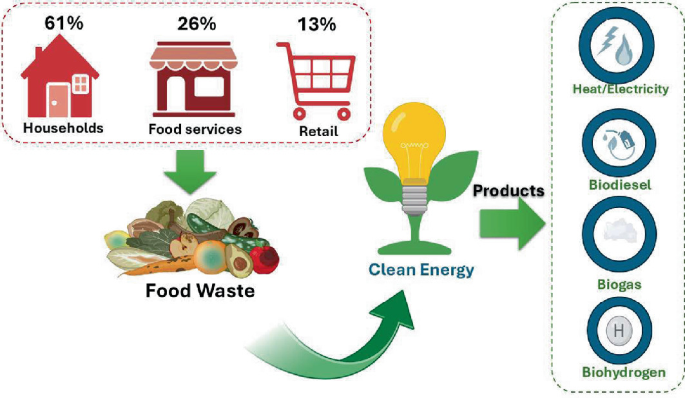
The energy products derived from food waste are more varied than most people would think. Depending on the technology used and the kind of waste being treated, food waste can produce gaseous fuels, biofuels in liquid form, solid fuel materials, and direct electricity. Each of these has its own uses and efficiency. Learn more about food waste recycling equipment that can aid in this conversion process.
The reason food waste is so beneficial as a feedstock is because of its high moisture content and rich organic composition. Fruit and vegetable waste, cooked food scraps, and dairy byproducts all contain a lot of caloric energy trapped in their molecular structure. The right conversion process can unlock that energy in a form that’s immediately usable.
A study published in Waste Management (2015) on converting food waste into energy found that the most environmentally and economically beneficial methods are those that minimize energy loss. This means that the closer the conversion process is to the source of the waste, the more efficient the system tends to be.
Using Biogas and Biomethane for Power and Heat
Biogas is the most straightforward and easily obtained energy product from food waste. It is created through anaerobic digestion and raw biogas is a combination of roughly 50–70% methane and the rest is mostly carbon dioxide. At this point, it can be directly burned in combined heat and power (CHP) units to generate electricity and thermal energy at the same time — making it one of the most efficient ways to use the fuel.
When we further refine biogas by removing carbon dioxide and other trace gases, it becomes biomethane — a gas that is virtually identical to conventional natural gas. Biomethane can be injected directly into existing gas grid infrastructure, used as vehicle fuel, or stored for on-demand energy generation. This upgradeability makes the outputs of anaerobic digestion especially valuable for communities trying to decarbonize existing energy systems without having to build entirely new infrastructure.
Alternative Biofuels to Conventional Natural Gas
In addition to biogas, fermentation processes can transform food waste streams rich in sugar into bioethanol, a liquid biofuel that can be used directly in transportation. Fruit waste, stale bread, and byproducts of the beverage industry are especially suitable for this process because of their high fermentable sugar content. Waste-to-liquid conversion processes can also produce biofuels designed to match the energy density of conventional natural gas, providing a direct replacement that does not require changes to the engine or infrastructure.
Using Heat to Create Syngas and Biochar
Heating methods like pyrolysis and gasification create syngas — a fuel gas that can be used in a variety of ways and is composed of hydrogen and carbon monoxide — and biochar, a solid that is rich in carbon and very stable. Syngas can be used to generate electricity by burning it or it can be processed further into liquid fuels using Fischer-Tropsch synthesis. Biochar, on the other hand, is very valuable as a soil amendment because it sequesters carbon and improves the productivity of agriculture, adding another layer to the circular economy aspect of heating food waste conversion that goes well beyond simply recovering energy.
Why Turning Food Waste into Energy is a Win-Win
Turning food waste into energy isn’t just good for the planet — it’s also good for the economy, society, and infrastructure. Communities and households that use these systems can kill two birds with one stone: they can get rid of waste and generate energy at the same time, which is an unusual dual benefit in the world of sustainability.
Reduced Greenhouse Gas Emissions From Landfills
The first benefit is the significant decrease in methane emissions from landfills. Each ton of food waste that is diverted from landfill and treated through anaerobic digestion or thermal conversion is a ton that will not produce uncontrolled methane as it decomposes. Considering that methane has a global warming potential approximately 28 times greater than CO₂ over a 100-year timeframe, this diversion has a disproportionately large climate benefit relative to the volume of waste involved.
The larger picture of reducing emissions includes several interconnected benefits that accumulate over time:
- Direct reduction of landfill methane — less organic waste decomposing anaerobically without capture
- Replacement of fossil fuels — biogas and biomethane replacing coal and natural gas in energy generation
- Reduction in transport emissions — bioethanol and biomethane used as vehicle fuels reducing petroleum consumption
- Decreased waste transport emissions — localized processing systems cutting the distance waste travels before treatment
- Sequestration of soil carbon — biochar from thermal processes locking carbon into agricultural land long-term
Each of these methods contributes to a measurable reduction in emissions that scales with adoption. Cities with mature programs that convert food waste to energy show that the cumulative effect across all these channels is substantial enough to meaningfully reduce municipal carbon footprints.
Consistent Source of Renewable Energy
Food waste is a constant and predictable source of energy, unlike solar or wind energy. People eat daily, and restaurants, supermarkets, and food manufacturers produce organic waste regardless of the weather, season, or time of day. This makes food waste a reliable renewable energy source that can generate power 24/7 without the irregularity issues that other renewables face when integrating with the grid.
The reliability of this method is often overlooked in the wider discussion of renewable energy. A community biodigester that uses food waste from local restaurants and homes can generate a consistent and predictable supply of biogas. Energy planners can use this to develop a grid strategy, which is a major challenge for solar and wind power on a large scale.
Financial Advantages for Local Areas
Systems that convert food waste to energy create jobs in the local area in the fields of collection, processing, and operating facilities. They also reduce the costs of managing waste for municipalities by redirecting organic material away from costly landfill operations. The biofertilizer produced as a byproduct of anaerobic digestion is commercially valuable in agriculture, which creates another source of income that helps to balance the costs of operating facilities and supports local systems of food production.
Obstacles Still to Overcome
While the technology to convert food waste to energy is a proven one, it’s not without its difficulties. Scaling it up, especially in communities where there is no existing waste management infrastructure, presents genuine logistical and financial challenges that cannot be ignored.
It is important for anyone who is planning or advocating for energy programs that use food waste to be aware of the challenges involved. The aim is not to discourage the adoption of these programs, but to set realistic expectations about what is involved in implementing them and where further innovation is required.
Steep Costs for Infrastructure and Technology
It’s no small investment to build industrial-scale anaerobic digestion facilities and thermal conversion plants. You’re looking at tens of millions of dollars just to construct a commercial biogas plant that can handle hundreds of tons of food waste every day. And that’s before you even consider the costs of creating networks for waste collection, upgrading gas equipment, and connecting to the grid.
While smaller-scale systems lower the threshold for entry, they come with their own cost factors. Home biodigesters, like those provided by HomeBiogas, offer an easy way to get started, but municipal-scale solutions require a coordinated investment from both the public and private sectors. To make the economics work at a community level, financing models, government subsidies, and tipping fee revenue from waste processors are usually all necessary.
Turning food waste into energy is a worthwhile investment, but it’s not a quick win. It can take years to recoup the initial outlay, but the long-term benefits, such as lower landfill costs, income from energy generation, and the potential for carbon credits, are persuasive. However, the initial cost is a significant hurdle, especially for poorer areas and developing regions where there is a lot of food waste but not much money for infrastructure.
Cost Reality Check: A small community anaerobic digestion facility serving a population of 50,000 people can require $5–15 million in capital investment. However, over a 20-year operational lifespan, the combined value of energy produced, waste diversion savings, and biofertilizer sales can significantly exceed that initial outlay — particularly as landfill tipping fees and carbon pricing continue to rise globally.
Seasonal and Compositional Variability in Food Waste
Food waste is not a uniform feedstock. Its composition shifts dramatically depending on the season, region, cultural diet patterns, and the source — whether it’s household scraps, restaurant leftovers, or agricultural surplus. A biodigester optimized for fruit and vegetable waste will perform very differently when fed a stream heavy in cooked meat, dairy, or starchy carbohydrates. This variability affects biogas yields, digestion efficiency, and the quality of the biofertilizer output.
Handling the diversity of waste composition requires either versatile processing technology that can manage a variety of inputs or advanced waste sorting and collection systems that separate food waste streams by type prior to processing. Both solutions increase operational complexity and cost. A 2017 study published in Biomedical Research International on food waste-to-energy methods emphasizes the importance of nutrient recycling and feedstock consistency in determining the long-term efficiency of any conversion system.
How Policies are Pushing Food Waste Energy Solutions
Government policy is a crucial factor in turning food waste energy conversion from a niche concept into a widespread reality. Without definitive regulatory guidelines, financial motivation, and compulsory diversion goals, most cities and towns will opt for the least expensive immediate solution — which is usually landfilling. The countries and regions that are leading the way in food waste energy conversion are those that have robust laws supporting it.
Here are some key policy mechanisms that are encouraging global adoption:
- Landfill bans on organic waste — Several EU member states and U.S. states like California and Massachusetts have introduced or proposed outright bans on sending food waste to landfill, forcing municipalities to invest in alternative processing infrastructure.
- Renewable energy feed-in tariffs — Guaranteed prices for biogas-generated electricity fed into the national grid make anaerobic digestion projects financially viable for private investors.
- Extended Producer Responsibility (EPR) schemes — Placing financial responsibility for food waste management on producers and retailers creates upstream incentives to reduce waste generation and fund processing systems.
- Carbon pricing mechanisms — As carbon markets mature and landfill methane emissions attract higher carbon costs, the economic case for food waste diversion strengthens automatically.
- Municipal composting and biogas mandates — Cities like San Francisco and Seoul have implemented mandatory organic waste separation programs that supply consistent, high-quality feedstocks to processing facilities.
The European Union’s circular economy action plan has been particularly influential in driving food waste energy policy across member states, establishing targets for organic waste diversion and creating funding mechanisms for biogas infrastructure investment. The direction of travel globally is clear — regulatory pressure on landfilling is increasing, and the financial case for food waste energy systems is only getting stronger as a result.
How Communities Can Implement These Systems
Transitioning from the idea of a food waste energy infrastructure to actually putting one into place requires careful planning at the community level. The technology is already there and has been proven to work on a large scale. The real challenge is figuring out the logistics: designing the collection networks, deciding where to place the facilities, and getting residents and businesses on board with the program.
Location is Key: Where to Place Facilities and Set Up Waste Collection Networks
Food waste-to-energy facilities are most effective when they are located near areas that generate the most waste. These areas are typically urban centers, food markets, areas with a high concentration of restaurants, and food manufacturing areas. By minimizing the distance that the waste needs to be transported, you can reduce collection costs, lower the carbon footprint of the logistics chain, and maintain the energy content of the feedstock, which can degrade if it has to be transported long distances in warm conditions. A good collection network will use sealed, odor-controlled containers and regular pickup schedules to ensure that there is a consistent flow of feedstock into the digestion or thermal processing system.
Choosing a location for the facility also requires consideration of where the electricity will be exported, how the biofertilizer will be distributed to agricultural land, and how the community will react. Successful municipal food waste energy projects see the location of the facility as part of a larger infrastructure decision, not just a waste management choice. This means it’s directly connected to local energy planning, agricultural policy, and urban development frameworks.
Public Involvement and Education is Mandatory
Even with the most advanced food waste energy systems, they are useless without the involvement of the community. One of the most frequent and expensive operational issues that municipal biogas facilities face is the contamination of organic waste streams. This happens when non-organic materials are mixed into food waste collections. If one collection route has high contamination rates, it can disrupt the entire processing batch. This reduces biogas yields and can harm the digester equipment.
Public education programs that are effective concentrate on three things: making the right behavior easy and clear, showing residents the concrete local results of their involvement, and maintaining regular communication through various channels. Cities that combine mandatory organic waste separation with accessible community education, such as visual guides on bins, school programs, and regular reporting on energy and emission results, consistently achieve higher participation rates and lower contamination levels than those relying solely on voluntary compliance.
Turning Food Waste into Energy is One of the Most Intelligent Sustainability Actions We Can Take
There’s no doubt about it: food waste is one of the largest contributors to unnecessary greenhouse gas emissions and one of the most overlooked sources of renewable energy. The technology to convert food waste into biogas, biomethane, bioethanol, syngas, or electricity is already here. This process not only reduces the amount of greenhouse gas emissions, but also adds to our energy supply. Whether it’s done at home with a biodigester or on a larger scale with an industrial anaerobic digestion facility, every kilogram of food waste that is turned into energy instead of being sent to a landfill is a definite win for the environment. The concept of a circular economy, where waste from one process is used as input for another, is the kind of thinking that we need to embrace if we are to address the climate crisis. We have the tools to do this. The only thing left to decide is how quickly we will start using them.
Common Questions
Turning food waste into energy is a new concept for many people, and it naturally leads to a lot of questions. The answers below are designed to address the most common points of confusion and provide the information you need to understand or take action on this topic.
Is it possible to turn your household food waste into energy?
Yes, it is. In fact, it’s much easier than you might think. There are home-scale biodigester systems that are specifically designed to convert your daily kitchen waste into usable cooking gas and liquid biofertilizer. Take the HomeBiogas systems for example, these are designed to be used outdoors at home and can easily handle food waste, animal manure and other organic waste with very little effort on your part. Here’s what you would typically need for a basic home biodigester setup:
- A suitable outdoor space with access to sunlight for maintaining digester temperature
- A consistent supply of organic waste — food scraps, vegetable peels, small amounts of cooked food
- Access to water for the dilution of inputs
- A gas line connection to a stove or cooking appliance
- Occasional liquid fertilizer outlet management for garden or agricultural use
The biogas produced flows directly to a connected cooking stove, replacing LPG or natural gas for meal preparation. The liquid biofertilizer that exits the system as a secondary output is nutrient-rich and can be applied directly to garden beds or agricultural plots, closing the loop between kitchen waste and food production in a genuinely circular way.
It’s worth mentioning that biodigesters for home use tend to work best in climates that are moderate to warm. This is due to the fact that the process of anaerobic digestion slows down quite a bit when it’s cold. There are designs for digesters that are insulated or heated, which can make them usable in cooler regions. However, even with these designs, performance can vary with the seasons in climates that are temperate.
It’s important to note that composting, while sometimes suggested as a home alternative, does not actually produce energy. Instead, it transforms food waste into soil amendment through aerobic decomposition. While composting is a valuable practice in reducing landfill contributions, it does not generate biogas or electricity. If your goal is to produce energy, a home biodigester would be the appropriate choice.
Is anaerobic digestion a better choice than incineration for food waste?
When it comes to food waste, anaerobic digestion is generally seen as the better choice from an environmental and resource recovery standpoint. Anaerobic digestion captures the chemical energy in food waste as biogas, while also recovering nutrients in the form of digestate biofertilizer. This means it is extracting value from the waste twice. Incineration completely destroys the organic material, only recovering thermal energy and leaving behind ash with no agricultural value. The circular economy credentials of AD are much stronger, and its emission profile, when biogas replaces fossil fuels, delivers more net carbon benefits than combustion-based approaches. Incineration is still relevant for mixed municipal waste where separation of organic material isn’t feasible. But for dedicated food waste streams, anaerobic digestion is the more efficient and sustainable choice in most scenarios.
How much energy can we actually get from food waste?
It’s a lot more than you might think. The Environmental and Energy Study Institute (EESI) reports that processing just 100 tons of food waste every day through anaerobic digestion can create enough renewable energy to power up to 1,400 homes for a year. On a national level, the energy potential in the food waste stream of a country like the United States — where more than 80 million tons of food waste are produced each year — is a huge untapped source of renewable energy. A study published in Waste Management in 2015 confirms that converting food waste into electricity is not only technically possible, but also economically viable when done on the right scale and with the right processing conditions.
Can we cut down methane emissions by turning food waste into energy?
Indeed, we can. This is, in fact, one of the strongest arguments in favor of transforming food waste into energy from an environmental standpoint. When food waste rots in landfills without any system in place to capture the gases, it releases methane directly into the atmosphere. This is a greenhouse gas that, over the course of a century, has a global warming potential that is 28 times greater than that of carbon dioxide. By transforming food waste through a process known as anaerobic digestion, we can capture this methane in the form of biogas before it has a chance to escape. This biogas can then be used as a fuel source, replacing fossil fuels. This has two benefits for the climate: not only does the methane that would have contributed to global warming get burned in a controlled manner, but it also generates useful energy and results in the production of carbon dioxide, which has a significantly lower warming impact.
Even systems that recover landfill gas — which trap methane from waste that is already in the ground — have significant methane emission reductions compared to landfill sites that are not managed. The math of the climate consistently favors any controlled conversion pathway over decomposition that is not managed, making this one of the clearest, most quantifiable environmental victories available in the waste management sector.
How do governments influence the conversion of food waste to energy?
Government policies are crucial in making the conversion of food waste to energy financially feasible and scalable. The initial infrastructure costs of anaerobic digestion and thermal conversion facilities can be hard to justify against the seemingly cheaper short-term costs of traditional landfill methods without policy support. This is especially true when the environmental costs aren’t factored into the equation. Learn more about food waste valorisation strategies that can support these initiatives.
The most successful government strategies combine regulation with financial incentives. This means they use landfill bans or diversion mandates to create a need for alternative processing infrastructure, while also providing subsidies, feed-in tariffs, or low-interest financing to lessen the financial risk for facility developers. Some national governments have also included food waste energy targets in their larger renewable energy and climate commitments, which creates long-term policy certainty that encourages private investment.
City councils and local governments have a significant impact on the effectiveness of waste collection systems, the success of public education programs, and the choices made regarding energy supply. A city that requires the separation of organic waste, establishes a municipal biogas facility, and agrees to buy the energy produced has created a system that proves it can work and encourages public backing for more funding. The government’s role in this area is not just to make things easier – it often determines whether converting food waste to energy becomes a standard part of the infrastructure instead of just a trial run.
Around the world, food waste is a serious problem. It’s not just the food itself that’s wasted – it’s also the resources that went into producing it. However, there’s a way to turn this problem into a solution: converting food waste into energy. This process not only reduces the amount of waste that ends up in landfills, but also provides a renewable source of energy.
There are several methods for converting food waste into energy. One of the most common is anaerobic digestion, a process that uses bacteria to break down organic matter in the absence of oxygen. The bacteria produce biogas, a mixture of methane and carbon dioxide, which can be used as a fuel. Another method is incineration, which involves burning the waste to produce heat and electricity. However, this method has a higher environmental impact, as it releases greenhouse gases and other pollutants into the atmosphere.
Converting food waste into energy has many benefits. It reduces the amount of waste that ends up in landfills, which helps to reduce greenhouse gas emissions. It also provides a renewable source of energy, which can help to reduce our reliance on fossil fuels. In addition, it can help to reduce the cost of waste disposal, as the energy produced can offset the cost of processing the waste.
Overall, converting food waste into energy is a win-win solution. It helps to address the problem of food waste, while also providing a renewable source of energy. With the right policies and infrastructure in place, it could play a key role in creating a more sustainable future.
Discover more from IPPTS Depackaging Equipment Insights
Subscribe to get the latest posts sent to your email.