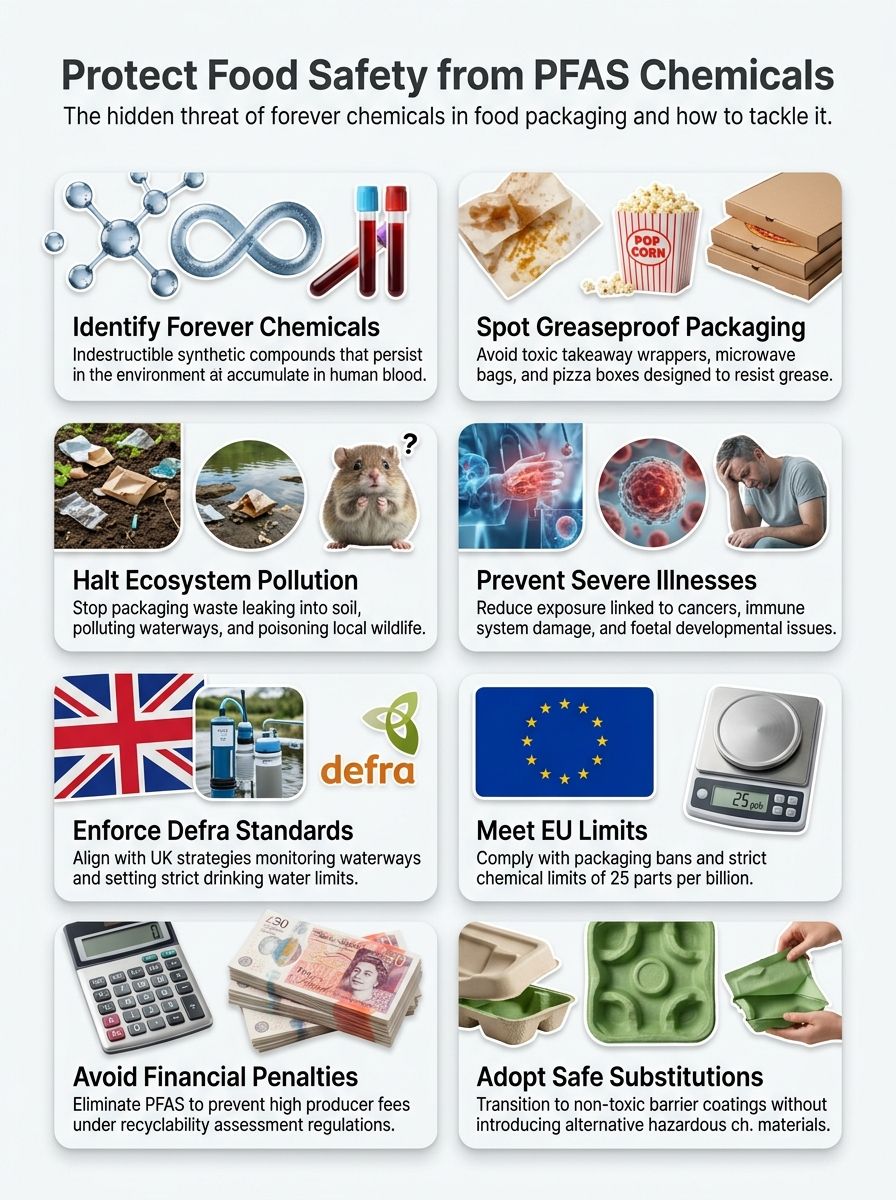
Keeping your family’s food safe starts with knowing what touches it. Every takeaway burger, bakery bag, and microwave popcorn pouch can carry hidden chemicals called PFAS in packaging that leak into your meals.
These synthetic substances hide in fast-food wrappers, bakery bags, and disposable food packaging across the country. 2 You cannot see them, smell them, or taste them.
Yet they enter your body with every bite.
Here is the key fact you need to master: PFAS are known as “forever chemicals” because they persist indefinitely in the environment and do not break down naturally. 1 Scientists have found them in human blood samples worldwide.
Your body builds them up over time through dietary exposure. They can even cross the placenta during pregnancy, potentially affecting a baby’s development. The food contact materials industry uses these chemicals widely because they resist water, oil, grease, and heat so well.
This guide reveals exactly how PFAS in packaging threatens food safety and the environment around you. 3 You will learn what the UK government plans to do, how producers must take responsibility, and which safer alternatives exist.
Most importantly, you will get practical steps to protect yourself and the people you love.
Key Takeaways
- PFAS are “forever chemicals” that never break down in the environment or human bodies, accumulating over decades and linked to cancer, hormone disruption, and immune system damage.
- Food packaging contains PFAS chemicals that migrate into meals through fast-food wrappers, microwave popcorn bags, and takeaway containers, exposing families daily without their knowledge.
- The UK government’s PFAS Plan and the EU’s Packaging and Packaging Waste Regulation impose strict limits of 25 parts per billion for individual PFAS by August 2026.
- Producers must test packaging for PFAS concentrations, include findings in Risk Assessment and Mitigation documentation, and switch to safer alternatives to avoid financial penalties and market restrictions.
- Companies must carefully check replacement materials to avoid regrettable substitution, making sure new packaging solutions remove PFAS without adding other hazardous chemicals to food supplies.
Understanding PFAS in Packaging

PFAS, short for per- and polyfluoroalkyl substances, sit inside food contact packaging materials everywhere, from takeaway boxes to sandwich wrappers. These chemicals resist grease and water, which makes them ideal for food packaging. Yet they persist in the environment and your body for decades, earning their nickname as “forever chemicals”.
PFAS as “forever chemicals”
Per- and polyfluoroalkyl substances earned the nickname “forever chemicals” for a simple reason. They resist breaking down in ways most other compounds cannot match.
Scientists designed them for durability, and that durability has become a serious problem. The carbon-fluorine bonds in PFAS molecules are extraordinarily strong, making these substances almost indestructible once released into the environment.
This extreme persistence means PFAS contamination spreads through soil, water, and air for decades. The United States Environmental Protection Agency and environmental health organisations like Chem Trust have documented how these chemicals build up in ecosystems far from their original sources. Over 4,500 different PFAS compounds exist, and each one refuses to break down naturally.
Your body can accumulate PFAS over time because these chemicals do not degrade inside you either. According to a June 2026 epidemiological study, one compound called PFHxS can stay in the human body for up to 35 years. In other words, exposure today can affect your health for decades.
The CDC recognises PFAS as a potential risk factor for chronic diseases, largely because they persist in human tissue. Scientists have detected PFAS in blood samples across populations worldwide, and research shows these chemicals can cross the placenta during pregnancy.
Food contact substances contaminated with PFAS transfer these compounds directly onto your food, creating a pathway into your body. Unlike microplastics, which are physical particles, PFAS are a distinct chemical family that poses unique dangers precisely because they never truly disappear.
Forever chemicals demand forever solutions, not temporary measures that shift the problem elsewhere.
Common uses in packaging
Manufacturers add PFAS to many food packaging products because these chemicals create excellent barriers against grease, moisture, and oil. Here is where they show up most often:
- Fast-food wrappers contain PFAS to stop grease soaking through the paper and reaching your hands or bag.
- Microwave popcorn bags use these chemicals so butter and oils cannot penetrate the packaging during cooking.
- Pizza boxes and takeaway containers rely on PFAS coatings to resist grease and hold their shape with hot, oily food.
- Ready-meal boxes use these chemicals to block moisture and keep food fresh for longer.
Paper and cardboard manufacturers apply PFAS specifically as grease-proofing agents to improve water, oil, and grease resistance. Even recycled cardboard may contain trace PFAS without any intentional treatment, which complicates compliance across the packaging industry.
Here is a surprising twist. Based on joint testing data published by the environmental charity Fidra, the highest PFAS concentrations were consistently found in moulded plant fibre products, such as bowls and boxes sold as “compostable” or “eco-friendly”. A green label does not always mean a chemical-free product.
Recent testing of UK retail and foodservice packaging confirms how widespread this treatment has become. In a screening of 42 distinct packaging items collected from takeaway outlets and retail channels, 32 samples showed detectable PFAS signatures consistent with intentional grease-proofing treatments. Among those positive samples, 18 exceeded 25 parts per billion for one or more targeted PFAS markers in surface extracts.
The link between intentional grease-proofing and measurable PFAS was especially strong in single-use fast-food wraps and popcorn bags. There is good news, though. According to tracking by the UK PFAS Free campaign, major supermarkets including Asda, Co-op, and Morrisons committed to removing intentionally added PFAS from all own-brand food packaging by the end of 2025, proving that a phase-out is commercially possible.
Harmful Impacts of PFAS
PFAS chemicals seep into our soil and water supplies, then build up in fish and wildlife over time. These persistent toxins travel into our bodies through the food we eat, posing serious risks to our health and the natural world around us.
Environmental contamination and bioaccumulation
PFAS chemicals spread through soil and water systems with alarming ease. These “forever chemicals” resist breaking down, so they persist in the environment for decades. 3 Waterways carry PFAS from packaging waste into ecosystems, where they accumulate in fish, wildlife, and livestock.
The contamination travels far beyond the original source, detected globally in places where no one has ever used PFAS-containing products. The UK picture is stark. According to a 2025 report by the Environment Agency, 110 out of 117 English rivers, lakes, and estuaries tested contained detectable levels of PFAS.
Monitoring of PFAS in waterways forms a key part of the UK government’s regulatory plans, as organisations like Fidra and Chem Trust have documented. Once PFAS enters the food chain through contaminated water and soil, it builds up in animal tissues over time, a process called bioaccumulation. Humans then eat these contaminated animals, ingesting PFAS through food contact materials and natural food sources alike.
The lifecycle of disposable food packaging makes it a major contributor to PFAS pollution worldwide. Food contact notifications reveal that manufacturers have used PFAS in grease-resistant and water-resistant coatings for decades, turning everyday packaging into a source of environmental contamination.
PFAS can migrate from packaging into soil and water, spreading contamination to farmland and drinking water supplies. The European Food Safety Authority and researchers studying process contaminants in food have raised urgent concerns about this migration pathway.
Unlike other hazardous materials such as bisphenols, phthalates, and acrylamide, PFAS refuses to degrade naturally. That means contamination from packaging waste persists indefinitely, threatening both food safety and ecosystem health.
Negative impacts on human health
This bioaccumulation process does not stop in the environment. These chemicals travel into our bodies through contaminated food and water, building up over time in our blood and organs.
Scientists have detected PFAS in human blood across most populations, and research shows these substances cross the placenta during pregnancy. This means unborn babies face exposure before birth.
Pregnant women, nursing mothers, and children experience heightened sensitivity to PFAS effects because their bodies are still developing. Studies from pmc.ncbi.nlm.nih.gov reveal that high levels of PFAS exposure link to breast cancer, testicular cancer, and kidney cancer. The evidence grows stronger each year as researchers uncover more connections between PFAS and serious health problems.
Beyond cancer risks, PFAS damages multiple body systems in ways that affect daily life:
- Raised cholesterol levels and disrupted immune function, leaving people more vulnerable to infections
- Interference with hormones that control growth, reproduction, and metabolism
- Liver damage, thyroid disease, and reproductive issues linked to exposure in human studies
- Autoimmune risks: according to a June 2026 study, women with the highest levels of PFHxS had 63% higher odds of developing Multiple Sclerosis
Most people carry some PFAS at low levels, but concentrated sources like food packaging create higher exposures for certain groups. The Food Packaging Forum tracks these health hazards in its database, documenting how packaging materials introduce persistent chemicals into our food supply.
Children absorb PFAS more easily than adults. That makes food safety through packaging choices a critical public health priority.
UK Government’s Response to PFAS
The UK government takes PFAS seriously through Defra’s comprehensive plan, which sets out clear actions to reduce these harmful chemicals from our food systems and environment. This strategy works alongside the Chemicals Strategy for Sustainability to make sure producers test packaging and report PFAS concentrations, treating food safety as a genuine priority rather than an afterthought.
Defra’s PFAS Plan
Defra published its groundbreaking PFAS Plan in February 2026, marking the first comprehensive government strategy to tackle these persistent chemicals. 5 The plan structures action around three core pillars covering PFAS sources, environmental pathways, and cutting human exposure.
- Defra’s strategy identifies food packaging as a major source of PFAS exposure, directly threatening food safety across UK households and businesses.
- Three pillars form the foundation: understanding where PFAS comes from, stopping it from reaching our environment, and cutting down how much people absorb.
- Comprehensive monitoring programmes now track PFAS levels in waterways. As outlined in the UK Government’s February 2026 PFAS Plan, England will continue taking 2,400 freshwater PFAS samples each year, while Scotland expands its sampling to 500 in 2026.
- Consultation on legal drinking water limits for PFAS is underway, setting safety thresholds that protect public health nationwide.
- Innovation funding encourages UK businesses to develop safer alternatives to PFAS, creating competitive advantages in the global market.
- Food producers must recognise that this plan creates new compliance requirements, particularly around packaging materials used in food contact applications, so testing protocols for PFAS concentrations matter more than ever.
Potential further restrictions under UK REACH regulation
The UK government plans to reform UK REACH by December 2028, which will strengthen controls on PFAS chemicals significantly. 6 According to the HSE’s regulatory timeline, the Health and Safety Executive is currently running a Regulatory Management Options Analysis on PFAS, with a final decision on restriction proposals expected in 2027. This reform targets non-essential uses of PFAS in food packaging and other consumer products.
The government’s approach classifies certain PFAS as substances of very high concern, or SVHC, under the UK REACH regime. These designations open the door for phase-outs of PFAS that manufacturers do not absolutely need.
Businesses must act now to assess their current PFAS usage and identify safer alternatives before restrictions take effect. The expanded monitoring framework will require companies to test for PFAS concentrations in their products regularly. Sylvicta and other compliance specialists recommend that producers begin their Risk Assessment and Mitigation, or RAM, processes immediately to avoid costly disruptions.
Organisations like PAN UK and IPEN have pushed for stricter PFAS controls, highlighting the chemicals’ persistence in the environment and their bioaccumulation in living organisms. The UK’s post-Brexit independence allows policymakers to introduce measures that go beyond current European standards if needed.
Food packaging manufacturers should prepare for a future where PFAS use becomes increasingly restricted or banned outright. Companies that fail to move away from these forever chemicals face significant compliance risks and potential market exclusion.
EU Regulations on PFAS
The European Union took decisive action through the Packaging and Packaging Waste Regulation (PPWR), which restricts PFAS use across member states and sets strict limits on these persistent chemicals in food contact materials.
This shift has big implications for UK producers and importers. Many must now align their packaging standards with EU requirements or face market access problems.
Implementation of restrictions under the PPWR
Packaging rules in Europe shift dramatically from August 2026 onwards. Producers must act now to meet strict PFAS limits or face serious consequences.
- Food-contact packaging cannot exceed 25 parts per billion for any single PFAS substance after 12 August 2026.
- Total PFAS concentration must stay below 250 parts per billion. As stipulated in the EU Packaging and Packaging Waste Regulation applying from August 2026, a 50 parts per million limit for Total Organic Fluorine also acts as a catch-all for polymeric PFAS, and there is no grandfathering: non-compliant stock made before the deadline must be pulled from the market.
- Manufacturers cannot market packaging that breaches these concentration limits anywhere in the EU from the enforcement date, and single-use packaging containing PFAS faces outright restriction. 7
- Recycled materials present real challenges; meeting thresholds proves difficult when using reclaimed content. An audit of 15 recycled cardboard lots from a UK mill’s inbound batches found PFAS detections in 6 lots, with levels ranging from trace amounts up to 60 parts per billion total PFAS in pulp concentrates before finishing treatments. Contamination was higher in lots containing hospitality and takeaway waste, where PFAS-treated packaging enters recycling streams. Mills must therefore test batches intended for food contact uses to avoid breaching regulatory thresholds.
- Strict enforcement means regulators will carry out rigorous testing and inspections across the supply chain, so producers working with suppliers like ArjoWiggins must verify all materials meet PFAS standards before production begins.
- Companies should measure PFAS concentrations in their current packaging stocks immediately. Packaging containing glycidyl esters or other unintentional PFAS additions needs careful reformulation, and pfasfree.org.uk offers guidance on compliant alternatives and testing requirements.
- Producers bear full responsibility for demonstrating compliance; documentation and test results must be available for regulatory inspection.
Implications for the UK market
UK businesses face a critical shift in their compliance requirements. The EU’s new standards for PFAS in food packaging take effect in August 2026, creating immediate pressure for British exporters. 6 Companies selling into EU markets must meet these stricter rules or risk losing access to one of the world’s largest consumer bases.
The fragmented post-Brexit landscape means UK firms now juggle two separate systems. They must satisfy both domestic requirements and European standards at the same time. This dual compliance burden forces businesses to invest in testing for PFAS concentrations and reformulate their packaging solutions ahead of schedule.
There is one useful shortcut. According to the EN 13432 compostability standards, UK packaging that already carries an “OK Compost” certification has been screened to a ceiling of 100 ppm for total fluorine, putting those producers much closer to EU compliance thresholds already.
The FSA, through the National Reference Laboratory, continues to assess PFAS presence in UK food packaging, providing crucial data that shapes future policy. UK businesses must reduce their PFAS use to avoid financial and reputational risks, as groups like Fidra campaign for a full PFAS ban in packaging.
The UK government is also developing statutory limits for PFAS in drinking water, signalling that broader restrictions may follow. Companies that act now, rather than waiting for mandatory deadlines, gain a competitive advantage and show genuine commitment to food safety and environmental protection.
Producers’ Responsibilities and Actions
Companies must test their food packaging materials to measure PFAS concentrations and identify potential risks. Producers also need to include PFAS data in their Risk Assessment and Mitigation (RAM) documentation to show regulators and consumers that they take food safety seriously.
RAM inclusion of PFAS
Packaging producers now face real consequences for using PFAS chemicals in their products. 8 The Recyclability Assessment Methodology, or RAM, has transformed how the industry approaches these harmful substances.
- RAM forms part of the UK’s Extended Producer Responsibility regulations, making PFAS assessment mandatory for all packaging producers across the nation.
- Packaging containing intentionally added PFAS receives a “red RAM outcome,” which signals serious environmental and health concerns to regulators and consumers alike.
- A red outcome hits the bottom line hard. According to the UK Government’s 2026 EPR fee structure, packaging with PFAS above 1 part per million automatically triggers a fee multiplier of 1.2x the base fee in 2026/27, rising to 2.0x by 2028.
- Producers must now factor PFAS content into their recyclability calculations and fee structures as part of their compliance obligations.
- Testing for PFAS concentrations becomes essential; producers need accurate data to know whether their packaging triggers a red outcome or passes assessment.
- Supply chain decisions shift when manufacturers see that PFAS inclusion affects profits through higher fees and potential market restrictions, pushing producers towards safer material alternatives that avoid introducing other hazardous materials.
Testing for PFAS concentrations
Testing food contact materials for PFAS concentrations is essential to meet regulatory requirements and protect consumers. Producers must verify that their packaging meets safety standards set by authorities like the EFSA and comply with concentration thresholds. 9
- Contact your suppliers directly and request concentration data for any intentional PFAS use in your materials. This helps you understand what enters your supply chain and spot risks early.
- Measure PFAS levels against the EU threshold limits: 25 ppb for individual PFAS and 250 ppb for total PFAS in food-contact materials. These figures guide your testing protocols and compliance decisions.
- Test all packaging made from recycled materials, as these items may contain trace PFAS from previous uses. Recycled content needs extra scrutiny.
- Use accredited laboratories that apply validated testing methods to measure PFAS accurately. Proper procedures reduce regulatory risk and protect your brand reputation.
- Document all test results and keep records of your PFAS findings for regulatory inspections. Clear documentation shows your commitment to food safety and transparency.
- Review data resources from the Food Packaging Forum to understand PFAS hazards relevant to your materials, and set ongoing monitoring schedules so your packaging stays compliant as standards change.
Alternatives to PFAS
Manufacturers must explore safer materials that replace PFAS without introducing fresh risks to food safety or the environment. Scientists and producers are working together to develop coatings, barrier films, and water-resistant materials that perform well without the dangers forever chemicals create.
Consideration of potential negative impacts
Moving away from PFAS packaging creates a genuine challenge that demands careful thought before companies act. Many alternatives carry their own health and environmental risks, so we cannot simply swap one chemical for another without proper investigation. 10
Scientists and regulators worry that trading PFAS for different hazardous materials would repeat the same problems we want to solve. Companies must put each alternative through comprehensive risk evaluations before adopting it at scale. This prevents past mistakes, where harmful effects only emerged after widespread use.
The financial burden adds another layer. Industry estimates suggest that moving to PFAS-free packaging could cost up to USD 12.5 billion, putting pressure on producers and potentially affecting consumer prices.
For smaller businesses, the numbers look more manageable. Consider a four-site regional bakery that switched from PFAS-coated bags to certified PFAS-free alternatives:
- One-off supplier validation and QA audit cost: £3,200
- Extra material cost of £0.06 per bag, adding £4,680 per year across 78,000 bags
- Staff retraining and labelling changes: £950
- Total first-year transition cost: £8,830
The bakery’s finance team noted that switching liners meant a modest upfront spend but removed a growing compliance concern. Their budget model projected payback through avoided risk fees and improved market access over roughly 2.5 years.
Regulators keep pushing for genuine innovation rather than quick fixes, and consumer demand for sustainable packaging now drives this search forward. Companies must invest in research that produces materials meeting both safety standards and performance requirements without adding fresh hazards to our food supply.
Avoiding a shift to other hazardous materials
Producers must take care not to swap PFAS for other harmful chemicals. Switching from one problem substance to another simply moves the danger elsewhere. The evaluation of alternatives should ensure no new or greater health risks emerge. 1 Environmental risks also need careful attention during this transition.
This approach, known as avoiding regrettable substitution, stops the burden shifting from one chemical concern to another. According to safety advocacy groups tracking chemical substitutions, this mistake often happens when manufacturers replace restricted long-chain PFAS with shorter-chain variants like GenX or PFBS. Early studies show these substitutes trigger similar health and environmental problems.
Industry leaders across the UK and EU now recognise that sustainable packaging solutions must meet safety, environmental, and functional standards all at once. Innovations in non-PFAS materials are needed to maintain performance without introducing new dangers. 11 Cost parity with PFAS-based materials may become achievable as alternative technologies mature.
Industry-wide collaboration helps safe and sustainable material transitions happen smoothly. Producers should check each alternative thoroughly, asking whether it truly solves the PFAS problem or simply creates a different one.
The goal remains clear: eliminate harmful substances without trading one risk for another. This careful approach protects both human health and the natural world, while keeping packaging fit for purpose.
Conclusion
PFAS chemicals pose a serious threat to both our food and our environment, and we have explored this problem from every angle. These forever chemicals persist indefinitely in nature, contaminate our food packaging, and build up in our bodies over time.
The health risks include cancer, hormone disruption, and immune damage.
The UK government’s PFAS Plan and the EU’s strict rules under the Packaging and Packaging Waste Regulation show that action is underway, though more work remains to protect food safety and public health. Packaging producers now face financial incentives through Extended Producer Responsibility to remove PFAS from their materials, making safer alternatives both practical and achievable.
Finding suitable replacements takes careful evaluation, since switching to other hazardous substances would simply move the problem rather than solve it.
Your choices matter. By supporting companies that eliminate PFAS and demanding safer packaging standards, you help drive the change that protects your family’s health and preserves our environment for future generations.
FAQs
1. What are PFAS, and why are they found in food packaging?
PFAS are man-made chemicals used to make packaging resist grease and water. They coat items like takeaway boxes, crisp bags, and pizza wrappers. According to the UK Food Standards Agency, these chemicals can migrate from packaging into food, particularly with hot or greasy items.
2. How do PFAS in packaging harm the environment?
PFAS do not break down naturally and can persist in the environment for over 1,000 years, which is why they are called “forever chemicals”. They accumulate in soil, water, and wildlife across the UK.
3. Are PFAS the same as BPA?
No, PFAS and BPA are different chemicals, though both raise health concerns. BPA is found in some plastics and tin linings, while PFAS appear mostly in grease-proof paper and food contact coatings.
4. How can I avoid PFAS in my food packaging?
Choose fresh food over items wrapped in grease-proof packaging, and store leftovers in glass or stainless steel containers. You can also open your browser and search for retailers like Waitrose or M&S that have committed to removing PFAS from their own-brand food packaging.
References
- ^ https://www.env-health.org/wp-content/uploads/2021/05/FINAL_pfas_fcm_study_web.pdf
- ^ https://pmc.ncbi.nlm.nih.gov/articles/PMC10993423/
- ^ https://pmc.ncbi.nlm.nih.gov/articles/PMC12901289/
- ^ https://www.epa.gov/pfas/our-current-understanding-human-health-and-environmental-risks-pfas (2026-04-21)
- ^ https://defraenvironment.blog.gov.uk/2026/02/03/forever-chemicals-the-problem-and-our-plan/
- ^ https://www.fieldfisher.com/en/insights/pfas-uk-regulatory-snapshot (2026-02-19)
- ^ https://ec.europa.eu/commission/presscorner/detail/en/ip_26_664 (2026-03-29)
- ^ https://www.niehs.nih.gov/health/topics/agents/pfc
- ^ https://pmc.ncbi.nlm.nih.gov/articles/PMC8536021/
- ^ https://pmc.ncbi.nlm.nih.gov/articles/PMC10380748/
- ^ https://www.sciencedirect.com/science/article/pii/S0921344925003064
Discover more from IPPTS Depackaging Equipment Insights
Subscribe to get the latest posts sent to your email.