Depackagers are critical equipment in waste-to-energy/anaerobic digestion plants and resource recovery facilities. They separate organic material (waste food, out-of-specification beverages, or even paper pulp) from contaminating packaging—plastic bags, film, and rigid plastic and metal containers—while maintaining the quality of both output streams. Two prominent competitors in this space are the Drycake Twister and the Tiger De-Packager. While both are vertical machines, they operate on fundamentally different principles, which has significant implications for maintenance, throughput, the organic purity of the “soup” they make, reject output quality, and total cost of ownership.
This article breaks down how each machine works, compares their design choices, and provides a framework for evaluating which approach may suit your facility’s needs.
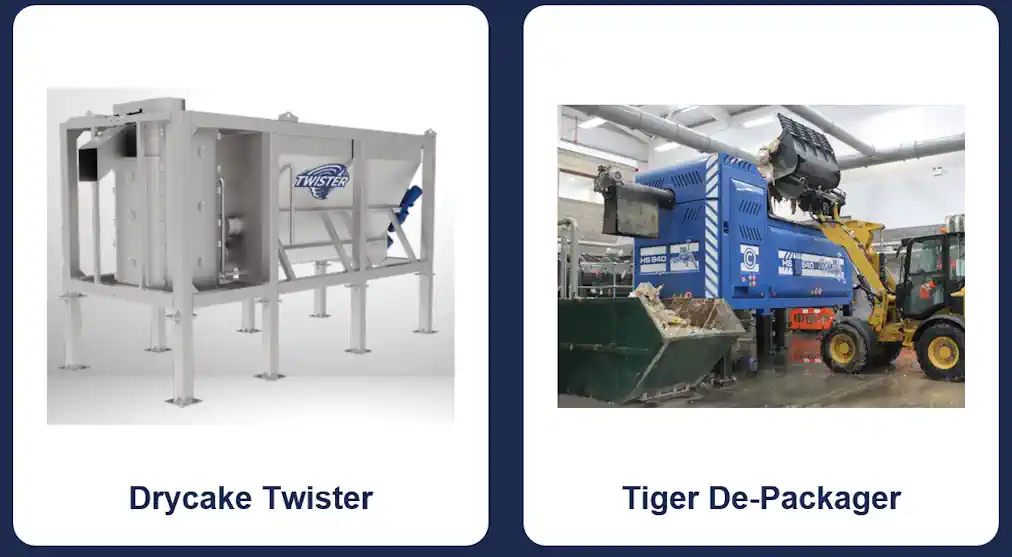
The Two Approaches: Vortex vs. Mill-Based Separation
The core difference between these machines lies in how they separate material:
Drycake Twister: Vortex Separation
The Twister uses centrifugal force and fluid dynamics. A turbine generates a strong vortex within the chamber. Light material (packaging) is drawn upward by the vortex and discharged at the top by centrifugal force. Heavy material (organics) is pushed through a perforated wall and base, where it is pulped into a pumpable slurry and exits the bottom. The spinning paddles create and maintain the vortex; they do not directly grind or force material. Unwanted material such as cutlery in kitchen waste is also batted upwards and exits with the reject output stream.
Tiger De-Packager: Mill-Based Separation
The Tiger uses a rotating drum with bolted paddles that function like a mill. The paddles spin the load against a perforated basket wall, forcing organics through the perforations while pushing packaging out laterally. The design is described by the supplier as a “vertical mill” with a hardoxed drum and individual paddle attachments.
Why This Matters
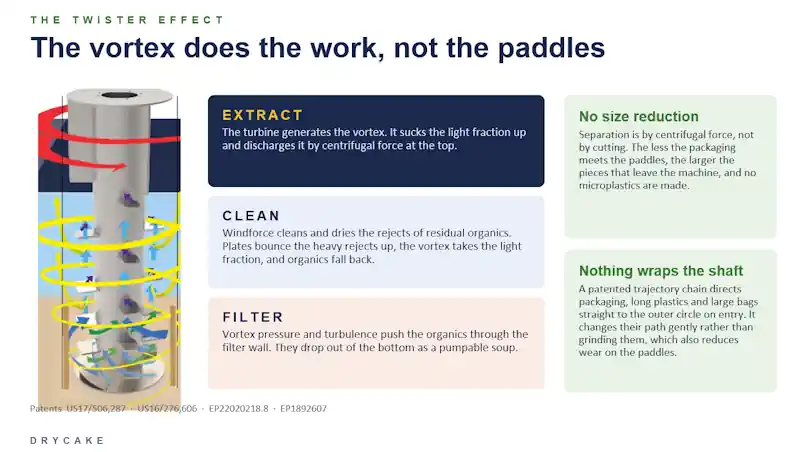
These mechanical philosophies lead to different rates of wear, different reject quality, and different maintenance profiles. A vortex-based system that avoids direct grinding of packaging inherently produces less fragmentation and microplastic generation. A mill-based approach, which must force material against a wall, experiences higher wear on both paddles and the wall itself.
How Each Machine Operates
Drycake Twister: Three-Stage Process
Stage 1: Extract
Material enters the vertical chamber. The turbine spins and generates a powerful vortex. Light fraction (packaging) is sucked upward and discharged by centrifugal force at the top of the chamber. Heavy fraction (organics) falls toward the perforated filter wall.
Stage 2: Clean
As the vortex circulates material, the patented trajectory chain—a unique feature of the Twister design—directs long plastics and large bags to the outer circle on entry. This gentles their path into the vortex rather than grinding them against paddles. Organics are cleaned by the windforce created by the vortex, which strips residual organic matter from the packaging before it exits.
Stage 3: Filter
Vortex pressure and turbulence push cleaned organics through the filter wall. They accumulate in the bottom of the chamber as a pumpable slurry (about 15% moisture with AirPolish treatment) and are discharged as a reject fraction suitable for RDF or SRF (solid recovered fuel) use.
Key Design Feature: The paddles on the Twister maintain a 2.5 cm clearance from the vessel wall. This wide gap allows packaging to ride the vortex around paddles rather than being pinned and scraped against the wall.
Tiger De-Packager: Mill-Based Grinding
Material enters the chamber with the 8-yard hopper (standard). The rotating drum with bolted hardoxed paddles mills the organics against the perforated basket wall, forcing them through the perforations. Packaging is pushed outward and discharged laterally by the centrifugal action of the paddles. The screen material is perforated carbon sheet metal.
Key Design Feature: Tiger machines maintain a typical clearance of <1 cm between paddle tips and the wall. This tight clearance is necessary for a mill-based design to force material through the screen, but it increases contact and wear between paddles and wall.
Materials of Construction and Durability
How a machine is built directly affects how long wear parts last and what replacement costs will be.
| Component | Drycake Twister | Tiger De-Packager |
|---|---|---|
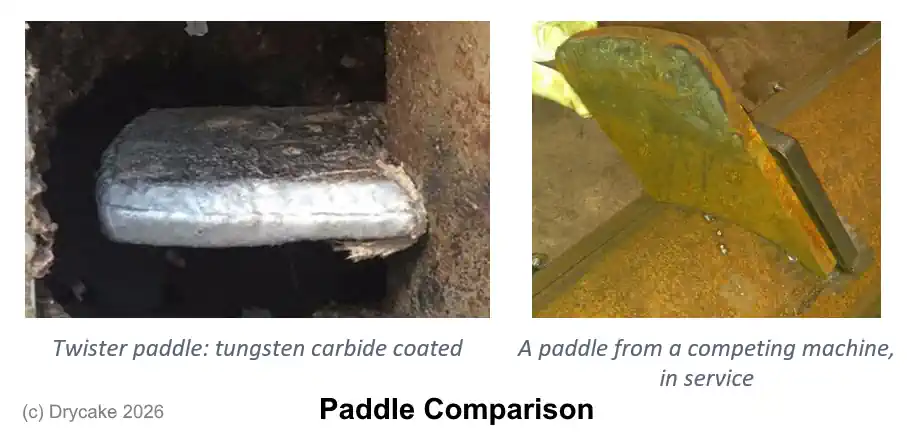
| Paddles | Tungsten carbide coated | Hardox 450, bolted to support |
| Shaft | Stainless steel with tungsten carbide protection | Carbon steel |
| Frame & Body | All stainless, TIG welded | Carbon steel |
| Screen | Laser-cut stainless steel (10 mm thick), modular panels (6–25 mm options), individually replaceable | Perforated carbon sheet metal |
Wear Comparison
The Twister’s tungsten carbide-coated paddles are harder and more abrasion-resistant than hardox steel. The stainless steel construction throughout the Twister resists corrosion—important in moisture-heavy waste streams. The Tiger’s carbon steel frame and shaft are less corrosion-resistant and will oxidize faster in wet conditions.
Paddle Replacement Frequency:
- Twister: 2–3 paddles replaced every 2–3 years, ~2 hours labor per change
- Tiger: Published intervals not specified in supplier material; rotor rebuilds mentioned as a maintenance event, suggesting more frequent or more involved replacement
The Twister’s wide paddle-to-wall clearance means paddles steer the load’s trajectory without scraping. The Tiger’s tight clearance means paddles must work hard against the wall, creating friction and accelerating wear on both components.
Maintenance and Service
Service accessibility and cost predictability are major factors in total cost of ownership, especially for equipment that runs continuously in industrial settings.
Drycake Twister: Modular, Hand-Accessible Design
Screen Replacement
The Twister features a modular filter drum with individually replaceable panels. A damaged panel can be removed and replaced without taking the entire drum out of the machine. This reduces downtime and allows for staggered replacement of panels as they wear.
Paddle Replacement
Paddles are bolted from inside the chamber through an inspection door. They are at arm’s reach and can be changed in approximately two hours without lifting gear or entering a confined space. Panels are also available in multiple sizes (6–25 mm), allowing customization for different materials or throughput requirements.
Lower Thrust Bearing
The bearing is designed for easy alignment and has a central greasing point, reducing maintenance labour.
Tiger De-Packager: Standard Industrial Maintenance
The Tiger uses a soft starter (standard), and the supplier describes a “full digital Can Bus system” for control. However, rotor rebuilds are referenced, suggesting that paddle replacement involves more disassembly than the Twister’s modular approach. No specific labour times are published.
The Drycake Five-Year Maintenance Package
Drycake offers an optional five-year fixed maintenance contract that includes:
- All wear parts: paddles, screen panels, bearings, seals, and belts
- Scheduled labor performed by Drycake engineers
- A guaranteed shaft assembly held in bonded stock (Fast Access Program), dispatched within 72 hours of call
- One fixed annual fee agreed at contract signature
Financial Impact:
A facility committing to a Twister with this package knows its maintenance budget for five years before purchase. Depending on utilization, this can save approximately €178,000 per plant compared to paying per-service fees, parts replacement, and labour on a competitor’s published maintenance schedule.
Why This Matters:
Few equipment suppliers are willing to quote fixed-price parts and labor for five years. The ability to do so reflects both Drycake’s control over production (they build the turbine in-house) and the Twister’s designed serviceability (scheduled maintenance is quick and predictable).
Operating Performance: Throughput and Reject Quality Throughput
Both machines are available in multiple capacities. The Tiger offers higher maximum throughput in North American models (up to 40 t/h on the HS-90), while the Twister’s European models top out at 20 t/h on the HS20.
Throughput specifications should be verified against actual conditions at your facility (material moisture, composition, density, and contamination level). European and North American models may perform differently due to design tuning.
Reject Quality and Contamination
This is where the operational philosophies produce different results.
Drycake Twister:
- Rejects leave cleaned and dried by the vortex at approximately 15% moisture (with AirPolish treatment)
- Output is described as RDF/SRF quality (suitable for solid recovered fuel applications)
- Organic contamination in output: 99% clean organic fraction from the Twister alone; approximately 0.02% with the CleanPress in the line (measured at a European installation)
- Organics are pulped and pushed through the filter wall by pressure and turbulence, not shredded
Tiger De-Packager:
- Supplier claims “less than 1% contamination in substrate”
- Output moisture not specified; described as “wet or dry” at “a simple flip of a switch”
- No published purity figure on the supplier’s own website (as of September 2026)
- Mill-based grinding may produce finer, more fragmented packaging pieces
Microplastics
A growing concern in waste processing is the generation of microplastics. Because the Twister separates by centrifugal force and does not shred packaging, it generates less fragmentation. The Tiger’s mill-based design inherently grinds packaging, which may produce more microplastic particles. Facility environmental regulations or downstream market requirements (e.g., for compost or animal bedding) may restrict microplastic content in rejects.
Cost of Ownership: Five-Year Total Cost
Purchase price is only one component of total cost of ownership. Maintenance, wear parts, labor, and downtime add up over time.
What Drives Cost Difference
- Wear Rate
The Twister’s 2.5 cm paddle-to-wall clearance means less scraping and lower wear. Fewer paddle replacements mean lower parts costs and less downtime. The Tiger’s tight clearance accelerates wear on both paddles and the wall. - Maintenance Labour
The Twister’s modular design and hand-accessible components mean shorter service times. Paddle changes take ~2 hours. If the Tiger requires rotor rebuilds (full disassembly), labor costs are higher and downtime is longer. - Parts Supply and Availability
The Drycake Fast Access Program holds a shaft assembly in bonded stock, available within 72 hours. This reduces the risk of emergency downtime. Other suppliers typically require parts to be ordered, leading to longer lead times. - Predictability
The five-year fixed-price maintenance package eliminates budget uncertainty. Facilities can forecast maintenance costs years in advance. Most suppliers cannot offer this, making the comparison itself instructive.
Illustrative Calculation (Rough Example)
Assumptions:
- Purchase price: Similar baseline cost
- Operating hours: 8,000 hours per year (typical)
- Paddles on Twister: 2–3 replaced every 2–3 years
- Paddles on Tiger: Frequency unknown; rotor rebuilds assumed every 3–5 years
Five-Year Cost Comparison (Approximate):
| Line Item | Twister + 5-Year Package | Tiger (Pay-per-service) |
|---|---|---|
| Maintenance contract | €X/year (fixed) | — |
| Paddle replacements | Included | €Y per rebuild × 1–2 rebuilds |
| Screen/filter replacements | Included | Additional cost |
| Labor (scheduling) | Included | Billed per visit |
| Emergency parts (expedited) | Included | Risk of longer downtime |
| Estimated 5-year total | €5X | €5X + €178,000 (approx.) |
The €178,000 figure cited in the presentation assumes a competitor’s maintenance costs over five years; the exact amount depends on your region, utilization, and contractual terms.
Key Evaluation Questions for Any Depackager Supplier
If you are evaluating vertical de-packagers, Drycake recommends asking these questions of any supplier:
- Separation Mechanism: What happens to a bag inside the machine? Is it lifted out, or forced through a screen? (Vortex vs. mill implies different wear and output quality.)
- Reject Quality: How dry is the packaging leaving the machine, who takes it, and at what calorific value? (Dry rejects = better RDF/SRF quality and lower transport/disposal cost.)
- Organic Loss: How much organic matter leaves with the packaging? (Lost organics = lost biogas production and lower economic return.)
- Purity Definition: What is the purity figure measured on, and above what particle size is foreign matter counted? (This affects compatibility with downstream processes like anaerobic digestion.)
- Component Materials: What are the paddles, shaft, and screen made of, and what does each cost to replace? (Material choice indicates durability and long-term cost.)
- Maintenance Interval: How many operating hours between paddle changes, and how many labor hours does a change take? (Affects downtime and labor planning.)
- Field References: Ask an operating reference site how often the rotor has actually been replaced, and compare that with published intervals. (Actual field experience often differs from spec sheets.)
- Contractual Commitment: Will the supplier put parts, labour, and availability in writing for five years? (Predictability and shared risk; few suppliers will agree to this.)
Summary
The Drycake Twister and Tiger DePack represent two different engineering philosophies:
- Twister: Vortex-based, low-contact separation – Minimizes wear, produces cleaner and drier rejects, supports predictable maintenance schedules, and offers fixed-price service contracts. Stainless steel construction, modular parts, and tungsten carbide paddles support long intervals between replacements. Best suited for facilities prioritizing predictable costs, high reject quality, and low microplastic generation.
- Tiger Depack: Mill-based, high-force grinding – Compact footprint, higher throughput in some models, tight paddle-to-wall contact. Mill designs are a proven industrial technology, but they accelerate wear on paddles and screens, typically require more frequent rotor rebuilds, and produce more fragmented output. Best suited for facilities with established mill-based maintenance workflows and lower emphasis on reject quality.
Cost of ownership over five years favours the Twister if your facility can utilize a fixed maintenance contract, as predictability and included parts/labor eliminate the financial surprises that come with pay-per-service models.
The best choice depends on your facility’s priority: maximum cost control and reject quality (Twister), or higher throughput with a more traditional mill design (Tiger).
Frequently Asked Questions
Q: Can both machines handle wet and dry feedstock?
A: Yes. Both are described as capable of handling wet or dry material. The Twister adjusts through a single setup; the Tiger through a “simple flip of a switch” for output configuration.
Q: How much do these machines cost?
A: Purchase prices are not published in supplier materials and vary by region, capacity, and customization. Contact distributors for current quotes.
Q: Does the Twister really eliminate microplastics?
A: No, but it produces significantly less fragmentation because it separates by centrifugal force rather than grinding. Packaging exits in larger, cleaner pieces. Some microplastics may still be generated during shredding or incidental contact, but the rate is lower than mill-based designs.
Q: What is RDF/SRF, and why does it matter?
A: RDF (refuse-derived fuel) and SRF (solid recovered fuel) are recycled energy sources made from processed waste, and known as energy extraction in the waste hierarchy. Higher calorific value and lower moisture/contamination make these fractions more valuable for energy recovery. The Twister’s dry, clean rejects command better pricing in RDF/SRF markets.
Q: Is the five-year maintenance package mandatory?
A: No, it is offered as an option. However, few suppliers can offer fixed-price parts and labor for five years, making it a competitive differentiator if cost predictability is important to your facility.
Q: Can I upgrade or swap paddles between machines?
A: No. Paddles are machine-specific and designed for their respective separation mechanisms. Twister paddles are tungsten carbide-coated and spaced for vortex generation; Tiger paddles are bolted hardox attachments for mill-action grinding.
Next Steps
Ready to evaluate de-packagers for your facility? Use the key evaluation questions in this article to develop a structured RFQ (request for quote) and baseline comparison. Request field references from both suppliers, and verify actual maintenance intervals by talking to operating facilities in similar applications. Budget and performance will depend on your specific material type, moisture, throughput, and contamination profile.
About the Source Material: This article is based on technical specifications and competitive information published by Drycake and distributors as of September 2026. Tiger De-Packager information is drawn from statements on tigerdepack.com, ecoverse.net, and supplier competitive documentation. Specifications and pricing are subject to change; verify current details directly with suppliers before making purchasing decisions.
Discover more from IPPTS Depackaging Equipment Insights
Subscribe to get the latest posts sent to your email.