Every tonne of food waste hides something valuable. Locked inside that discarded produce is water, nutrients, and energy that most of us never think about recovering.
Here is the number that changes everything: food waste is typically 60% to 70% water. When it rots in a landfill, that moisture turns into toxic leachate, and the decomposing food releases methane emissions that speed up climate change.
Food waste circularity offers a smarter path. Instead of the linear “take, use, dispose” model, this approach captures the water, nutrients, and energy in food waste and puts them back to work.
The scale is real, too.
One company already processes 100,000 tons of wasted food each year at a single facility, turning it into clean fertiliser and recovered water. The secret lies in removing packaging at the start of the process, not the end.
This guide breaks down exactly how that recovery works. You will see the real numbers behind water recovery and nutrient yields, and learn how this circular system pays off for retailers, farmers, and the planet.
Key Takeaways
- Divert processes 100,000 tons of food waste annually, producing 500,000 gallons of liquid nitrogen fertiliser and 10,000 wet tons of soil amendment per facility.
- Front-end wet process depackaging systems remove contamination early, preventing plastics from damaging digesters and ensuring clean, high-grade fertiliser products reach farmers.
- Food waste contains 60% to 70% water; Divert achieves net positive water recovery, and one day it may be possible through membrane bioreactors, eliminating the toxic leachate that traditional landfills generate to recycle this wate.
- Retail partners receive weekly circularity reports tracking energy, nutrient, and water recovery metrics, supporting environmental, social, and governance compliance with sustainable development goals.
- Circular food systems combining prevention, redistribution, upcycling, and nutrient recovery cut greenhouse gas emissions whilst strengthening local agriculture and creating genuine economic opportunities.
One facility processing mixed retail food waste over a 12-month period shows the scale of water recovery possible. The installation handled 100,000 tonnes of food waste with an average moisture content of 64%, recovering 480,000 gallons of reuse-quality water for internal process cycles. The membrane bioreactor discharge averaged 20,000 cubic metres treated to municipal consent levels.
Internal mass balance analysis revealed something striking. The plant returned more usable water to operations than it drew from the mains, achieving a net positive water balance of 12% versus inlet volumes.
Why is food waste circularity important?
Food waste circularity matters because it closes gaps in our food system and stops valuable resources from ending up in landfill. When we recover nutrients and water from food waste, we reduce greenhouse gas emissions, strengthen soil health, and create genuine economic opportunities across supply chains.
The stakes are especially high in Britain. According to 2026 UK food waste statistics, the UK generates around 9.5 million tonnes of food waste every year, responsible for roughly 25 million tonnes of CO2-equivalent emissions. That is a huge climate burden created by resources we simply throw away.
How does Divert recover vital fertiliser and water?
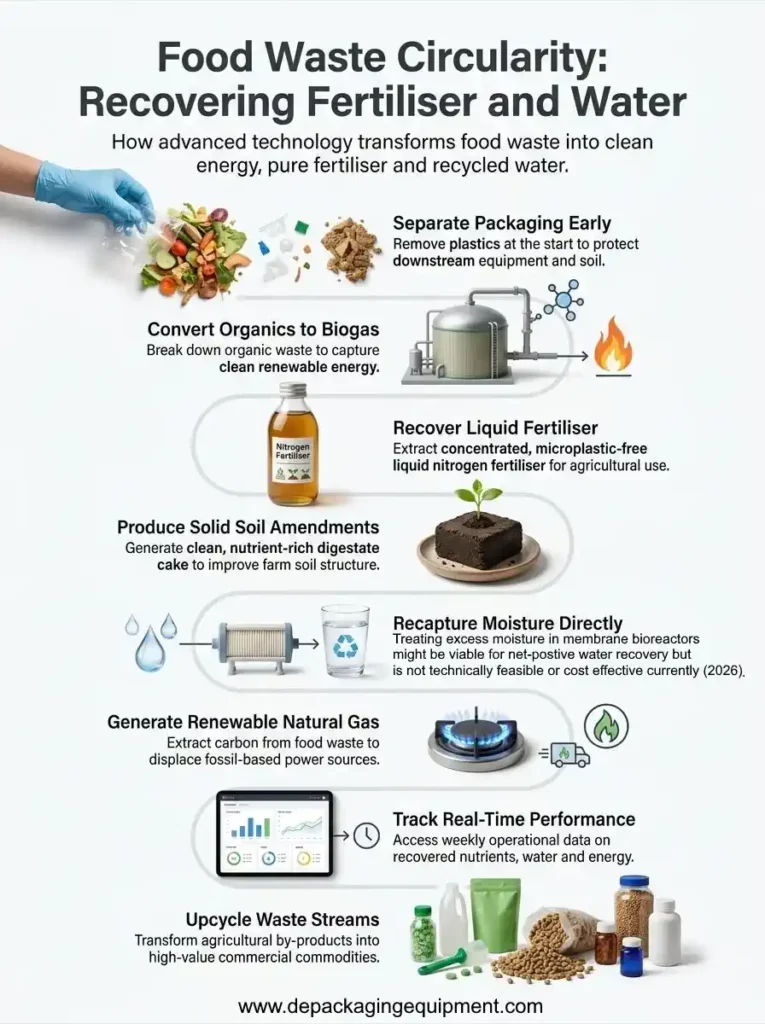
Divert transforms food waste into valuable resources through a system that captures both nutrients and water. The company runs a front-end wet process high-recovery depackaging system that strips out contamination from packaging materials, so only clean waste streams enter the treatment phase.
Membrane reactors then extract concentrated liquid nitrogen fertiliser from the processed waste, whilst excess moisture is recaptured and treated via membrane bioreactors. Each facility processes 100,000 tons of wasted food annually, producing 500,000 gallons of liquid nitrogen fertiliser and 10,000 wet tons of soil amendment.
The recovered water cycles back through the facility, achieving net positive water recovery that eases the strain on local water supplies. Through this nutrient cycling approach, material that once went to landfill now returns to regenerative agriculture and improves soil health.
Circular economy principles transform waste into wealth, not just for businesses but for the planet itself.
The impact of a single operation is striking. Each facility generates 450,000 pounds of high-grade nitrogen fertiliser annually, directly disrupting the synthetic fertiliser market with a sustainable alternative.
The process also extracts carbon from food waste to produce renewable natural gas, creating multiple value streams from a single input. Recovering nutrients this way avoids conventional fertiliser production, which carries heavy greenhouse gas emissions and environmental costs.
This blend of waste prevention and resource recovery shows how circular food systems can support food security whilst creating economic opportunities for communities. Understanding the contamination challenges below reveals why Divert’s depackaging system is such a critical advance for managing produce supply chain waste.
Challenges in food waste management
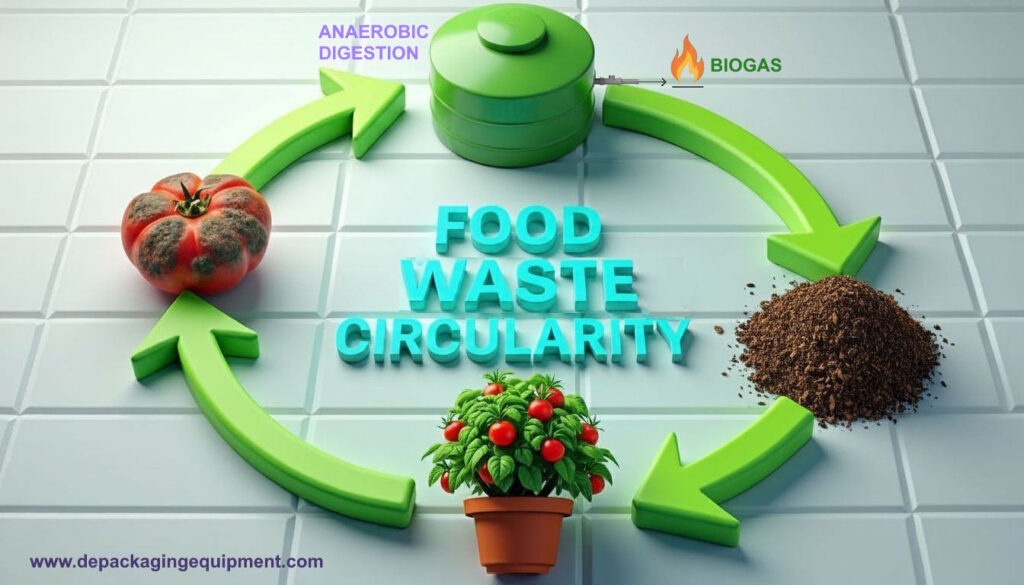
Food waste streams carry real problems. Contamination ruins incoming materials, produce supply chains leak nutrients and resources, and how we manage these challenges decides whether we can truly close the loop in our food systems.
Keep reading to see how these obstacles affect your community and what solutions exist.
What contamination issues affect incoming waste streams?
Incoming grocery waste streams carry serious contamination challenges that threaten the entire recycling process. Plastics, cardboard, and stickers mix through organic materials, creating major problems for waste reduction efforts.
These contaminants must be removed early to stop them from damaging digesters and cutting energy yields. One rejected inbound load showed the risk clearly: it contained 4.2% by weight of film plastics and laminated pouches. That contamination spike matched a 14% drop in biogas yield over the following three days and forced an unscheduled grit and scraper clean costing an estimated £1,200 in labour and downtime. The post-incident analysis concluded that front-end separation failures let a small but dense fraction of plastics into the system, causing rapid fouling and a measurable energy penalty.
The pressure on facilities is about to grow. As highlighted by 2026 waste management sector analyses on the new Simpler Recycling mandates, separate food waste collection becomes a legal requirement for businesses and households in England by March 2026. That means far more packaged organic waste arriving at facilities, making automated depackaging essential rather than optional.
Traditional methods struggle because they separate debris at the end of processing, letting plastics build up inside equipment and harm agricultural systems. The Food Standards Agency and environmental impact studies show that plastics re-entering soil damage farm infrastructure and biodiversity. Proper depackaging at the front end of the value chain stops this contamination before anaerobic digestion begins.
Divert tackles these challenges by screening and filtering contaminants from organic materials right from the start. This front-end wet process high-recovery depackaging system removes plastics before they reach digesters, keeping the equipment clean and efficient.
By eliminating debris early, the process protects agricultural soil from plastic damage, supports regenerative food production, and keeps recovered nutrients pure and marketable for farmers and communities.
What are the current problems in produce supply chains?
Beyond contamination, produce supply chains face obstacles that ripple through the entire system. Households in developing countries contribute heavily to food waste through over-purchasing and spoilage, whilst retailers and producers suffer real economic losses.
The Food and Agriculture Organization of the United Nations highlights that food loss remains a critical issue, particularly in nations where income levels vary dramatically. Supply chains struggle to separate food waste from municipal solid waste effectively, creating environmental and public health risks.
Consumer behaviour shifts constantly, shaped by food preferences and urbanisation trends, so producers find it hard to predict demand accurately. Organisations like WRAP and the Ellen MacArthur Foundation stress that these problems need solutions matched to each nation’s economic and demographic context.
Several factors make progress harder:
- Economic disparities: Advanced recycling technologies and strict regulations, as seen in Taiwan, contrast sharply with the obstacles faced in countries like Bangladesh.
- Weak community engagement: In many areas, this stops effective waste management strategies from taking root.
- Inconsistent regulation: The Consumer Goods Forum and DEFRA recognise that compliance rules vary widely across markets, complicating shared standards.
- Slow adaptation: Food preferences shift quickly, yet supply chains struggle to keep pace.
Prevention and redistribution strategies need stronger coordination between stakeholders. At the same time, upcycled products and food valorisation offer promising ways to lighten the load on produce systems.
Technology and process overview
Landfill waste diversion technology turns food waste into valuable resources through a series of carefully engineered steps. Wet process depackaging systems separate materials with precision, membrane reactors extract high-grade fertiliser, and water recovery methods ensure nothing goes to waste.
Read on to see exactly how these innovations work together.
How does the front-end wet process high-recovery depackaging system work?
Divert’s front-end wet process high-recovery depackaging system tackles contamination at the very start, not the end. The technology separates packaging from organic waste immediately, using water-based screening and filtering to remove debris before anything enters anaerobic digestion.
This stops plastics building up inside digesters, which means cleaner equipment and better results. The system handles food waste from grocery supply chains with precision, isolating each material type so the organic content stays pure. Early removal of packaging protects the entire process downstream, a significant market differentiator over conventional methods.
High recovery rates define this proprietary system. Front-end separation delivers maximum purity of organic material, which directly improves the quality and yield of the final fertiliser and soil amendments. Controlling contamination at this stage means fewer problems later, less disruption, and uncontaminated fertiliser production alongside net positive water recovery. These results support sustainability reporting and align with sustainable development goals and agroecology principles.
Front-end contamination control transforms waste into wealth, not burden. – Sustainability Innovation Principle
The depackaging line follows a precise five-step workflow:
- A wet hopper feed with optical pre-sort receives incoming material.
- Water curtain separation and vibratory screening at 3 mm aperture removes fine contaminants.
- Density-based float-sink separation divides materials by weight.
- A continuous conveyor removes plastics to a 200 kg per day reject bin.
- The clean organic slurry moves to digesters at 6% solids concentration.
This wet workflow reliably removes macro contaminants before anaerobic digestion, keeping the solids feedstock at the target concentration for optimal reactor performance.
What role do membrane reactors play in fertiliser extraction?
Membrane reactors are the powerhouse behind Divert’s nutrient recovery operation, transforming food waste into valuable fertiliser. After carbon removal for renewable natural gas production, these reactors extract concentrated liquid nitrogen fertiliser from the remaining organic material.
Each facility generates 450,000 pounds of nitrogen fertiliser annually, offering a renewable alternative to the volatile synthetic fertilisers that dominate agricultural markets.
The membrane technology keeps contamination to a minimum throughout extraction, producing clean, high-grade fertiliser ready for direct agricultural use. The science backs this up: based on a 2025 comprehensive review of AnMBR technology published by Taylor & Francis, anaerobic membrane bioreactors can recover nutrients with 83% to 94% efficiency, turning wastewater into high-grade liquid digestate suitable for fertigation. That efficiency makes commercial-scale nutrient recovery genuinely viable.
The concentrated liquid fertiliser offers direct value to farms seeking sustainable soil amendments. Divert’s process captures nutrients that would otherwise add to greenhouse gas emissions in landfill, and channels them back into productive agricultural cycles.
The marketability of this high-grade product disrupts conventional fertiliser supply chains, giving farmers a reliable source of nutrient-rich inputs. Food Standards Agency compliance and rigorous quality controls ensure every batch meets agricultural standards. What once looked like a waste problem becomes a resource solution, closing the loop between cities, food systems, and environmental responsibility.
How is water recovered and treated?
Food waste contains 60% to 70% water, which Divert’s process captures and reuses effectively. This approach achieves net positive results, unlike traditional landfilling or composting, which create toxic leachate or lose moisture through evaporation.
- Divert recaptures moisture directly from food waste during depackaging and feeds it back into the wet depackaging hoppers for further processing.
- Excess water the system cannot reuse is treated with membrane bioreactors, which filter and clean the liquid before discharge. According to a 2025 engineering review published by Taylor & Francis, these advanced bioreactors need up to 30% to 50% less energy than conventional activated sludge systems while maximising water recovery.
- Treated water meets strict quality standards set by regulators before entering municipal water networks safely.
- The facility’s water management system supports environmental compliance and resource efficiency across all operations.
- Traditional landfills generate toxic leachate from food waste moisture, whereas Divert’s approach removes this environmental hazard entirely.
- Composting often loses significant water through evaporation, making it less efficient than Divert’s closed-loop recovery system.
- This circular water recovery supports the sustainable development goals and tackles resource sustainability challenges in food systems, with circular transition indicators measuring the success of water recovery and environmental performance.
- Divert’s water treatment aligns with Consumer Goods Forum standards for environmental, social, and governance metrics across supply chains.
Key benefits of Divert’s process
Divert’s process delivers clean digesters and high-grade fertiliser, directly challenging the synthetic fertiliser market while cutting greenhouse gas emissions in ways that matter to retailers and consumers alike.
This circular approach also generates net positive water recovery and soil amendments, creating tangible environmental, social, and governance metrics that partners can track through detailed circularity reports.
How does Divert produce clean digesters and high-grade fertiliser?
Divert removes plastic packaging early in its process, which keeps digesters clean and free from debris. This early removal prevents the operational problems that plague traditional waste systems.
Clean digesters deliver higher, more consistent energy yields from anaerobic digestion, so facilities generate more power from the same amount of waste. Maintenance costs drop because clean equipment lasts longer and breaks down less often. Farmers and energy producers both benefit as operational lifespans stretch, and quality assurance protocols maintain product purity and safety throughout.
High-grade fertiliser emerges from the membrane reactors after carbon extraction removes unwanted materials. This nutrient-rich liquid fertiliser contains no microplastic contamination, outperforming standard compost products on the market.
Farmers get a consistent, high-quality nutrient source that improves crop yields without synthetic additives. The end product disrupts the synthetic fertiliser market because it offers superior quality at a competitive cost.
This recovery method supports sustainable development goals and gives retail partners the circular reporting they need for environmental, social, and governance metrics. It transforms food waste into valuable resources, closing loops within localised circular food systems and delivering real environmental and economic benefits to agricultural communities.
How does Divert disrupt the synthetic fertiliser market?
This clean fertiliser opens the door to something bigger. Divert shifts the entire fertiliser landscape by producing 450,000 pounds of nitrogen fertiliser annually per facility.
This liquid nitrogen gives farmers a renewable alternative to volatile, fossil-based fertilisers that have dominated agriculture for decades. The shift matters because synthetic fertilisers drain resources and add to the greenhouse gas emissions harming our planet.
Divert tackles this head-on, moving the industry away from unstable, non-renewable sources. Farmers gain consistent, high-quality nutrients without the environmental cost of chemical production.
Local distribution of the digestate cuts transport emissions, further disrupting supply chains built on long-distance shipping. The contamination-free product, with a 0.0% contamination rate, exceeds industry standards for compost and proves that quality need not compromise sustainability.
This renewable fertiliser strengthens soil health whilst reducing reliance on synthetic alternatives, supporting the sustainable development goals championed by organisations like the United Nations Environment Programme. Turning food waste into valuable nutrients creates economic opportunity whilst addressing the climate crisis fuelled by greenhouse gases.
What is the yield of fertiliser and soil amendment?
Each Divert facility produces two main outputs: 500,000 gallons of liquid nitrogen fertiliser and 10,000 wet tons of solid soil amendment per year. These yields make the circular approach genuinely viable for farmers and communities.
| Output Type | Annual Yield Per Facility | Key Characteristics |
|---|---|---|
| Liquid Nitrogen Fertiliser | 500,000 gallons | Nutrient-rich liquid concentrate; directly applicable to crops; reduces dependency on imported synthetic fertilisers; supports regional food production |
| Solid Soil Amendment | 10,000 wet tons | Clean digestate cake with zero contamination; enhances soil structure; improves fertility; suitable for immediate agricultural application; provides long-term soil benefits |
| Combined Impact | Dual-output system | Maximises resource extraction from waste streams; localised distribution reduces environmental footprint; demonstrates scalability for regional adoption; creates economically viable circular agriculture model |
Both outputs come from recovered organic material, cutting out synthetic production entirely. The digestate cake improves soil structure and contains zero contamination, giving agricultural communities clean, nutrient-dense products sourced locally.
The wider benefits stack up quickly:
- Shorter supply chains: Distribution stays close to source points, minimising transport emissions and reducing reliance on fertilisers imported from distant suppliers.
- Stronger local nutrient cycles: Organic matter returns to the land, boosting both immediate crop yields and long-term soil health.
- Simple application: The liquid fertiliser needs minimal extra processing before field deployment.
- Real economic returns: Production costs fall as facilities reach capacity, rewarding communities that invest in circular infrastructure.
Scalability is achievable because these yields support multiple farms and regions efficiently. Waste prevention merges seamlessly with resource creation.
How does Divert achieve net positive water recovery?
Divert treats food waste as a valuable water resource, not simply rubbish to discard. The company recaptures and reuses moisture from food waste in the wet depackaging hoppers, keeping water within the system instead of losing it to the air.
Excess water is treated thoroughly before flowing safely into municipal networks. This contrasts sharply with traditional landfills, which generate toxic leachate from food waste moisture and contaminate soil and groundwater. Divert’s process achieves net positive water recovery, offsetting the water lost to evaporation during composting.
The recovered water feeds directly into the supply chain’s sustainability metrics, supporting circular water use within the facility itself. The system captures moisture that would otherwise escape during conventional treatment, creating a closed loop that benefits both the environment and operational efficiency.
This approach shows how companies can turn food waste challenges into resource recovery opportunities. Retailers and partners see the impact through circularity reports, with an insights engine tracking measurements and providing transparency for decision-making across the Consumer Goods Forum and beyond.
Sustainable food systems demand fresh thinking about resources we typically overlook. Water is the clearest example.
Circular reporting for closing the loop
Divert shares detailed circularity reports with retail partners, giving them environmental, social, and governance metrics that track prevented greenhouse gas emissions and recovered water. These metrics align with the sustainable development goals and help partners understand their true environmental impact.
Here is how these transparent reports close the loop and change business practices.
How are circularity reports provided to retail partners?
Retail partners receive weekly operational data showing exactly what happens with their waste streams. These circularity reports capture real numbers on energy, nutrients, and water recovered from each store’s specific waste.
- Grocery stores access store-level operational data every week to improve product management and cut shrinkage.
- Energy recovery figures show partners how much power their waste streams generate for reuse.
- Nutrient data highlights the fertiliser and soil amendments extracted from food waste at each location.
- Water recovery metrics show the volume of clean water reclaimed and treated from incoming waste streams.
- Partners use these reports to track progress toward their environmental goals and sustainability standards set by the Consumer Goods Forum. In Britain, this matters even more: under the framework of the UK Food and Drink Pact (formerly the Courtauld Commitment) led by WRAP, food businesses are working toward a 50% per capita cut in food waste and a halving of greenhouse gas emissions by 2030.
- Store managers get actionable feedback specific to their operations, so they can improve waste reduction and resource recovery performance.
- Reports promote transparency and accountability across the closed-loop supply chain, showing grocers the real impact of their partnership.
- Retailers access environmental, social, and governance metrics aligned with sustainable development goals and circular economy frameworks, and can share their circularity efforts with customers and stakeholders.
One retail partner proved the power of these weekly reports through a trial across 30 stores over 16 weeks. After receiving the operational data, participating stores cut organic contamination in segregated streams by 18% on average, reduced weekly waste volumes sent to the facility by 6%, and increased diverted edible redistribution by 9%.
Managers reported that the weekly data highlighted simple on-shelf practices that immediately reduced contamination and shifted surplus to redistribution channels. Frequent, actionable feedback drives measurable improvement at store level.
How can partners access environmental, social, and governance metrics?
Beyond the weekly circularity reports, Divert opens the door to comprehensive environmental, social, and governance metrics. Corporate teams access this data through Divert’s dedicated reporting platform, tracking sustainability performance with precision and confidence.
| Access Point | Key Features | Business Impact |
|---|---|---|
| Divert’s Reporting Platform | Corporate teams access annual ESG metrics through a centralised digital system. Sustainability efforts receive clear measurement and documentation. Real-time dashboards display water and nutrient recovery data. | Companies monitor year-over-year improvements in circularity. Supply chain management decisions gain solid evidence. Regulatory compliance becomes straightforward and verifiable. |
| Environmental Metrics | Water returned to agriculture receives quantification. Nutrients recovered from food waste streams show measurable volumes. Carbon footprint reductions appear in detailed breakdowns. Waste diversion rates display performance against targets. | Partners benchmark against industry standards effectively. Environmental impact becomes transparent to stakeholders. Sustainability objectives align with corporate strategy clearly. |
| Social Metrics | Community engagement programmes receive documentation. Employment opportunities in circular economy jobs appear in reports. Local partnership development shows quantifiable growth. Educational initiatives receive tracking and assessment. | Corporate reputation strengthens through social contribution. Stakeholder trust grows with demonstrated commitment. Community relationships develop into lasting partnerships. |
| Governance Metrics | Supply chain transparency receives comprehensive coverage. Compliance with environmental regulations appears clearly. Ethical sourcing practices show verification. Data integrity measures ensure accuracy and reliability. | Risk management improves through better visibility. Investor confidence increases with strong governance. Strategic decisions rest on solid information foundations. |
| Year-over-Year Tracking | Annual reports show progress trends over time. Comparative analysis reveals improvement areas. Performance gaps receive identification and attention. Success stories emerge from consistent monitoring. | Partners identify growth opportunities quickly. Strategic adjustments become data-driven and effective. Long-term sustainability goals stay achievable and clear. |
Corporate partners use this reporting infrastructure to show genuine commitment to sustainability. Water recovery assessments reveal exactly how much liquid returns to agricultural systems each year, whilst nutrient recovery figures quantify fertiliser and soil amendment production from waste streams.
Companies also draw on this information for investor relations and stakeholder communication. Standardised metrics make benchmarking against industry standards possible, and strategic decisions on resource allocation rest on solid environmental performance data.
Transitioning to a localised circular food system
Creating local food systems that recover nutrients and prevent waste needs action from retailers, communities, and food businesses working together toward the sustainable development goals that matter most.
What are the strategies for prevention and redistribution?
Food waste prevention stops the problem at its source, whilst redistribution networks rescue meals that would otherwise end up in landfill. These strategies work together to create a circular food system that benefits both people and the planet.
- Track production levels closely to spot overproduction early; this helps retailers and suppliers cut waste before it happens.
- Educate shoppers on meal planning and smart purchasing habits, so they buy only what they need and use it wisely.
- Partner with surplus food sharing networks like Too Good To Go and Olio, which connect businesses with customers seeking affordable meals.
- Run food rescue programmes that collect unsold groceries and meals from shops, then distribute them to communities in need.
- Use IoT and Big Data technology to monitor food storage conditions and shelf life, preventing spoilage before it occurs.
- Collaborate across supply chain stakeholders, including producers, distributors, and retailers, to align prevention efforts and share best practices.
- Support the sustainable development goals through coordinated action; organisations like UNEP and the Consumer Goods Forum champion these initiatives.
- Build closed-loop agricultural systems that convert food scraps into animal feed and fertiliser, keeping nutrients in circulation rather than in waste streams.
- Train staff at every level on proper stock rotation and handling, reducing losses throughout distribution channels.
- Measure and report on prevention outcomes using frameworks like Circulytics, so partners clearly understand their environmental and social impact.
How does upcycling and valorisation contribute?
Upcycling turns agricultural by-products and food processing waste into valuable new commodities. Spent brewing grains become baking ingredients, whilst peels convert into bioplastics or textiles.
This process adds genuine economic value to waste streams that would otherwise reach landfill. Valorisation strategies create fresh business opportunities from materials companies once discarded.
The Consumer Goods Forum and organisations like REFED champion these approaches because they cut landfill-bound waste significantly. Innovation flourishes when food and non-food sectors collaborate on product development, keeping resources in use rather than in disposal sites.
Nutrient recovery and energy generation emerge as powerful outputs of these efforts. Organisations backing sustainable development goals recognise that upcycling reduces greenhouse gas emissions across supply chains, whilst Love Food Hate Waste campaigns show how prevention and redistribution work alongside upcycling to close the loop.
Companies capture methane that would otherwise escape into the atmosphere and convert it into usable energy, with circular reporting tracking the results for retail partners. This interconnected approach sets the stage for understanding how nutrient recovery and energy generation achieve net positive environmental outcomes.
How are nutrient recovery and energy generation achieved?
Food waste transforms into valuable resources through proven conversion methods. Divert and similar organisations turn waste streams into fertilisers and biogas, supporting sustainable development goals and reducing greenhouse gas emissions across supply chains.
- Anaerobic digestion breaks down organic matter in controlled environments, producing nutrient-rich digestate and biogas at the same time. According to recent environmental engineering data on UK food waste AD solutions, this process can cut greenhouse gas emissions by up to 95% compared with sending food waste to traditional landfill.
- Composting methods speed up natural decomposition, creating soil amendments that restore nutrients to farmland and reduce reliance on synthetic fertiliser products.
- Innovative recycling techniques extract maximum value from food waste, converting materials into biofertilisers that support soil health and sustainable agriculture.
- Biogas generation captures methane emissions, providing renewable energy that replaces fossil fuels in production and distribution operations.
- Nutrient recovery systems isolate nitrogen, phosphorus, and potassium compounds from digestate, creating high-grade fertiliser products that compete with conventional chemical alternatives.
- Energy generation from waste cuts operational costs whilst lowering carbon footprints; facilities powered by biogas show measurable emissions reductions.
- Upcycling waste into new products, such as flours made from brewing by-products, adds commercial value and extends resource lifecycles beyond traditional disposal.
- Integrating these strategies maximises resource recovery, capturing both energy and nutrients from every tonne of food waste processed.
Conclusion
Divert turns waste into wealth by recovering vital fertiliser and water from 100,000 tons of wasted food annually. Each facility produces 450,000 pounds of nitrogen fertiliser per year, replacing volatile synthetic alternatives.
Just as importantly, it captures the 60% to 70% water content that would otherwise create toxic leachate in landfill.
Retail partners track energy, nutrients, and water recovery through weekly circularity reports, improving product management and meeting sustainable development goals along the way.
Food waste circularity moves us away from the linear “take-make-dispose” model. It embraces prevention, redistribution, upcycling, and nutrient recovery instead.
By closing the loop on food waste, we cut greenhouse gas emissions, strengthen local food systems, and build a genuinely regenerative future where nothing goes to waste.
FAQs
1. What is food waste circularity, and why does it matter?
Food waste circularity transforms discarded food into valuable resources like fertiliser and clean water. This matters because rotting food produces greenhouse gas (GHG) emissions that worsen climate change, whilst recovering these materials helps achieve the Sustainable Development Goals (SDGs).
2. Who is leading research on recovering fertiliser and water from food waste?
Jessica Westlake at the University of Bath leads research into extracting nutrients and water from food waste streams. Her work focuses on cutting GHG emissions whilst providing farmers with more sustainable fertiliser options.
3. How do companies like the Balbo Group support this circular approach?
The Balbo Group, guided by Leontino Balbo, applies regenerative farming methods that return nutrients to the soil. The Consumer Goods Forum (CGF), which represents over 400 global retailers and manufacturers, encourages member companies to minimise waste across their supply chains.
4. How do experts measure the value of these recovery efforts?
Experts use the contingent valuation method, which asks people what they would pay for cleaner environmental outcomes. The Food Standards Agency (FSA) ensures that recovered fertiliser and water meet safety standards before agricultural use.
References
- https://www.thepacker.com/news/sustainability/food-waste-circularity-outputs-no-ones-talking-about-recover-vital-fertilizer
- https://www.mdpi.com/2079-9276/13/12/164
- https://www.worldbiogasassociation.org/wp-content/uploads/2018/05/Global-Food-Waste-Management-Full-report-pdf.pdf
- https://www.sciencedirect.com/science/article/pii/S2405844024092491
- https://www.frontiersin.org/journals/sustainable-food-systems/articles/10.3389/fsufs.2025.1575113/full
- https://pmc.ncbi.nlm.nih.gov/articles/PMC12846053/
- https://www.researchgate.net/publication/399766008_Circular_Economy_from_Wastewater_Resource_Recovery_A_Review_of_Recent_Advances_and_Global_Disparities (2026-01-22)
- https://divertinc.com/recycling-nutrients-minimizing-plastic-contamination/ (2026-06-29)
- https://pmc.ncbi.nlm.nih.gov/articles/PMC12604025/
- https://sustaine.org/onyeaka_chukwugozie-suse-v1i1-9/
Discover more from IPPTS Depackaging Equipment Insights
Subscribe to get the latest posts sent to your email.