Food waste disposal is one of the most pressing operational challenges facing businesses today. High water content in the rejects output of all the long-established depackaging machine models makes organic waste non-combustible, ruling out incineration as a standard disposal method. Mixed packaging creates a second layer of difficulty, producing waste streams that conventional infrastructure is not built to recycle.
Without effective food waste separation for recycling and biogas programmes, these streams accumulate as a liability. Landfill taxes, tipping charges, and compliance penalties erode margins year on year as landfill gate fees rise.
The Drycake Twister Waste Food Depacker is a proven industrial solution to this problem.
The system separates organic food content from inorganic packaging with mechanical precision, converting contaminated waste into two distinct, usable streams ready for biogas generation and resource recovery. The following sections provide a detailed breakdown of how the system operates, why it is critical under current UK waste legislation, and the environmental and economic returns it delivers.
Key Takeaways
- The Drycake Twister Waste Food Depacker separates organic material from inorganic packaging, enabling biogas generation and recycling whilst eliminating landfill disposal costs.
- Food waste with high water content is non-combustible and cannot be processed through standard incineration, creating compound disposal challenges that traditional methods cannot resolve.
- Methane captured from biogas traps heat approximately 28 times more effectively than carbon dioxide over 100 years, making waste diversion critically important for climate protection.
- Metal extraction removes ferrous and non-ferrous contaminants during depacking, protecting downstream equipment and ensuring clean material streams suitable for biogas plants and recycling facilities.
- Businesses can recover initial capital investments within eighteen months through multiple revenue streams, including energy production sales, metal recovery, and eliminated landfill disposal fees.
What are the challenges of non-combustible, non-decomposable food waste?
Waste streams containing food materials present a genuine operational puzzle. High water content makes food waste non-combustible due to its low calorific value, which means traditional incineration methods simply do not work economically.
For citizens and businesses in the UK, it got even worse this year. According to updated 2026 guidelines on the UK’s Simpler Recycling legislation, disposing of food waste into sewers and the use of macerators are now banned, removing what was once a low-effort workaround for many facilities.
Packaging materials are undergoing changes. There is a return to paper and cardboard where possible, but food packaging often remains non-decomposable or new designs add new non-degradable components, adding another layer of difficulty. These two elements together create a compound disposal problem that landfills handle, but only by adding to unacceptable emissions.
The core challenges facing waste management professionals can be summarised as follows:
- High water content renders organic waste non-combustible and unsuitable for standard incineration
- Non-decomposable packaging cannot break down in landfill environments
- Sewer and macerator disposal is now prohibited under 2026 UK waste legislation
- The organic fraction of municipal solid waste (OFMSW) generates harmful methane emissions when left in landfills
- Contaminated feedstock is unsuitable for biogas installations and cannot be used as animal feed
Anaerobic digestion processes require clean organic material, yet most waste arrives mixed with non-decomposable packaging. Most biogas installations cannot pretreat (depackage and separate) the organic pulp from the contaminants in household and commercial kitchen waste feedstock efficiently. By that, we mean that the energy value within organic waste goes unrealised, and even basic (bottom of the hierarchy) energy extraction fails.
The New Technology Solution – Gentle Low-impact Depackaging Tech
The organic fraction of municipal solid waste contains valuable resources trapped inside packaging that traditional methods were unable to extract. But now paddle depacker systems and vertical air-vortex depackaging machines have emerged specifically because conventional approaches failed to solve this problem.
Without dedicated depackaging technology, valuable resources remain locked away. The circular economy potential within food waste stays unrealised, and the environmental burden of landfill disposal continues to grow.
The Drycake Twister: Efficient Food Waste Separation for Biogas and Recycling
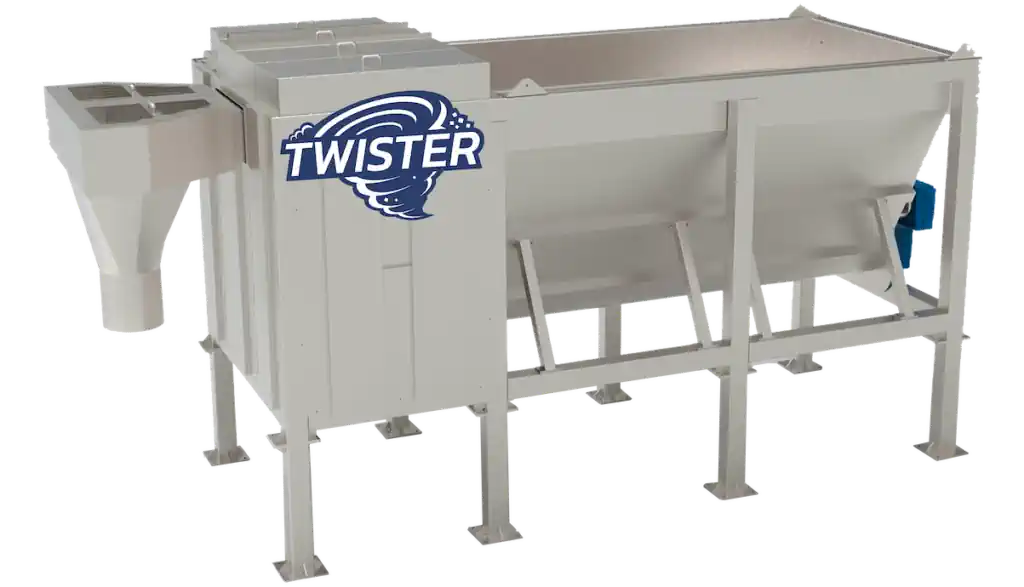
The Drycake Twister Waste Food Depacker stands out as a powerful machine that tackles food waste separation for biogas plants and recycling operations across the globe. This innovative paddle depacker model processes mixed food waste streams, removing non-combustible materials like metals and non-decomposable items, so your facility can convert waste into valuable resources rather than sending it to landfill.
How does the Drycake Twister Waste Food Depacker process work?
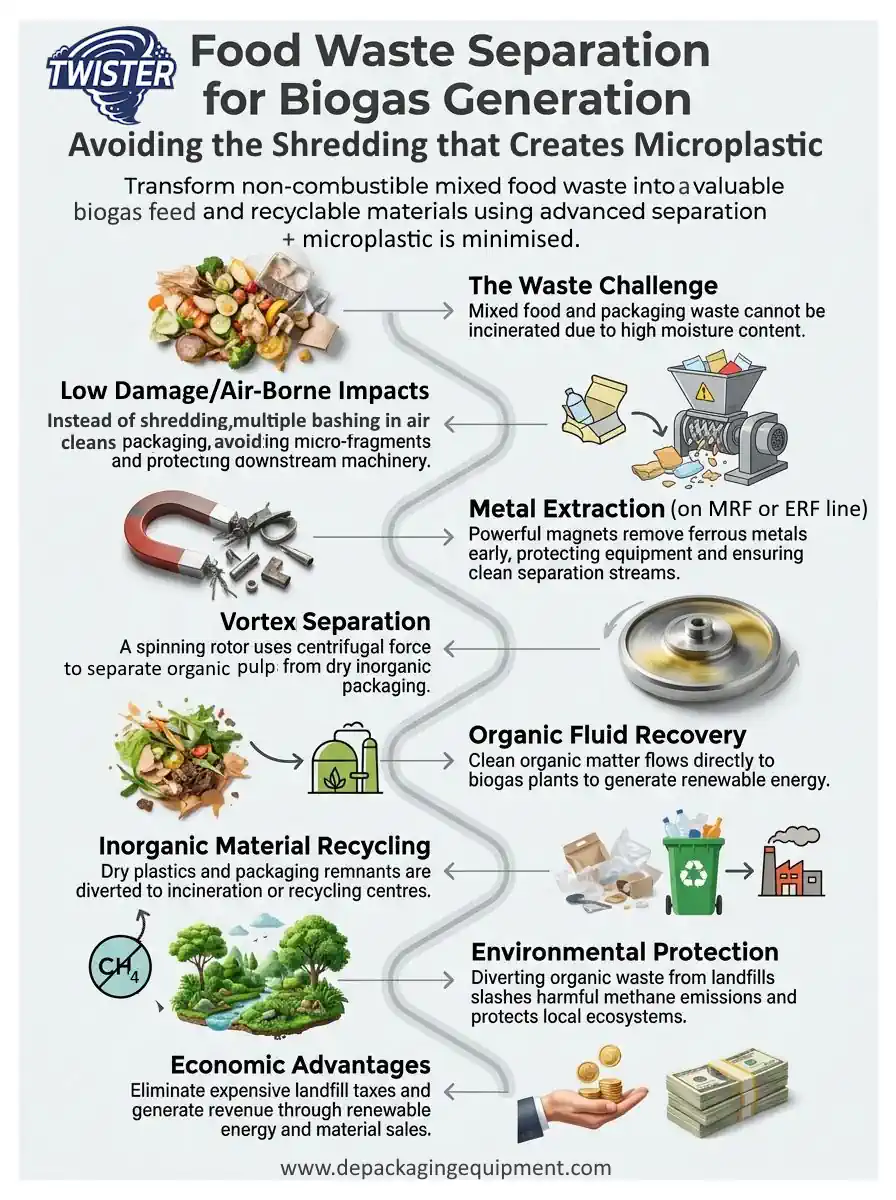
The Drycake Twister Waste Food Depacker operates through a series of distinct stages that separate organic matter from inorganic materials efficiently. This system transforms problematic waste streams into valuable resources for biogas plants and recycling operations.
- Raw food waste enters the depacker system, where operators feed mixed packaging and organic content into the machine’s intake hopper for initial processing.
- A Haarslev crusher with integrated motors and gears performs the shredding step, breaking down packaged materials into smaller, manageable pieces without over-processing the waste.
- Metal extraction occurs after shredding, removing ferrous and non-ferrous contaminants that would damage downstream equipment or compromise final product quality.
- A spinning rotor inside the depacker chamber separates organic fluid from inorganic solids through centrifugal force and mechanical action during the separation phase.
- Dry inorganic material, including plastics and packaging remnants, gets transported to incineration facilities or recycling centres for proper disposal and resource recovery.
- Organic fluid collects in a separate chamber and flows directly to biogas plants for anaerobic digestion and renewable energy generation.
- Dewatering occurs on the inorganic stream, reducing moisture content and transport costs whilst preparing materials for their final destinations.
- Odour control systems activate throughout the process, capturing and neutralising emissions during food waste processing operations.
What happens during the shredding step, and why is aggressive shredding avoided?
A shredder or “crusher”, often in the past operated as the first stage in the food waste depacking process, reducing waste food into smaller, more manageable pieces. The philosophy was that small pieces would not get wound around recycling equipment, nor would they create clogs and blockages. But, they are also prone to creating microplastics and even smaller nanoplastics. Knives manufactured from special steel cut through material with precision, ensuring the durability of the knives under demanding conditions. Unfortunately, this very asset also makes pieces of plastic almost too small to see. That was all very well, before science showed how dangerous to the environment and ultimately to our own bodies tiny pieces of plastic in our bloodstream could be.
Dated crusher designs do, nevertheless, reduce maintenance requirements and considerably extend the operational life of MRFs and ERFs.
On the other hand, the Drycake Twister system deliberately avoids aggressive shredding methods. There is no cutting that creates fine microplastic particles. And yet it still removes the plastic items that otherwise clog separation equipment and reduce efficiency across the entire depacking system.
The much smaller fragments created by screening and crushing also contain heavy metals; for example, zinc-coated tins, when shredded and crushed, increase the heavy metals content with tiny shards too small to be extracted by magnetic separation. So, these show up as heavy metal contamination in the organic pulp.
Odour control is also improved by the Twister’s ability to remove plastics at industry-best dryness. A controlled, less violent, partial size reduction approach preserves material integrity and allows magnetic systems to extract discrete metal contaminants more effectively as nearly complete cans, bottles and packets.
This strategy maintains higher separation quality, protects downstream equipment such as screw compactors, and produces clean recyclable materials ready for biogas generation and resource recovery.
How is metal extracted from the waste?
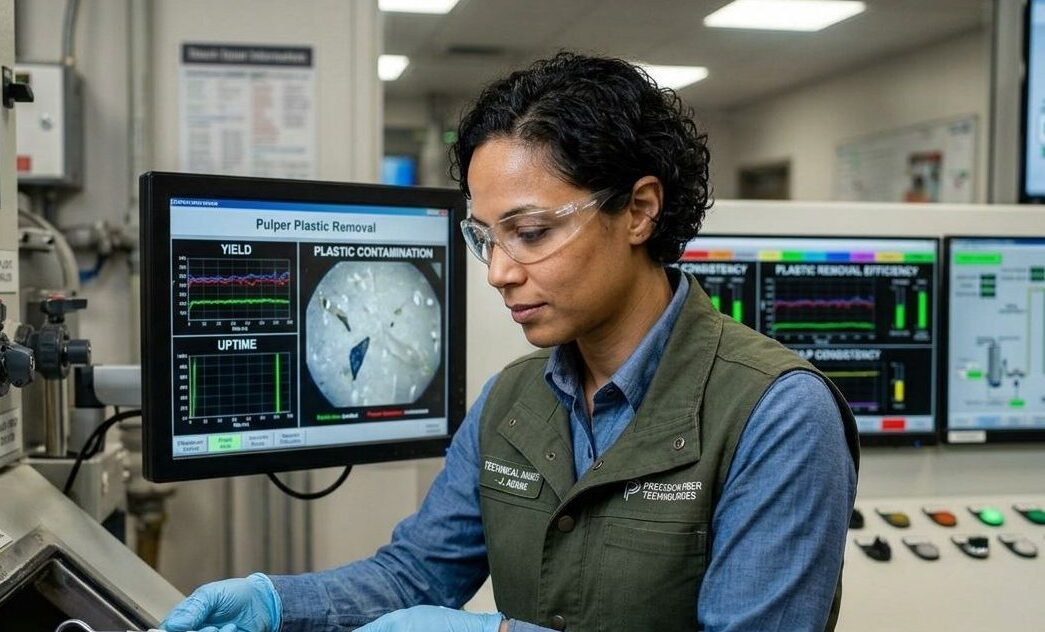
Metal extraction generally happens after passing through the Twister Unit. Powerful magnets pull ferrous metals such as steel and iron from the rejected materials output stream, removing these contaminants before they cause problems downstream.
Inert materials and microplastics already present in the incoming source-separated organic output are moved using the Drycake Seditank Unit installed after the Twister Unit. This step protects expensive equipment from abrasion damage and effectively cleans the organic waste stream. Facilities benefit considerably from this stage, as it ensures the purity of materials destined for biogas production or recycling.
Non-ferrous metals like aluminium are also separated through additional screening and sorting technologies integrated into modern waste food systems. Removing these materials prevents costly equipment damage and protects the integrity of downstream processes.
Metal extraction is the guardian of your waste processing system, protecting both your equipment and the quality of your final product.
Operators understand that metal extraction is essential for reliable operation. This separation stage represents best practice across global service providers and major waste management companies.
Clean, metal-free, inert-free, and plastic-free waste streams then move forward through the recycling centre (MRF or ERF) with confidence, ensuring maximum efficiency in food waste separation for recycling and biogas generation.
How does separation occur in the depacker?
The Twister vertical waste food depacker uses a spinning rotor in-air to separate organic content from inorganic packaging waste. This rotor spins inside the depacker chamber, creating centrifugal force via multiple “bats” that bash packages, bottles, and flexible film bags, clean and remarkably dry, while simultaneously pushing contaminating materials upward and outward at varying speeds.
Lighter organic materials, such as food scraps and decomposable matter, move downwards, while both lighter and heavier inorganic items, like plastic, and metal cans and tins, are expelled at the top. The design works to break off dried-on food waste and allows it to drop out through pulp screens on the sides and at the bottom.
Efficient separation occurs because the rotor’s motion forces materials through different exit points based on multiple physical properties. Organic fractions exit through one outlet, whilst inorganic materials travel out at the top toward a second collection area.
This mechanical action delivers thorough separation, improving the quality of both fractions considerably. Organic waste destined for biogas facilities must be free from contamination, and the separation process achieves exactly that before processing begins.
Inorganic waste streams, including plastics and metals, exit separately for proper recycling or disposal. The spinning rotor continuously maximises separation accuracy, reducing cross-contamination between streams and protecting the integrity of each output fraction.
Facilities using paddle depacker models achieve superior results because the system removes non-decomposable items that would otherwise damage equipment or reduce biogas yield. The Twister technology delivers consistent, reliable separation that supports both environmental protection and operational efficiency.
How are the separated materials handled?
The Drycake Twister Waste Food Depacker separates materials into two distinct streams, each managed for maximum resource recovery. This process minimises landfill use and converts waste into assets with measurable commercial value.
- Dry inorganic materials are expelled via an outlet conveyor to smart sorting, with the residue going to incineration facilities, where they undergo controlled combustion for energy recovery, or to landfill.
- Organic fluid (pulp) collects in a bottom conveyor system and transfers directly to biogas generation plants, ready for anaerobic digestion without additional processing steps.
- Based on a 2026 industry brief by the Anaerobic Digestion and Bioresources Association (ADBA), there are more than 750 active AD plants currently operating across the UK, providing an established national network ready to receive and monetise your organic fluid stream. A similar number of biogas plants is available in other countries.
- Ferrous and non-ferrous metals separated during depacking are sent to recycling centres for material recovery and resale, generating supplementary income from what was previously a waste contaminant.
- Odour control measures are activated throughout the handling process, preventing environmental nuisance and maintaining workplace safety standards for operators and nearby communities.
What are the environmental and economic benefits of the system?
The Drycake Twister Waste Food Depacker transforms food waste into valuable resources that power biogas generation and recycling programmes. Your facility cuts carbon emissions, reduces disposal costs, and meets strict waste management regulations through efficient separation.
How is food waste converted into useful resources?
Food waste conversion transforms what businesses once discarded into genuine assets. The Drycake Twister Waste Food Depacker separates organic material from inorganic contaminants, creating two distinct, valuable streams.
Shredded and separated organic material becomes suitable for biogas plant input, feeding anaerobic digesters that generate renewable energy. The system enables direct pumping of organic fluids to biogas facilities, eliminating extra handling steps and reducing the risk of contamination.
Dry inorganic material gets prepared for incineration, supporting energy recovery programmes. Both fractions become resources rather than liabilities, turning a dual waste problem into a dual revenue opportunity. The conversion pathways are straightforward:
- Organic pulp feeds anaerobic digesters for methane production, supplying energy for grid electricity supply, cooking, heating, and transport operations
- Inorganic dry material enters energy recovery incineration, reducing landfill volume
- Extracted metals go to recycling centres for direct resale
- Digestate from biogas processes can be applied as agricultural fertiliser (subject to local health security regulations), returning nutrients to the land
As highlighted in a 2025 energy sector report detailing AstraZeneca’s partnership with Future Biogas, a biomethane plant in Lincolnshire now produces 100 GWh of green energy annually. This demonstrates the real commercial scale achievable when clean organic feedstock from depackaging operations enters the UK energy network.
The process aligns with standards set by industry leaders such as Veolia Watertech and Komptech, ensuring quality outputs that meet biogas plant specifications. Companies implementing this technology find that their waste streams transform into revenue-generating inputs, particularly when supplying biogas facilities or energy recovery operations.
What environmental benefits come from diverting waste and generating biogas?
Diverting organic waste from landfills creates measurable environmental advantages that extend well beyond simple waste reduction. According to 2026 UK food waste statistics published by environmental reporting bodies, food waste is responsible for approximately 25 million tonnes of CO2-equivalent greenhouse gas emissions across the UK each year. Effective diversion and biogas capture directly address this figure at the source. A similar proportion applies in many other nations.
| Environmental Benefit | Impact |
|---|---|
| Landfill Avoidance | Prevents organic waste from decomposing in landfills, eliminating methane emissions and reducing environmental pollution. This lessens the overall environmental footprint of waste management operations. |
| Renewable Energy Generation | Generating biogas from organic waste produces renewable energy that replaces fossil fuel consumption. This clean energy source powers facilities, heats buildings, or feeds electricity back into the grid without depleting finite resources. |
| Methane Reduction | Capturing biogas prevents methane from escaping into the atmosphere. Methane traps heat approximately 28 times more effectively than carbon dioxide over a 100-year period, making its capture critically important for climate protection and for reducing the UK’s 25 million tonnes of annual food waste emissions. |
| Waste Volume Minimisation | Incineration of inorganic fractions further reduces waste volume destined for landfills. This cuts the environmental footprint of food waste disposal across the entire supply chain. |
| Carbon Footprint Reduction | Diverting waste eliminates transportation to distant landfill sites. Fewer vehicle journeys cut carbon emissions, whilst renewable energy generation offsets greenhouse gases from other sources. |
| Soil and Water Protection | Preventing waste decomposition in landfills stops leachate from contaminating groundwater and soil. Nutrient-rich digestate produced during biogas generation can be applied as a natural fertiliser, returning value to agricultural land responsibly. |
| Ecosystem Preservation | Reduced landfill pressure protects surrounding ecosystems from pollution and habitat destruction. Air quality improves through decreased methane and odour emissions, benefiting wildlife and local communities alike. |
Organic waste that previously required landfill space now generates power, reduces emissions, and protects natural resources simultaneously. The Drycake Twister system captures this potential by separating materials efficiently, ensuring every component reaches its optimal end-use pathway.
What economic advantages result from turning waste into an asset?
Turning food waste into valuable resources creates genuine financial opportunities for businesses across food processing, manufacturing, and hospitality. The Drycake Twister Waste Food Depacker shifts waste management from a cost centre into a measurable source of returns.
| Economic Advantage | Financial Impact |
|---|---|
| Reduced Landfill Costs | Businesses eliminate expensive disposal fees by processing waste on-site. Landfill taxes and tipping charges disappear from operational budgets. Companies save thousands of pounds annually through waste diversion strategies. |
| Energy Production Revenue | Biogas generation from separated organic matter powers facilities and produces surplus energy for sale. Early 2026 market projections for the UK biomethane sector indicate national output is set to reach 9 TWh by the end of 2026, reflecting a rapidly growing market for clean organic feedstock and energy export income. |
| Asset Creation from Waste Streams | Drycake’s solution creates genuine economic value by converting waste into useful products. Recovered materials enter secondary markets, generating additional revenue streams. Waste transforms into marketable commodities rather than liabilities. |
| Operational Cost Reduction | Low-maintenance design reduces staff time and technical expenses. Long operational life minimises replacement and repair investments. Efficient waste processing translates into operational efficiencies that strengthen profit margins. |
| Material Recovery Value | Metal extraction yields valuable ferrous and non-ferrous materials for resale. Plastic recovery creates feedstock for recycling industries. Recovered materials command market prices, generating supplementary income channels. |
| Regulatory Compliance Benefits | Meeting waste management regulations for limits on heavy metals content, plastic content, and to provide health security, avoids costly penalties and fines. Businesses demonstrate environmental responsibility, attracting eco-conscious clients and positioning competitively within sustainability-focused markets. |
| Brand Value Enhancement | Waste reduction initiatives strengthen corporate reputation and customer loyalty. Sustainability commitments appeal to environmentally conscious consumers and investors, improving long-term market positioning. |
Operational expenses decrease through the system’s engineering design. Maintenance demands stay minimal, staff requirements drop compared to manual sorting, and facilities run longer between service intervals, reducing downtime and productivity losses.
Companies gain competitive advantages by monetising waste streams. Financial returns flow from multiple revenue sources simultaneously, and businesses recover initial capital investments faster through diversified income generation.
Conclusion
The Twister Waste Food Depacker transforms how food businesses handle packaging waste, turning a costly disposal problem into genuine value. This system separates organic material from inorganic packaging, allowing companies to recover resources instead of sending everything to landfill.
Your facility gains access to biogas production through the organic fraction, whilst the dry packaging becomes suitable for incineration or recycling. Companies operating at IFAT and across the sector now recognise that waste management requires low-impact and gentler food waste separation for recycling and biogas generation, not just outdated crushing equipment.
Invest in this depacker today, and your waste management costs fall whilst your environmental impact improves significantly.
FAQs
1. What is the Twister Waste Food Depacker used for?
The Twister Waste Food Depacker separates organic food waste from packaging materials, preparing it for anaerobic digestion or composting. This equipment is also used in Paper Mills to recycle paper mill pulper rejects.
2. How does the Twister support biogas production?
It extracts clean organic material from packaging and channels it directly to anaerobic digesters, where microorganisms convert the waste into biogas for electricity generation, biomethane production, and cooking and heating applications. The separated packaging can be diverted for recycling or energy recovery.
3. Is the Twister Waste Food Depacker suitable for large-scale operations?
Yes, the system is engineered for continuous processing of high-volume packaged food waste, making it appropriate for industrial recycling facilities and large-scale biogas plants. Its automated separation process maintains consistent output quality across extended operating periods.
4. Has the Twister been featured at major industry events?
Yes, it has been exhibited at IFAT Munich, the world’s leading trade fair for environmental technologies, ESS Birmingham, UK, and many others, where waste separation and resource recovery solutions are presented to an international audience of industry professionals.
Discover more from IPPTS Depackaging Equipment Insights
Subscribe to get the latest posts sent to your email.